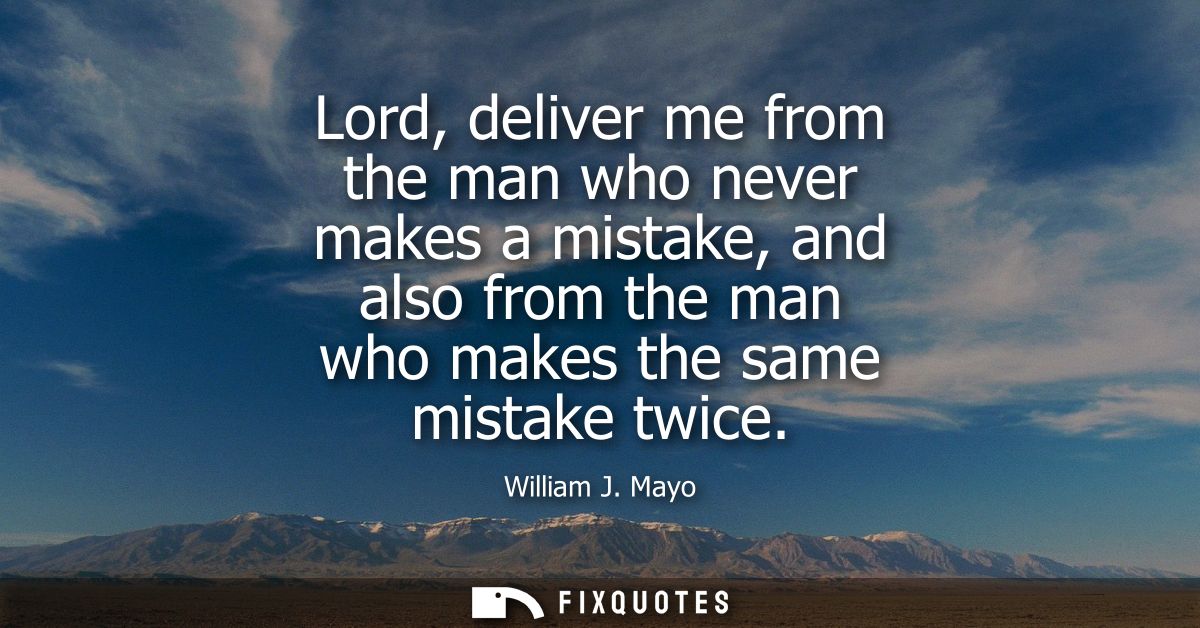
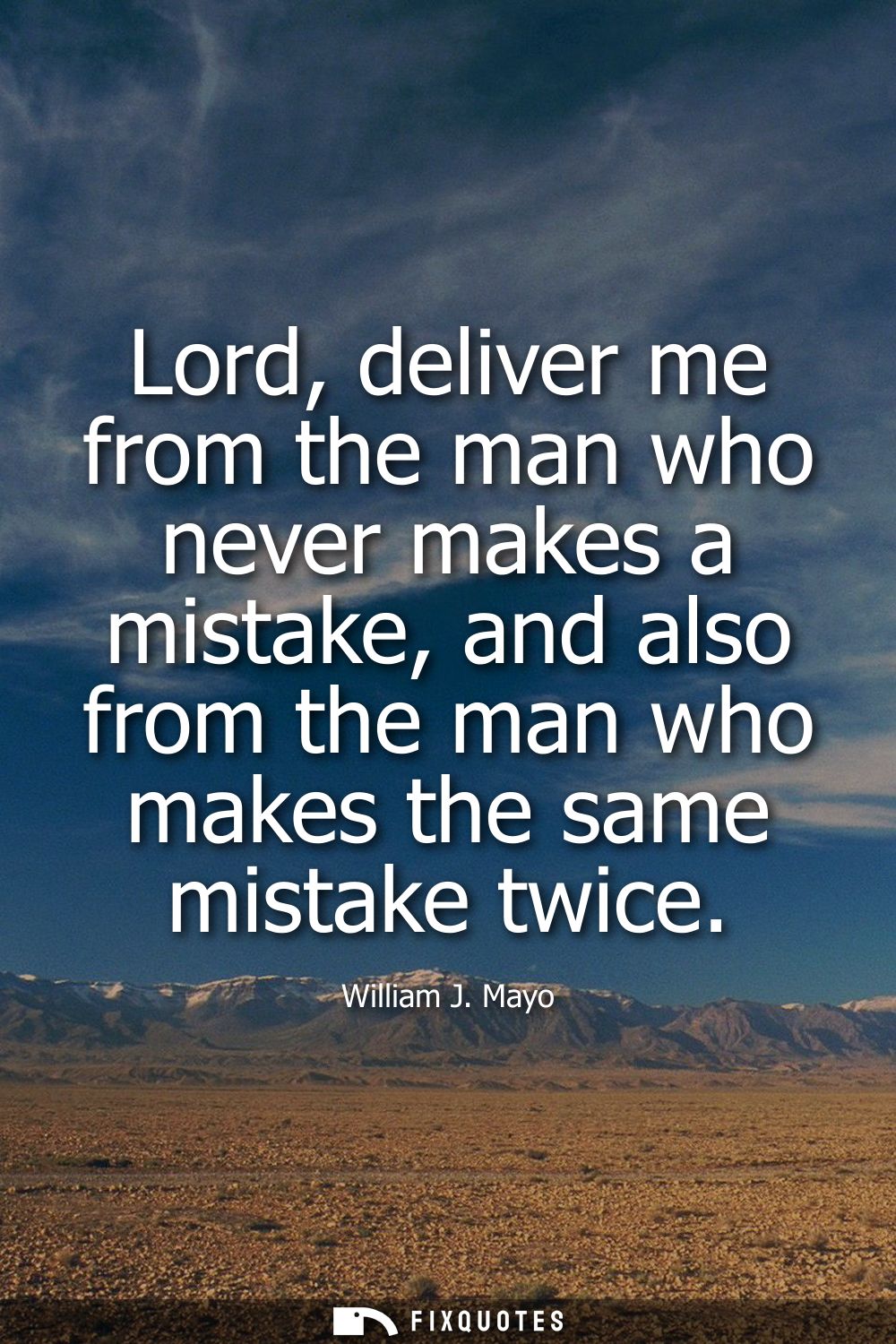
"Lord, deliver me from the man who never makes a mistake, and also from the man who makes the same mistake twice"
About this Quote
The second half tightens the moral logic. Mayo doesn’t romanticize error as “growth”; he draws a line between inevitable mistakes and negligent ones. The “same mistake twice” points to systems as much as individuals: poor recordkeeping, weak feedback loops, and cultures where juniors can’t challenge seniors. Coming from a scientist-physician, it also reads as an early argument for what we’d now call continuous improvement: you earn trust not by being error-free, but by being corrigible.
The quote’s intent is pragmatic, almost surgical: choose colleagues who can admit error, learn fast, and build habits that keep yesterday’s failure from becoming tomorrow’s routine. It’s a warning against two temptations in any high-stakes field: the performance of infallibility and the complacency of unexamined repetition.
Quote Details
| Topic | Witty One-Liners |
|---|---|
| Source | Help us find the source |
| Cite |
Citation Formats
APA Style (7th ed.)
Mayo, William J. (2026, January 16). Lord, deliver me from the man who never makes a mistake, and also from the man who makes the same mistake twice. FixQuotes. https://fixquotes.com/quotes/lord-deliver-me-from-the-man-who-never-makes-a-84362/
Chicago Style
Mayo, William J. "Lord, deliver me from the man who never makes a mistake, and also from the man who makes the same mistake twice." FixQuotes. January 16, 2026. https://fixquotes.com/quotes/lord-deliver-me-from-the-man-who-never-makes-a-84362/.
MLA Style (9th ed.)
"Lord, deliver me from the man who never makes a mistake, and also from the man who makes the same mistake twice." FixQuotes, 16 Jan. 2026, https://fixquotes.com/quotes/lord-deliver-me-from-the-man-who-never-makes-a-84362/. Accessed 13 Feb. 2026.