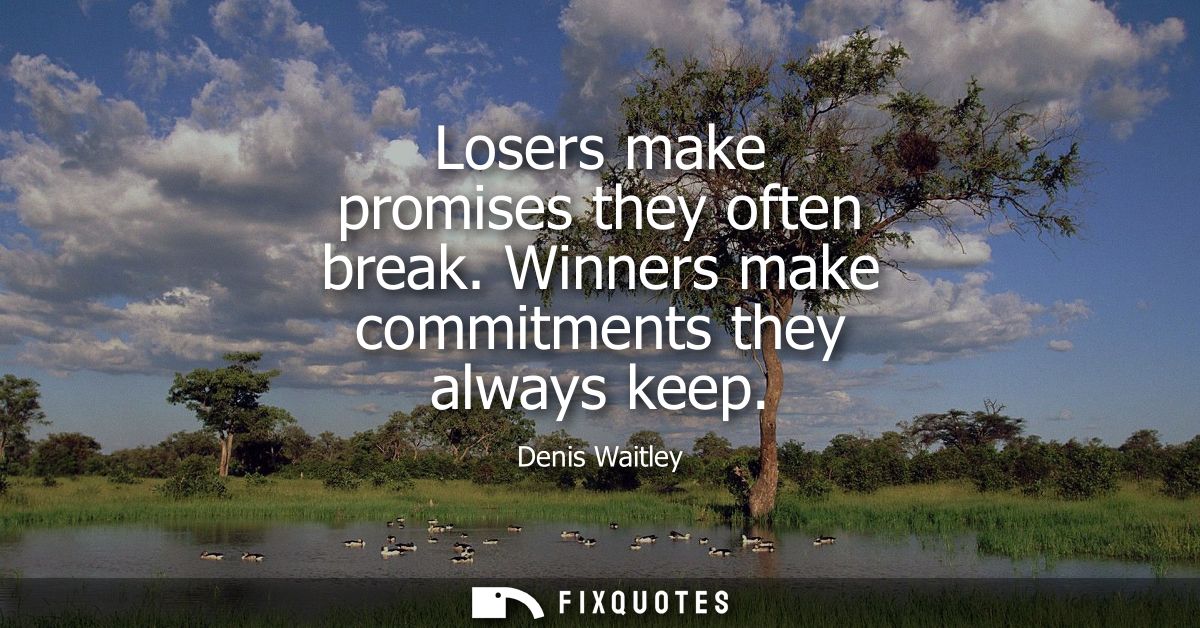
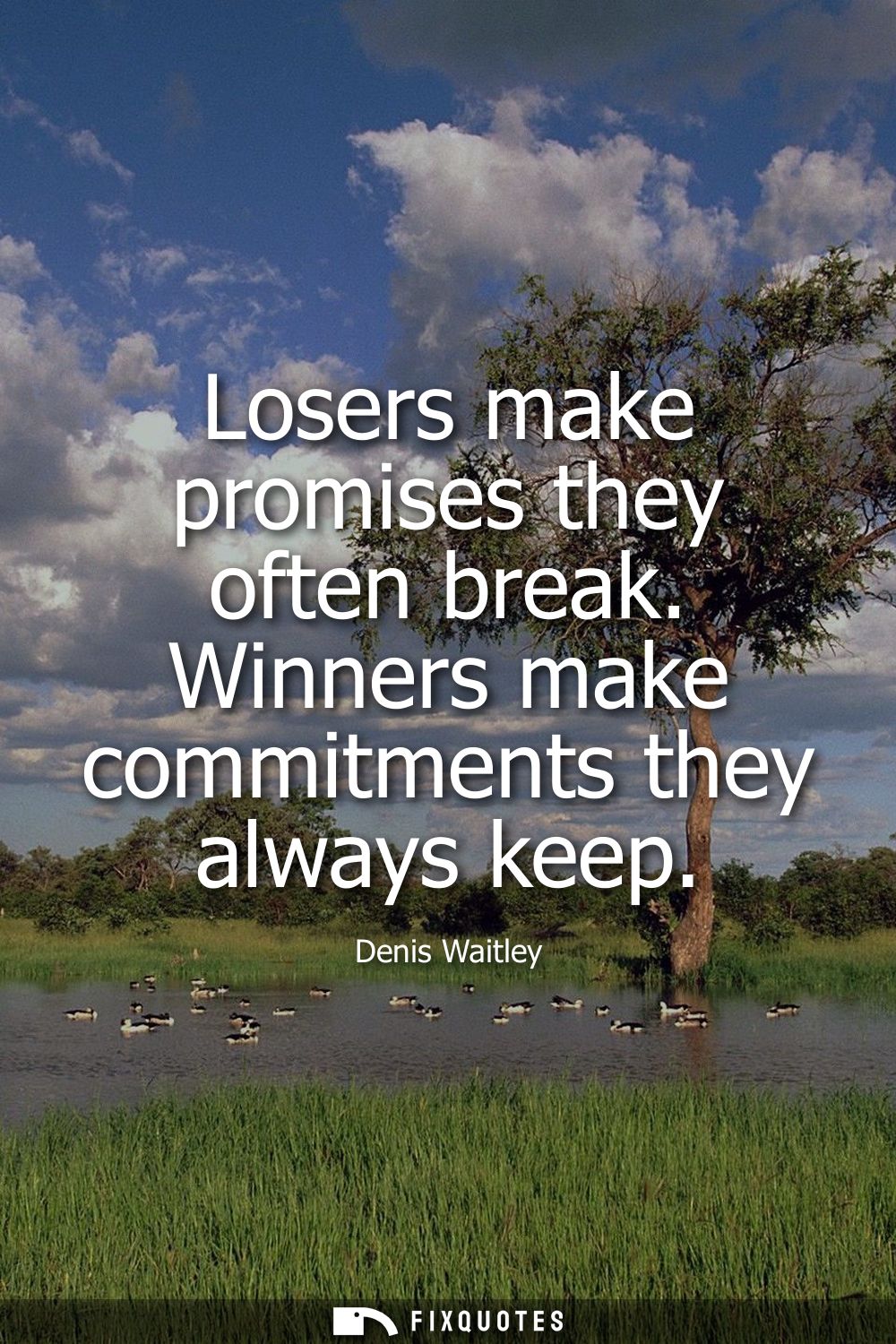
"Losers make promises they often break. Winners make commitments they always keep"
About this Quote
The subtext is classic American self-help: character is performance over time, and accountability is the only currency that matters. “Often break” and “always keep” are intentionally absolute, not because they’re empirically true, but because absolutism motivates. It gives readers a clean script for self-surveillance: stop talking, start doing, measure yourself by execution. It also flatters the audience’s aspiration. No one wants to be the person who “often breaks” anything; everyone wants to join the tribe that “always keeps.”
Context matters here. Waitley emerges from the late-20th-century motivation industry, where corporate training, sports psychology, and hustle ideology blur. In that world, language is a tool for behavioral engineering: simplify the messy reasons people fail (money, health, structural barriers, burnout) into a single lever you can pull tomorrow morning.
That simplification is the quote’s power and its problem. It’s galvanizing because it’s unambiguous. It’s also quietly punitive, implying that inconsistency is a moral defect rather than a human condition.
Quote Details
| Topic | Motivational |
|---|---|
| Source | Help us find the source |
| Cite |
Citation Formats
APA Style (7th ed.)
Waitley, Denis. (2026, January 18). Losers make promises they often break. Winners make commitments they always keep. FixQuotes. https://fixquotes.com/quotes/losers-make-promises-they-often-break-winners-6371/
Chicago Style
Waitley, Denis. "Losers make promises they often break. Winners make commitments they always keep." FixQuotes. January 18, 2026. https://fixquotes.com/quotes/losers-make-promises-they-often-break-winners-6371/.
MLA Style (9th ed.)
"Losers make promises they often break. Winners make commitments they always keep." FixQuotes, 18 Jan. 2026, https://fixquotes.com/quotes/losers-make-promises-they-often-break-winners-6371/. Accessed 12 Feb. 2026.