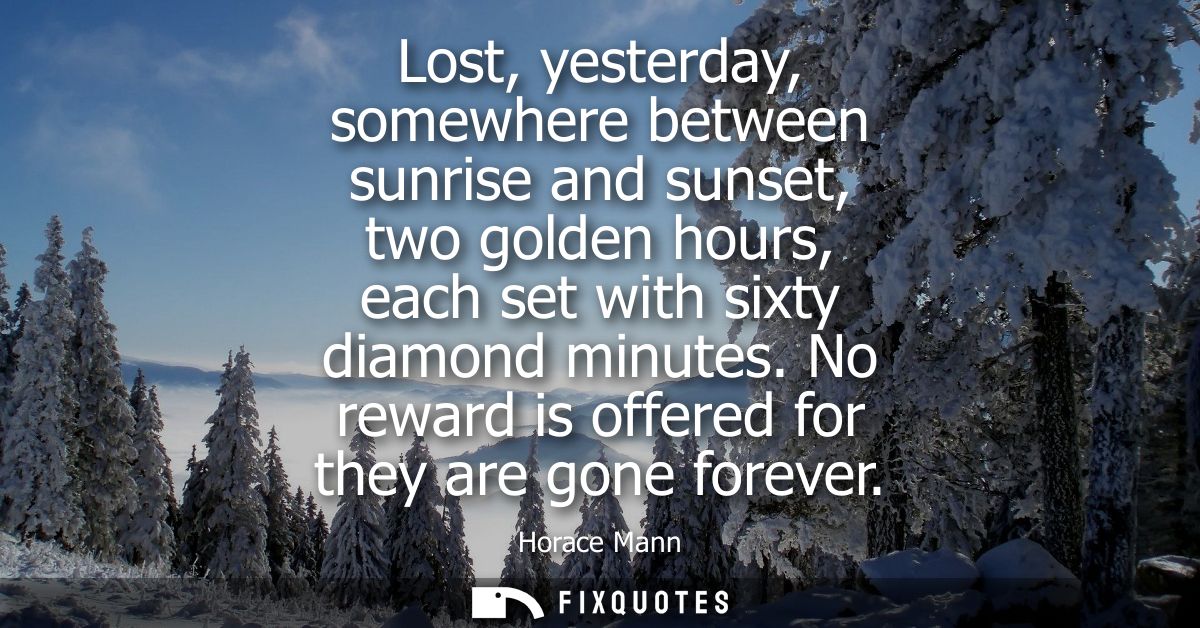
"Lost, yesterday, somewhere between sunrise and sunset, two golden hours, each set with sixty diamond minutes. No reward is offered, for they are gone forever"
About this Quote
The metaphor does double work. It flatters the reader with opulence (your ordinary afternoon contains jewels), then twists the knife by making that opulence irretrievable. “No reward is offered” reads like a notice tacked to a town square, except the bureaucratic tone is a trap: rewards exist for recoverable goods; time isn’t one of them. Mann isn’t romanticizing leisure so much as insisting on accountability. He’s effectively teaching a lesson with imagery, the educator’s move: make the abstract moral concrete enough to sting.
Context matters. Mann was the leading architect of the American common school movement, preaching self-discipline, literacy, and civic responsibility to a rapidly industrializing nation. Factory clocks and rail timetables were reorganizing daily life; “wasted time” was becoming both a moral failing and an economic error. The subtext is Protestant and reformist: your minutes aren’t just yours. Squander them and you’re not only poorer; you’re less useful, less educated, less worthy of the democratic project Mann was trying to build.
Quote Details
| Topic | Time |
|---|---|
| Source | Later attribution: Horace Mann (Horace Mann) modern compilation
Evidence: v no 19 2 october 1843 lost yesterday somewhere between sunrise and sunset two golden hours each set with sixty diamond minutes no reward is offered for they are gone forever published an Other candidates (2) Happy Homes and the Hearts that Make Them. Or Thrifty Peo... (Samuel Smiles, 1884) compilation97.8% ... Lost , yesterday , somewhere between sunrise and sunset , two golden hours , each set with sixty diamond minutes ... Life In The Argentine (Horace Mann, 1868) primary33.9% terms of conciliation by the feeble government gave time and resources to the aldaos the die was cast and the fate of... |
| Cite |
Citation Formats
APA Style (7th ed.)
Mann, Horace. (2026, February 16). Lost, yesterday, somewhere between sunrise and sunset, two golden hours, each set with sixty diamond minutes. No reward is offered, for they are gone forever. FixQuotes. https://fixquotes.com/quotes/lost-yesterday-somewhere-between-sunrise-and-5249/
Chicago Style
Mann, Horace. "Lost, yesterday, somewhere between sunrise and sunset, two golden hours, each set with sixty diamond minutes. No reward is offered, for they are gone forever." FixQuotes. February 16, 2026. https://fixquotes.com/quotes/lost-yesterday-somewhere-between-sunrise-and-5249/.
MLA Style (9th ed.)
"Lost, yesterday, somewhere between sunrise and sunset, two golden hours, each set with sixty diamond minutes. No reward is offered, for they are gone forever." FixQuotes, 16 Feb. 2026, https://fixquotes.com/quotes/lost-yesterday-somewhere-between-sunrise-and-5249/. Accessed 27 Mar. 2026.