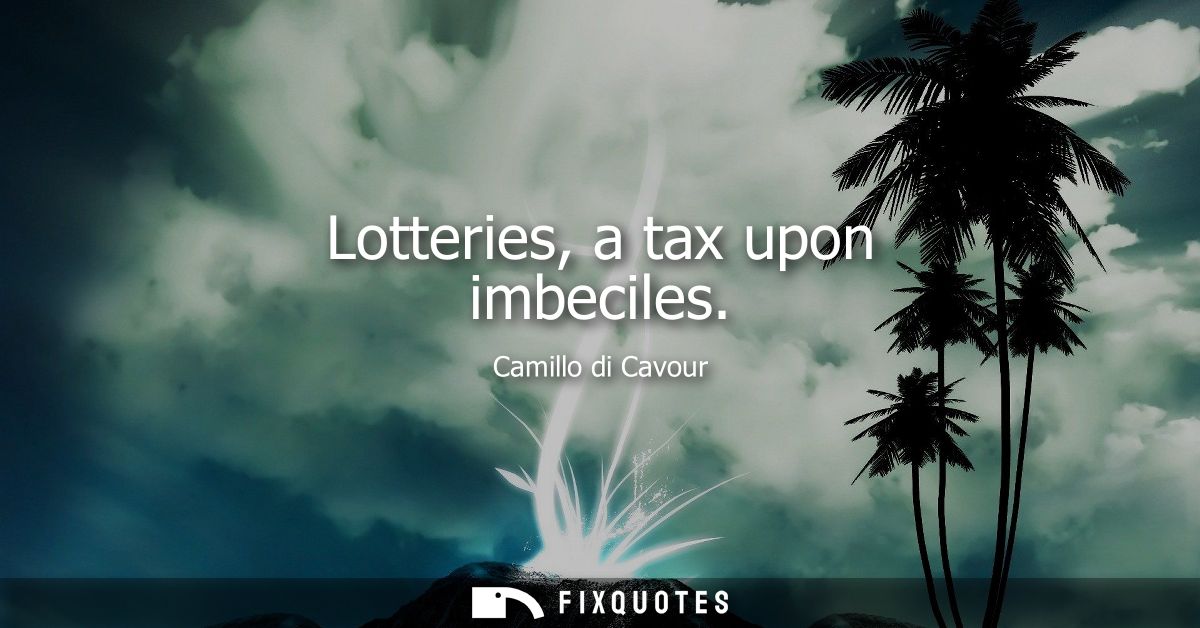
"Lotteries, a tax upon imbeciles"
About this Quote
A statesman’s insult can do more political work than a spreadsheet, and Cavour’s line is designed to sting in exactly the right places. Calling lotteries “a tax upon imbeciles” reframes what looks like voluntary entertainment as coerced revenue extracted through deception. The word “tax” is the knife: it yanks the lottery out of the realm of private choice and into public morality, implying the state is balancing its books by preying on the cognitively or socially vulnerable. “Imbeciles” isn’t clinical here; it’s rhetorical triage. It draws a hard boundary between the rational citizen Cavour wants to cultivate and the credulous subject a cynical government can exploit.
The subtext is a critique of fiscal cowardice. Lotteries let governments raise money without admitting they’re raising money. No unpopular levy, no parliamentary brawl, just a glittering promise of escape. Cavour exposes that promise as a regressive mechanism: the people most likely to buy tickets are those with the least disposable income and the greatest need for hope. In that sense, the “voluntary” aspect becomes part of the scam; you consent to your own extraction because the fantasy is priced cheaply enough to feel like agency.
Context matters: mid-19th century state-building required revenue, legitimacy, and a public trained to think in terms of civic duty rather than superstition and chance. Cavour’s barb argues that modern governance should be funded transparently and rationally, not through a state-sponsored mirage. It’s moral pedagogy disguised as contempt: a warning that a nation can’t modernize while monetizing its citizens’ desperation.
The subtext is a critique of fiscal cowardice. Lotteries let governments raise money without admitting they’re raising money. No unpopular levy, no parliamentary brawl, just a glittering promise of escape. Cavour exposes that promise as a regressive mechanism: the people most likely to buy tickets are those with the least disposable income and the greatest need for hope. In that sense, the “voluntary” aspect becomes part of the scam; you consent to your own extraction because the fantasy is priced cheaply enough to feel like agency.
Context matters: mid-19th century state-building required revenue, legitimacy, and a public trained to think in terms of civic duty rather than superstition and chance. Cavour’s barb argues that modern governance should be funded transparently and rationally, not through a state-sponsored mirage. It’s moral pedagogy disguised as contempt: a warning that a nation can’t modernize while monetizing its citizens’ desperation.
Quote Details
| Topic | Witty One-Liners |
|---|---|
| Source | Help us find the source |
| Cite |
Citation Formats
APA Style (7th ed.)
Cavour, Camillo di. (2026, January 16). Lotteries, a tax upon imbeciles. FixQuotes. https://fixquotes.com/quotes/lotteries-a-tax-upon-imbeciles-108809/
Chicago Style
Cavour, Camillo di. "Lotteries, a tax upon imbeciles." FixQuotes. January 16, 2026. https://fixquotes.com/quotes/lotteries-a-tax-upon-imbeciles-108809/.
MLA Style (9th ed.)
"Lotteries, a tax upon imbeciles." FixQuotes, 16 Jan. 2026, https://fixquotes.com/quotes/lotteries-a-tax-upon-imbeciles-108809/. Accessed 2 Apr. 2026.
More Quotes by Camillo
Add to List