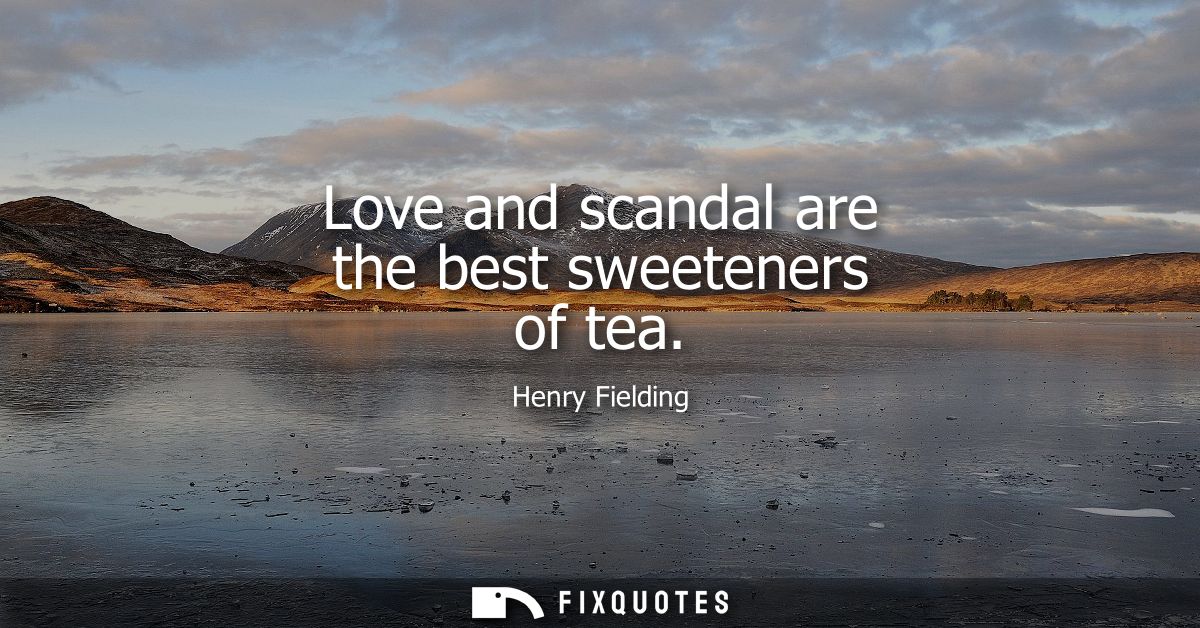
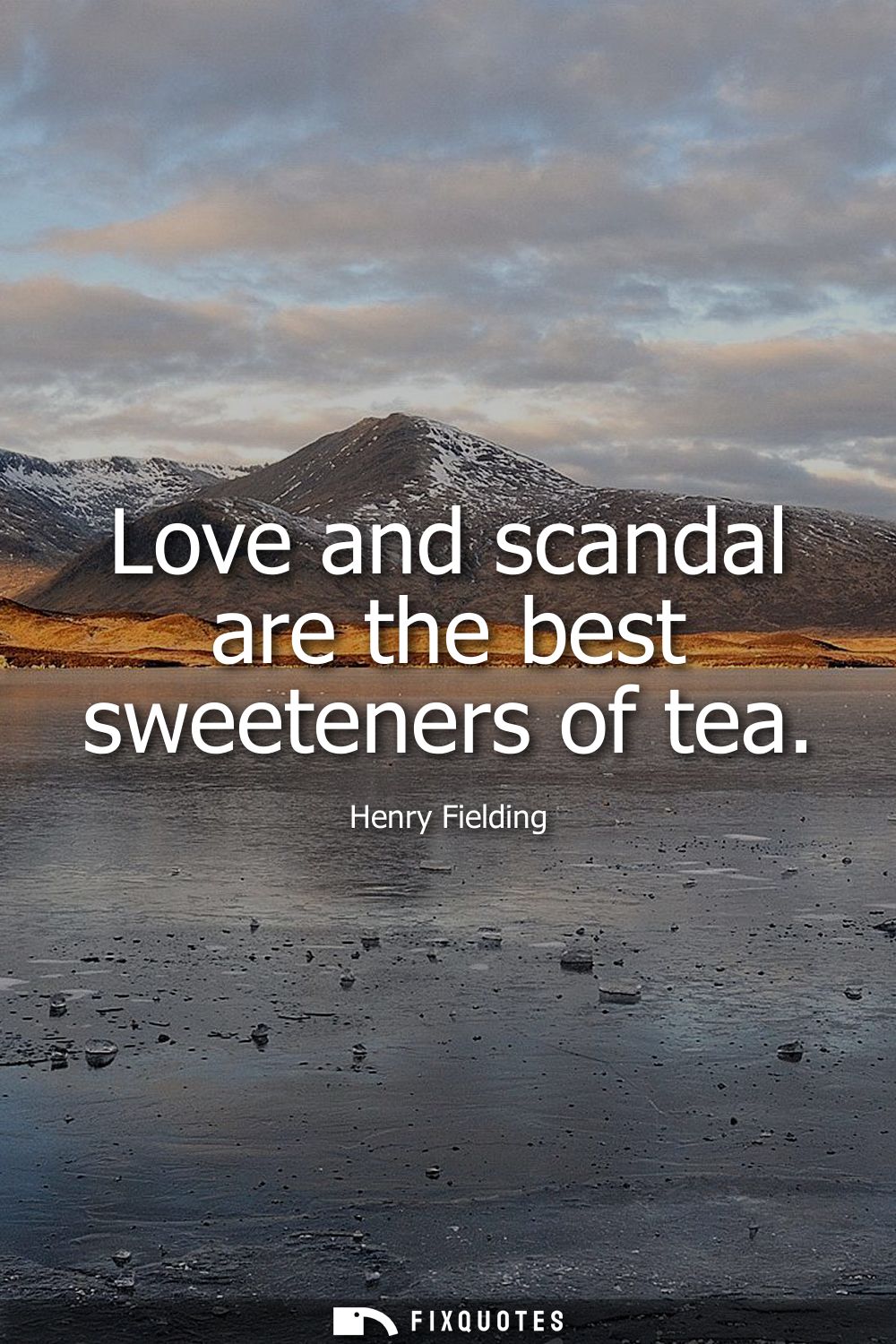
"Love and scandal are the best sweeteners of tea"
About this Quote
A cup of tea is supposed to soothe; Fielding’s line insists it’s really gossip and desire that make it go down easy. The genius is the domestic bait-and-switch. He takes an emblem of polite, middle-class calm and spikes it with the very forces polite society pretends to keep out of the parlor: romantic intrigue and public disgrace. “Sweeteners” is doing the real work here. Sugar is an additive, not the substance; love and scandal aren’t noble ideals in this formulation but stimulants, quick hits that improve the taste of an otherwise thin brew.
Fielding is writing in an 18th-century Britain where the novel is becoming a mass form and the public sphere is thick with coffeehouse chatter, pamphlets, and moral theater. Tea culture, imported and increasingly fashionable, signals refinement and routine. By pairing it with “scandal,” Fielding punctures the era’s self-image: the same people performing propriety are hungry for transgression, preferably at someone else’s expense. “Love,” placed first, keeps the remark from sounding purely misanthropic; it admits that the appetite for story is also an appetite for feeling. But it’s a shrewd, unsentimental love, love as plot engine.
The subtext is almost editorial: society runs on narrative fuel. We claim to want virtue and stability, yet we linger over the messy parts because they make life legible and entertaining. Fielding, a novelist with a satirist’s ear, turns a teacup into a tiny indictment of what sells, what sticks, and what people secretly come to the table for.
Fielding is writing in an 18th-century Britain where the novel is becoming a mass form and the public sphere is thick with coffeehouse chatter, pamphlets, and moral theater. Tea culture, imported and increasingly fashionable, signals refinement and routine. By pairing it with “scandal,” Fielding punctures the era’s self-image: the same people performing propriety are hungry for transgression, preferably at someone else’s expense. “Love,” placed first, keeps the remark from sounding purely misanthropic; it admits that the appetite for story is also an appetite for feeling. But it’s a shrewd, unsentimental love, love as plot engine.
The subtext is almost editorial: society runs on narrative fuel. We claim to want virtue and stability, yet we linger over the messy parts because they make life legible and entertaining. Fielding, a novelist with a satirist’s ear, turns a teacup into a tiny indictment of what sells, what sticks, and what people secretly come to the table for.
Quote Details
| Topic | Love |
|---|---|
| Source | Help us find the source |
| Cite |
Citation Formats
APA Style (7th ed.)
Fielding, Henry. (2026, January 15). Love and scandal are the best sweeteners of tea. FixQuotes. https://fixquotes.com/quotes/love-and-scandal-are-the-best-sweeteners-of-tea-71865/
Chicago Style
Fielding, Henry. "Love and scandal are the best sweeteners of tea." FixQuotes. January 15, 2026. https://fixquotes.com/quotes/love-and-scandal-are-the-best-sweeteners-of-tea-71865/.
MLA Style (9th ed.)
"Love and scandal are the best sweeteners of tea." FixQuotes, 15 Jan. 2026, https://fixquotes.com/quotes/love-and-scandal-are-the-best-sweeteners-of-tea-71865/. Accessed 28 Mar. 2026.
More Quotes by Henry
Add to List