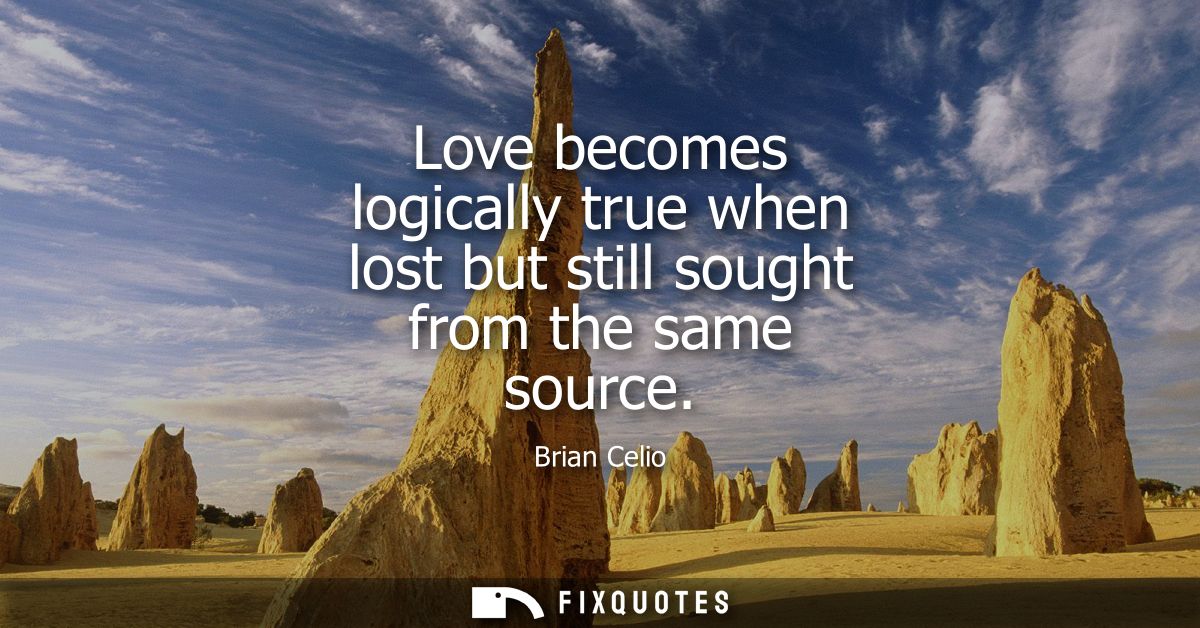
"Love becomes logically true when lost but still sought from the same source"
About this Quote
The key hinge is “still sought from the same source.” That’s not devotion in the Hallmark sense; it’s compulsion, maybe even self-harm dressed up as loyalty. If the source can’t or won’t return the love, why keep returning to it? Because the seeker is chasing coherence. The repetition becomes evidence: if I keep going back, it must have meant something. Loss turns love into narrative leverage, a way to rewrite what happened as inevitable rather than contingent, messy, mutual.
The subtext is modern and quietly indicting: we’re trained to confuse persistence with authenticity. In a culture that prizes “closure” but rarely grants it, the mind grabs onto logic as a substitute for consent, for clarity, for the simple fact of being chosen. Celio’s intent seems less to romanticize longing than to expose its argument-making. Love, when unreturned, doesn’t just ache; it lawyer-s up. It keeps appealing to the same court that already dismissed the case.
Quote Details
| Topic | Heartbreak |
|---|---|
| Source | Help us find the source |
| Cite |
Citation Formats
APA Style (7th ed.)
Celio, Brian. (2026, January 16). Love becomes logically true when lost but still sought from the same source. FixQuotes. https://fixquotes.com/quotes/love-becomes-logically-true-when-lost-but-still-98508/
Chicago Style
Celio, Brian. "Love becomes logically true when lost but still sought from the same source." FixQuotes. January 16, 2026. https://fixquotes.com/quotes/love-becomes-logically-true-when-lost-but-still-98508/.
MLA Style (9th ed.)
"Love becomes logically true when lost but still sought from the same source." FixQuotes, 16 Jan. 2026, https://fixquotes.com/quotes/love-becomes-logically-true-when-lost-but-still-98508/. Accessed 5 Mar. 2026.