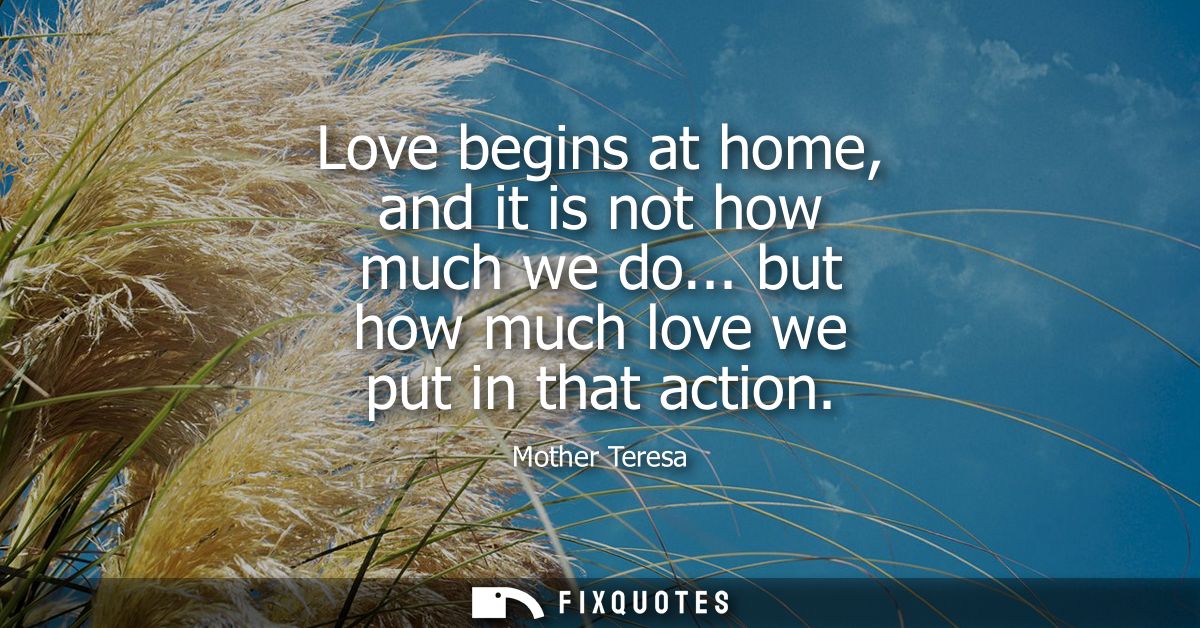
"Love begins at home, and it is not how much we do... but how much love we put in that action"
About this Quote
The second clause lands like a rebuke to modern productivity religion. “Not how much we do” challenges the idea that goodness can be tallied in hours, headlines, or output. For a leader who became globally synonymous with service, that’s strategic humility: she undercuts the temptation to perform charity as scale. The measure is interior, which is both spiritually exacting and conveniently resistant to external audit. You can’t spreadsheet “how much love” you put into something, and that’s part of the point.
Context matters: she’s speaking from a Catholic framework that treats intention as morally central, where small acts done with devotion can outrank large acts done for ego, guilt, or reputation. Subtext: don’t outsource your conscience to institutions or “causes” while neglecting the human being in front of you. It’s an argument against humanitarian vanity and also a defense of caregiving labor that rarely reads as heroic. The line works because it makes the invisible visible, then makes it non-negotiable.
Quote Details
| Topic | Family |
|---|---|
| Source | Help us find the source |
| Cite |
Citation Formats
APA Style (7th ed.)
Teresa, Mother. (2026, January 15). Love begins at home, and it is not how much we do... but how much love we put in that action. FixQuotes. https://fixquotes.com/quotes/love-begins-at-home-and-it-is-not-how-much-we-do-24936/
Chicago Style
Teresa, Mother. "Love begins at home, and it is not how much we do... but how much love we put in that action." FixQuotes. January 15, 2026. https://fixquotes.com/quotes/love-begins-at-home-and-it-is-not-how-much-we-do-24936/.
MLA Style (9th ed.)
"Love begins at home, and it is not how much we do... but how much love we put in that action." FixQuotes, 15 Jan. 2026, https://fixquotes.com/quotes/love-begins-at-home-and-it-is-not-how-much-we-do-24936/. Accessed 5 Apr. 2026.