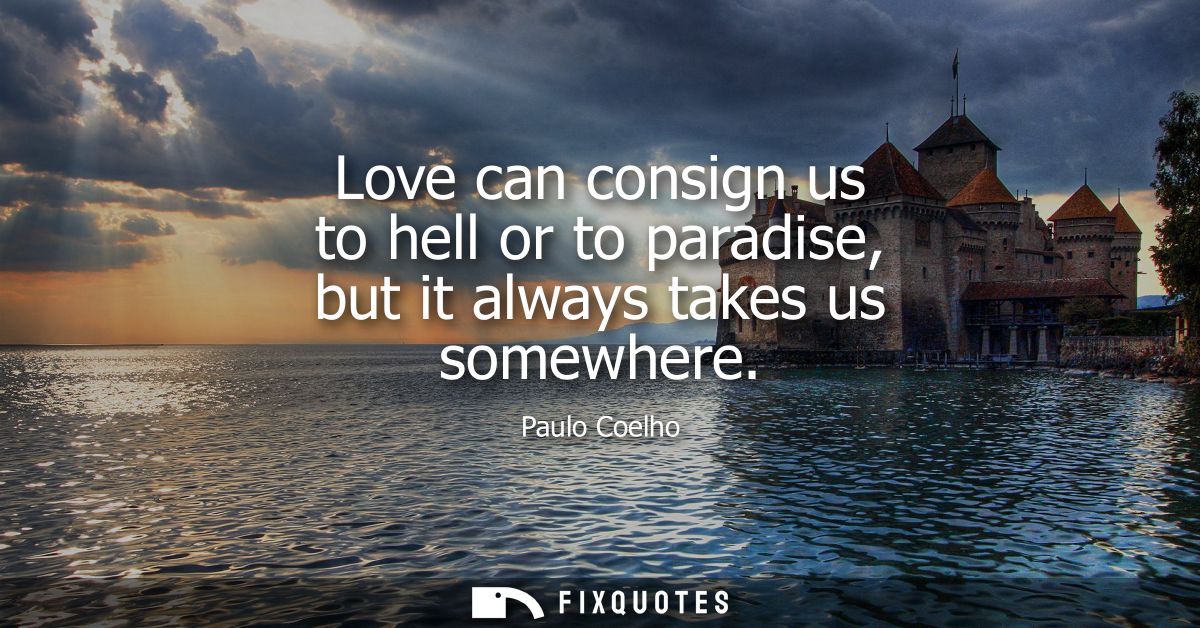
"Love can consign us to hell or to paradise, but it always takes us somewhere"
About this Quote
The specific intent feels almost pastoral, the kind of consoling severity Coelho often deploys: stop demanding guarantees from love. People want love to be safe and affirming; he insists it’s consequential and, crucially, directional. That’s the subtext: love is valuable not because it reliably produces “paradise,” but because it produces movement - decisions, risks, breakages, devotion, reinvention. Even the threat of “hell” is functional here, a warning that love’s power isn’t proof of its goodness, only its capacity to reorder your life.
Contextually, it sits neatly inside Coelho’s broader spiritual pop-fiction project, where the soul grows through trials that look suspiciously like narrative twists. In a culture that treats love as both consumer product and personal brand, this quote works as a corrective: love is not a vibe. It’s a passage. You don’t control the destination, but you’re changed by agreeing to the trip.
Quote Details
| Topic | Love |
|---|---|
| Source | Help us find the source |
| Cite |
Citation Formats
APA Style (7th ed.)
Coelho, Paulo. (2026, January 18). Love can consign us to hell or to paradise, but it always takes us somewhere. FixQuotes. https://fixquotes.com/quotes/love-can-consign-us-to-hell-or-to-paradise-but-it-1205/
Chicago Style
Coelho, Paulo. "Love can consign us to hell or to paradise, but it always takes us somewhere." FixQuotes. January 18, 2026. https://fixquotes.com/quotes/love-can-consign-us-to-hell-or-to-paradise-but-it-1205/.
MLA Style (9th ed.)
"Love can consign us to hell or to paradise, but it always takes us somewhere." FixQuotes, 18 Jan. 2026, https://fixquotes.com/quotes/love-can-consign-us-to-hell-or-to-paradise-but-it-1205/. Accessed 12 Feb. 2026.