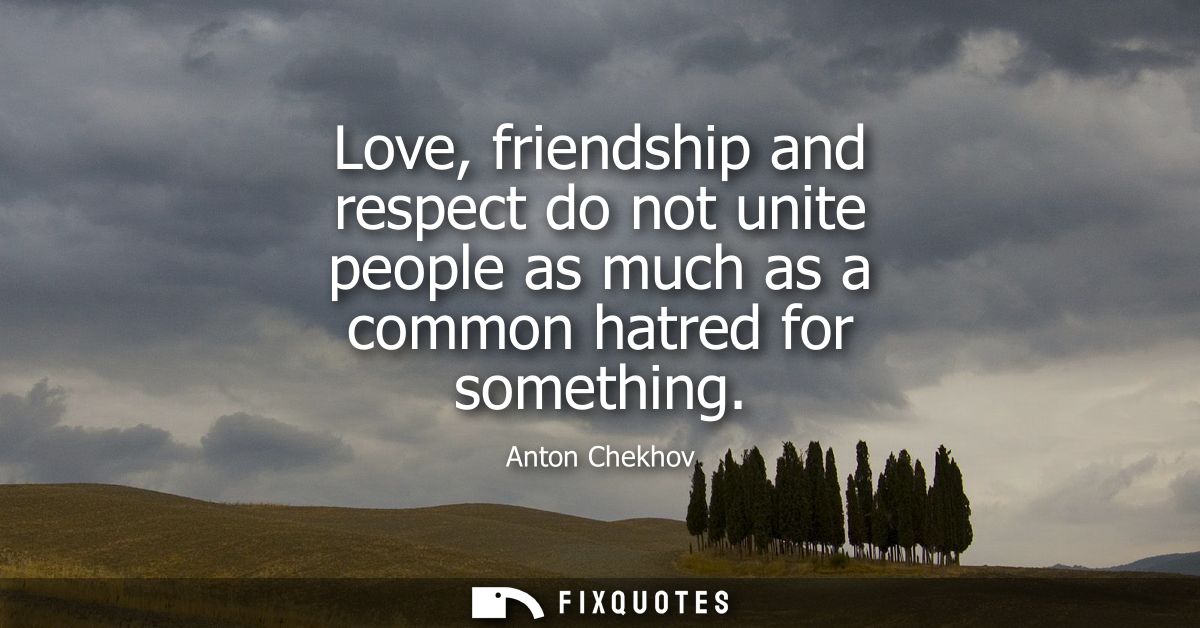
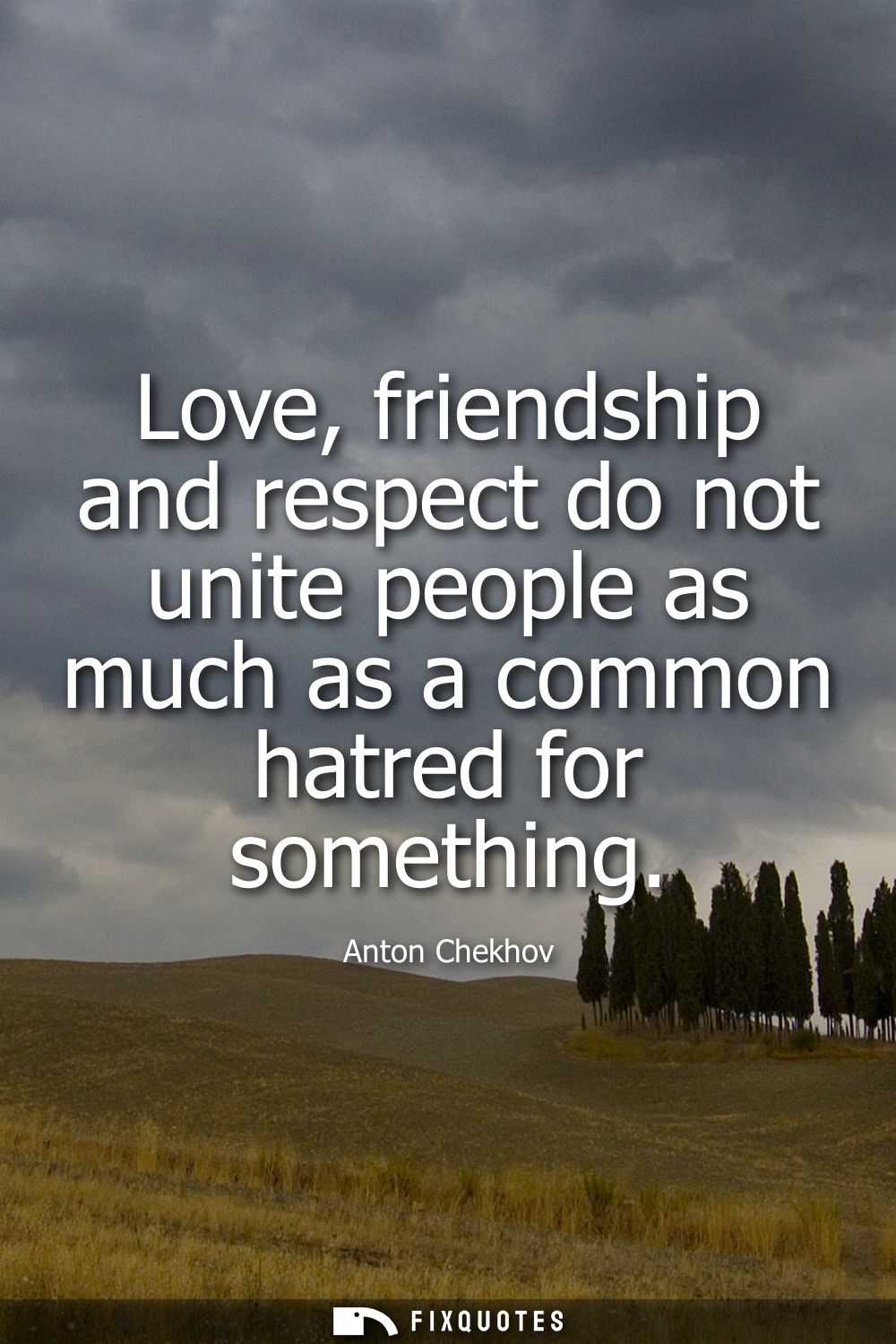
"Love, friendship and respect do not unite people as much as a common hatred for something"
About this Quote
The subtext is less “people are bad” than “people are tired.” In Chekhov’s world, characters drift, stall, and compromise with their own mediocrity. Common hatred offers them a sudden sense of clarity and purpose. It manufactures belonging without requiring change. You don’t have to build a shared future; you just have to point at what’s ruining the present. That’s why it unites: it gives a scattered group a single emotional rhythm, a chant, a cause, a story where everyone gets to be right.
Context matters. Chekhov wrote in a late-imperial Russia thick with class resentment, political surveillance, and ideological ferment, but his theaters are rarely about slogans; they’re about atmospheres. The line lands like a diagnosis of crowd psychology before the 20th century made it a headline. It also reads eerily current: online fandoms, partisan identity, even workplace culture often cohere less around shared values than around a shared villain. Chekhov’s cynicism isn’t performative; it’s clinical, and that’s what makes it sting.
Quote Details
| Topic | Friendship |
|---|---|
| Source | Help us find the source |
| Cite |
Citation Formats
APA Style (7th ed.)
Chekhov, Anton. (2026, January 14). Love, friendship and respect do not unite people as much as a common hatred for something. FixQuotes. https://fixquotes.com/quotes/love-friendship-and-respect-do-not-unite-people-38640/
Chicago Style
Chekhov, Anton. "Love, friendship and respect do not unite people as much as a common hatred for something." FixQuotes. January 14, 2026. https://fixquotes.com/quotes/love-friendship-and-respect-do-not-unite-people-38640/.
MLA Style (9th ed.)
"Love, friendship and respect do not unite people as much as a common hatred for something." FixQuotes, 14 Jan. 2026, https://fixquotes.com/quotes/love-friendship-and-respect-do-not-unite-people-38640/. Accessed 4 Feb. 2026.