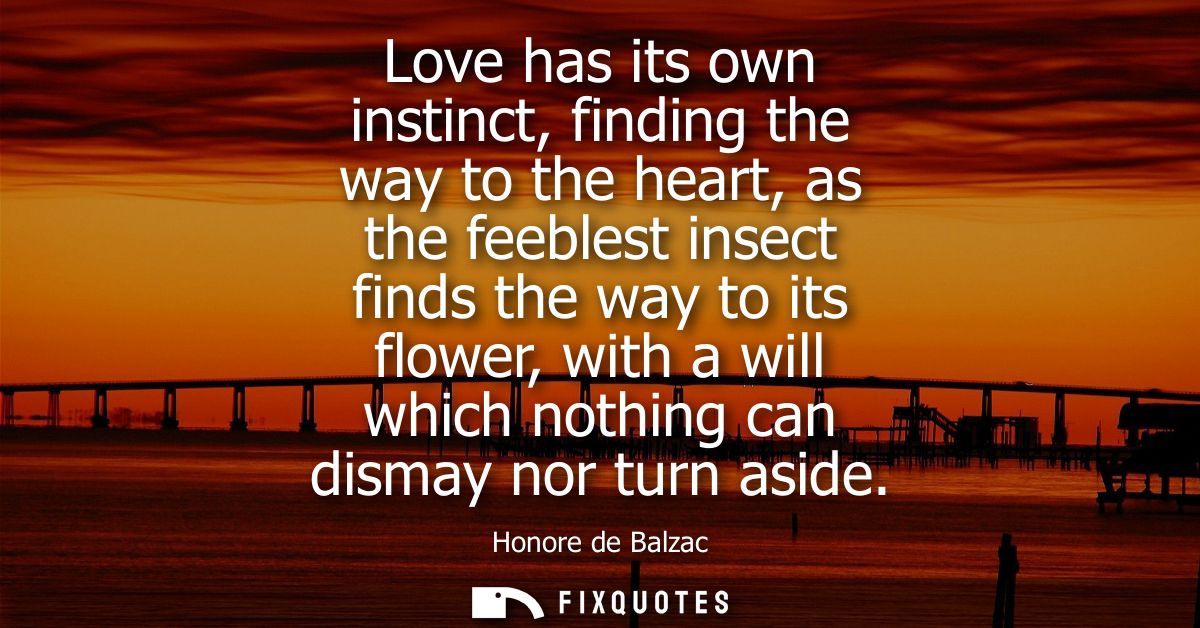
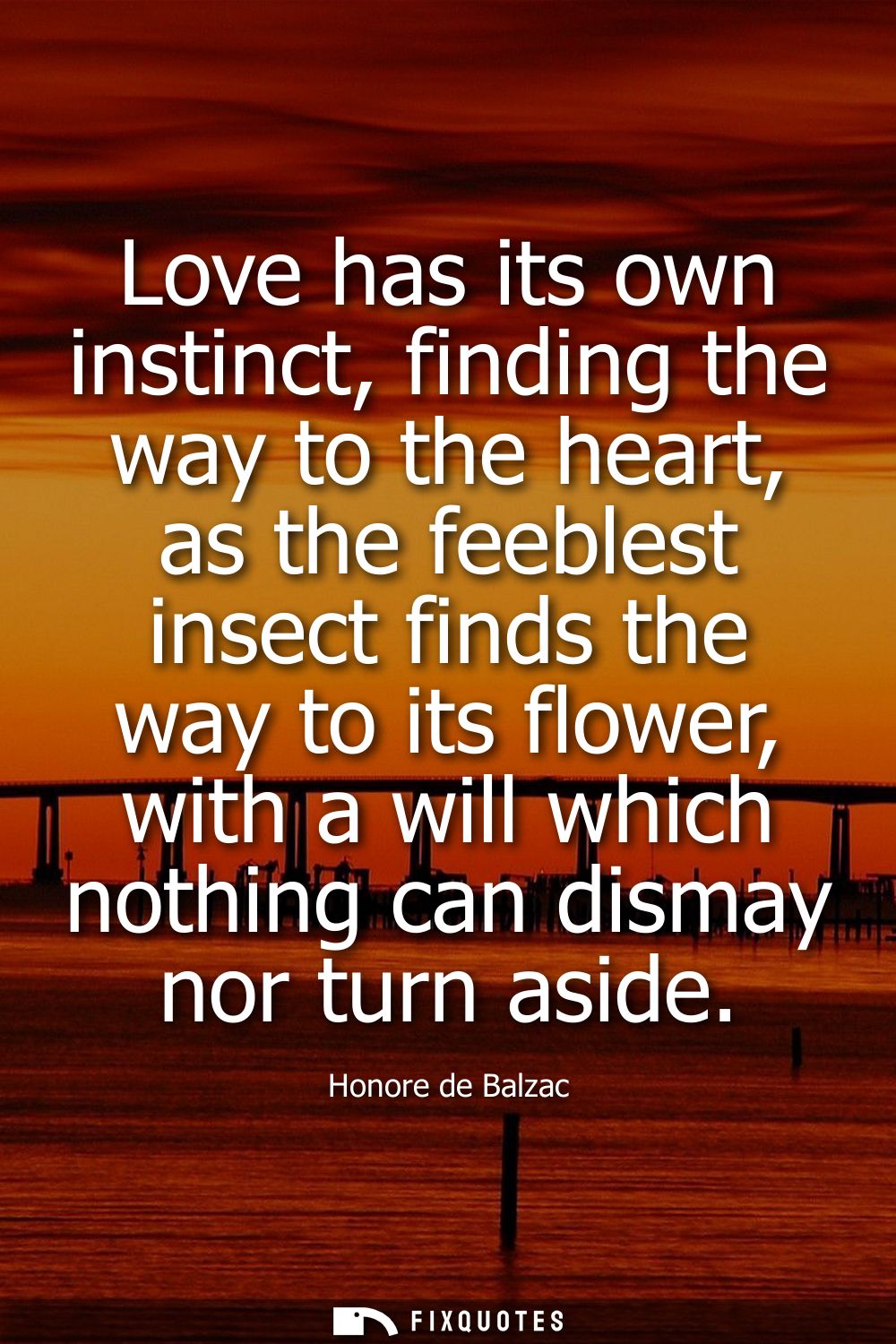
"Love has its own instinct, finding the way to the heart, as the feeblest insect finds the way to its flower, with a will which nothing can dismay nor turn aside"
About this Quote
Balzac makes love sound less like a grand moral choice and more like a force of nature with excellent aim. The comparison to the “feeblest insect” is doing quiet work: it lowers the temperature of romance. Love isn’t elevated here; it’s small, persistent, almost automatic. That’s the point. In Balzac’s world, people don’t float above their appetites and ambitions. They scuttle toward them.
The line’s real seduction is its flattery of inevitability. If love “finds the way,” then the lover isn’t merely brave or faithful; they’re simply obeying an instinct that can’t be “dismay[ed] nor turn[ed] aside.” That absolves as much as it exalts. It hints at the way desire can override prudence, class boundaries, marriage contracts, reputations - the whole social machinery Balzac loved to anatomize. Calling it “instinct” quietly strips it of ethics. You don’t argue with instinct; you manage the fallout.
Context matters: writing in post-Revolutionary, rapidly modernizing France, Balzac chronicled a society where money, status, and surveillance press in on private life. Against that grid, love becomes both refuge and sabotage - a tunneling creature finding a path where none should exist. The image of the insect and flower also smuggles in asymmetry: flowers attract; insects pursue. Love, for Balzac, is often less mutual harmony than relentless motion toward a desired object, propelled by a will that feels like fate.
The line’s real seduction is its flattery of inevitability. If love “finds the way,” then the lover isn’t merely brave or faithful; they’re simply obeying an instinct that can’t be “dismay[ed] nor turn[ed] aside.” That absolves as much as it exalts. It hints at the way desire can override prudence, class boundaries, marriage contracts, reputations - the whole social machinery Balzac loved to anatomize. Calling it “instinct” quietly strips it of ethics. You don’t argue with instinct; you manage the fallout.
Context matters: writing in post-Revolutionary, rapidly modernizing France, Balzac chronicled a society where money, status, and surveillance press in on private life. Against that grid, love becomes both refuge and sabotage - a tunneling creature finding a path where none should exist. The image of the insect and flower also smuggles in asymmetry: flowers attract; insects pursue. Love, for Balzac, is often less mutual harmony than relentless motion toward a desired object, propelled by a will that feels like fate.
Quote Details
| Topic | Love |
|---|
More Quotes by Honore
Add to List