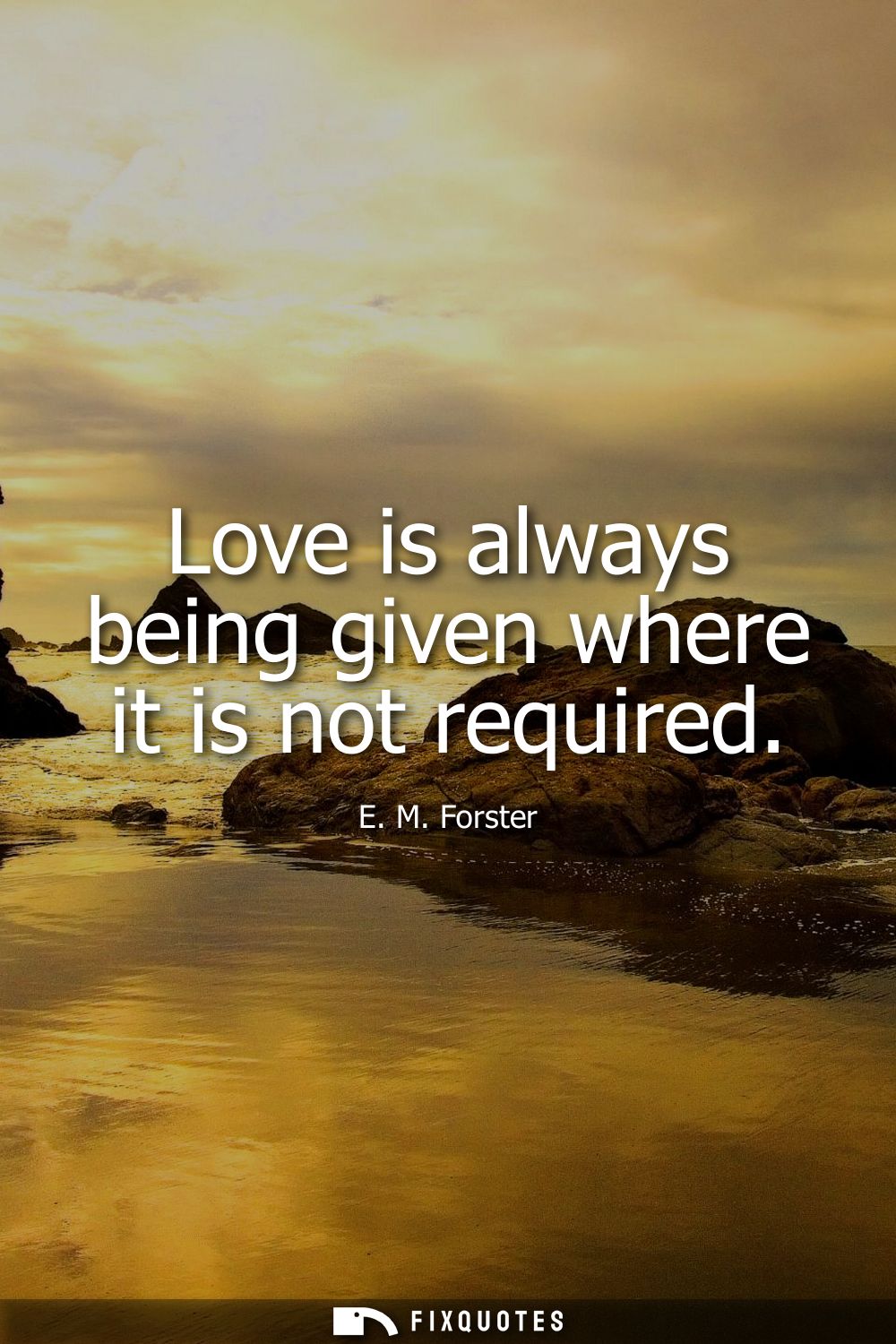
"Love is always being given where it is not required"
About this Quote
Love, for Forster, isn’t a contract; it’s an intrusion. “Always being given” has the steady, almost weary rhythm of a human habit we can’t break, while “where it is not required” flips the comforting romance script into something stranger and sharper. The line quietly refuses the modern fantasy that affection is best when it’s earned, reciprocated, or properly asked for. Forster points instead to love’s embarrassing surplus: the way it leaks out toward people who don’t need it, don’t want it, or can’t return it in kind.
The subtext is ethical as much as emotional. “Required” is the language of duty, institutions, and social permission. By placing love outside that framework, Forster defends a private, unruly force against the neatness of rules: class rules, family rules, respectability rules. It’s also a soft rebuke to the idea that we can rationalize care into something efficient. The unwanted gift can be misread as weakness or bad taste; Forster frames it as evidence of genuine feeling precisely because it isn’t strategically deployed.
Context matters. Forster’s novels orbit the friction between inner life and public convention, especially in early 20th-century England, where attachment could be policed by etiquette and, in queer lives, by law. In that world, “not required” doesn’t just mean unnecessary; it can mean unofficial, unsafe, unsanctioned. The sentence works because it smuggles a radical claim into plain language: love’s credibility lies in its lack of authorization.
The subtext is ethical as much as emotional. “Required” is the language of duty, institutions, and social permission. By placing love outside that framework, Forster defends a private, unruly force against the neatness of rules: class rules, family rules, respectability rules. It’s also a soft rebuke to the idea that we can rationalize care into something efficient. The unwanted gift can be misread as weakness or bad taste; Forster frames it as evidence of genuine feeling precisely because it isn’t strategically deployed.
Context matters. Forster’s novels orbit the friction between inner life and public convention, especially in early 20th-century England, where attachment could be policed by etiquette and, in queer lives, by law. In that world, “not required” doesn’t just mean unnecessary; it can mean unofficial, unsafe, unsanctioned. The sentence works because it smuggles a radical claim into plain language: love’s credibility lies in its lack of authorization.
Quote Details
| Topic | Love |
|---|
More Quotes by M. Forster
Add to List