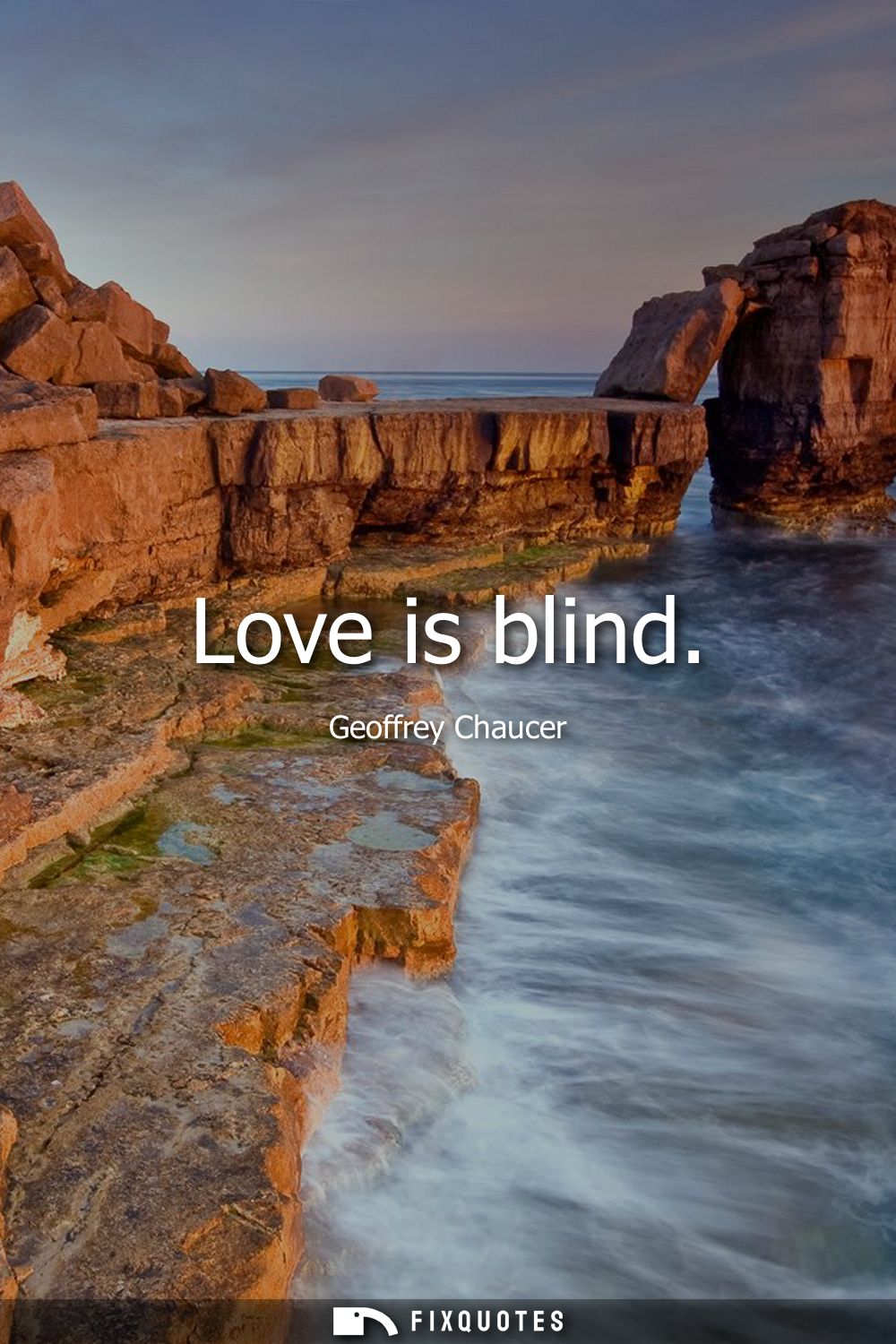
"Love is blind"
About this Quote
“Love is blind” lands with the sly clarity of a proverb, but Chaucer’s world gives it teeth. In late medieval courtly culture, love wasn’t just a feeling; it was a social performance with rules, hierarchies, and serious consequences. The line works because it pretends to offer commonsense wisdom while quietly indicting the very system that romanticizes irrational devotion. Chaucer, a poet with an ear for how people talk themselves into trouble, leans on “blindness” as both excuse and accusation: lovers aren’t merely unaware, they are willfully incapacitated, choosing fantasy over evidence.
The intent isn’t to sanctify love’s mystery; it’s to puncture the self-flattering narratives that come with desire. Blindness implies vulnerability to manipulation, bad judgment, and projection. It suggests that love doesn’t just ignore flaws; it actively edits reality, turning shortcomings into charms and red flags into destiny. That’s why the phrase has lasted: it’s compact enough to sound tender, sharp enough to sound like a warning.
In Chaucer’s hands, this kind of line thrives in the friction between ideal and appetite. His characters routinely dress up selfishness, lust, or ambition in the language of romance, and “love is blind” becomes their alibi. The subtext is brutally modern: when we’re invested in a story, we stop reading the footnotes.
The intent isn’t to sanctify love’s mystery; it’s to puncture the self-flattering narratives that come with desire. Blindness implies vulnerability to manipulation, bad judgment, and projection. It suggests that love doesn’t just ignore flaws; it actively edits reality, turning shortcomings into charms and red flags into destiny. That’s why the phrase has lasted: it’s compact enough to sound tender, sharp enough to sound like a warning.
In Chaucer’s hands, this kind of line thrives in the friction between ideal and appetite. His characters routinely dress up selfishness, lust, or ambition in the language of romance, and “love is blind” becomes their alibi. The subtext is brutally modern: when we’re invested in a story, we stop reading the footnotes.
Quote Details
| Topic | Love |
|---|---|
| Source | The Merchant's Tale, The Canterbury Tales (Geoffrey Chaucer), late 14th century — contains the Middle English line "For love is blind alday". |
| Cite |
Citation Formats
APA Style (7th ed.)
Chaucer, Geoffrey. (2026, January 16). Love is blind. FixQuotes. https://fixquotes.com/quotes/love-is-blind-132791/
Chicago Style
Chaucer, Geoffrey. "Love is blind." FixQuotes. January 16, 2026. https://fixquotes.com/quotes/love-is-blind-132791/.
MLA Style (9th ed.)
"Love is blind." FixQuotes, 16 Jan. 2026, https://fixquotes.com/quotes/love-is-blind-132791/. Accessed 2 Apr. 2026.
More Quotes by Geoffrey
Add to List