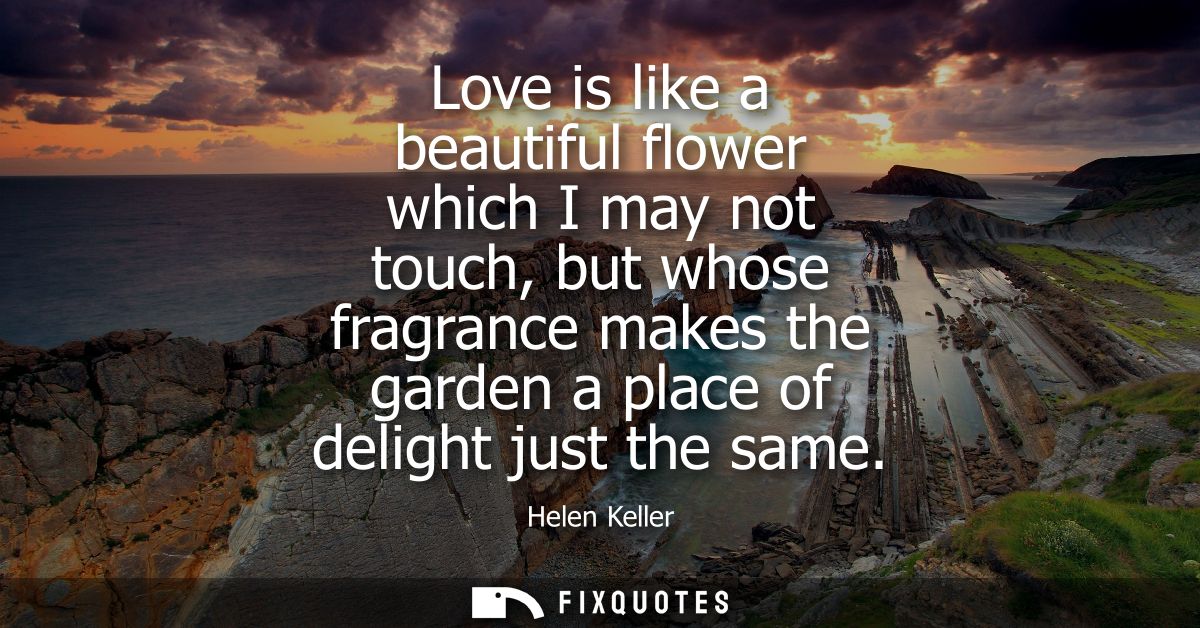
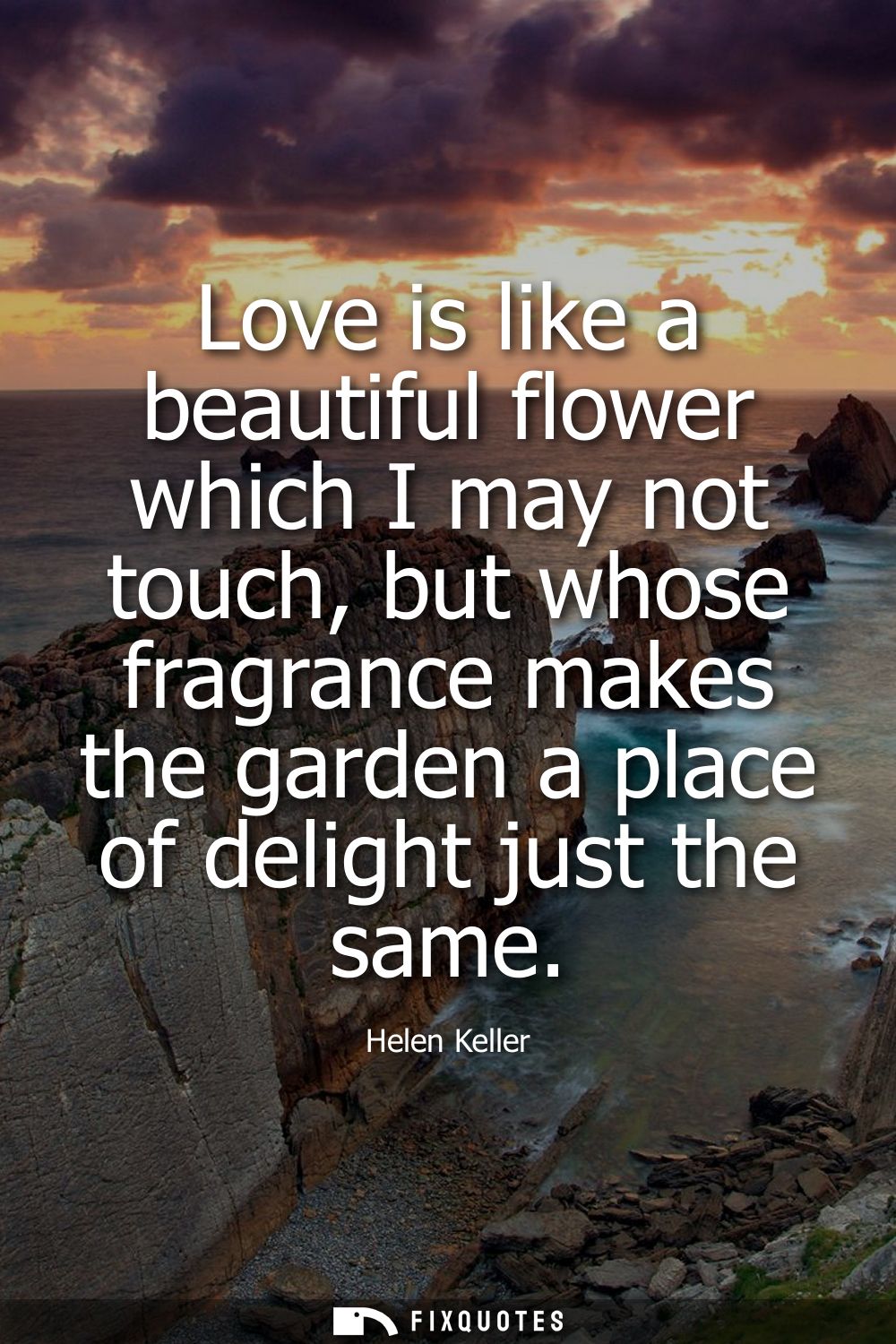
"Love is like a beautiful flower, which I may not touch, but whose fragrance makes the garden a place of delight just the same"
About this Quote
The intent isn’t to romanticize deprivation. It’s to argue for a different metric of intimacy and fulfillment: not ownership, not proximity, but influence. Keller’s phrasing quietly rebukes a culture that equates love with access - to bodies, to attention, to certainty. “May not touch” suggests constraint, not bitterness; the sentence doesn’t plead for pity. It pivots to “just the same,” a calm insistence that joy is still legitimate when it comes secondhand, mediated, or incomplete.
Subtextually, it’s also an ethics lesson. Touching the flower would imply taking; smelling it implies receiving without damage. Love, in this model, is something you honor by not consuming it. The garden matters because it’s shared space - an environment altered by care, patience, and perception. Keller makes a radical claim in gentle language: the richest parts of human life are often the ones you can’t seize, only notice.
Quote Details
| Topic | Love |
|---|---|
| Source | Help us find the source |
| Cite |
Citation Formats
APA Style (7th ed.)
Keller, Helen. (2026, February 16). Love is like a beautiful flower, which I may not touch, but whose fragrance makes the garden a place of delight just the same. FixQuotes. https://fixquotes.com/quotes/love-is-like-a-beautiful-flower-which-i-may-not-14112/
Chicago Style
Keller, Helen. "Love is like a beautiful flower, which I may not touch, but whose fragrance makes the garden a place of delight just the same." FixQuotes. February 16, 2026. https://fixquotes.com/quotes/love-is-like-a-beautiful-flower-which-i-may-not-14112/.
MLA Style (9th ed.)
"Love is like a beautiful flower, which I may not touch, but whose fragrance makes the garden a place of delight just the same." FixQuotes, 16 Feb. 2026, https://fixquotes.com/quotes/love-is-like-a-beautiful-flower-which-i-may-not-14112/. Accessed 31 Mar. 2026.