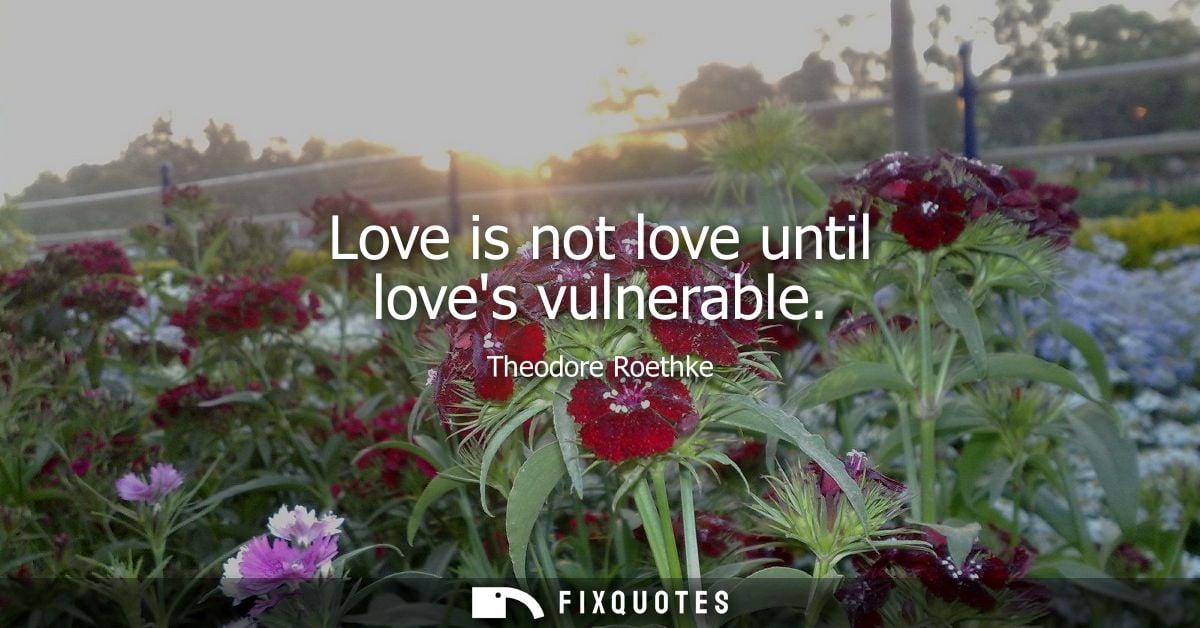
"Love is not love until love's vulnerable"
About this Quote
Roethke turns romance into a stress test. "Love is not love until love's vulnerable" refuses the Hallmark version of devotion as a feeling you privately enjoy. For him, love only becomes real when it stops being cost-free. The line is built like a small logical trap: it sounds like a definition, almost a proverb, but the repetition of "love" keeps slipping the word out of the reader's grasp. If you can say "love" three times and still need a fourth condition to make it true, maybe what most people call love is closer to appetite, admiration, or comfort.
The apostrophe in "love's" matters. It compresses "love is" into something intimate and spoken, while also hinting at possession: love's vulnerable, as in vulnerability belongs to it. Roethke implies that risk isn't an unfortunate side effect of caring; it's the entry fee. The subtext cuts against the mid-century American craving for composure and self-sufficiency, the idea that the competent adult keeps their needs tidy. Roethke, writing out of a psyche that knew instability and tenderness in equal measure, makes exposure a kind of proof.
Contextually, this sits neatly in a postwar literary moment when confessional pressure was building and the polished surfaces of public life felt increasingly false. Vulnerability becomes not just emotional openness, but an ethical stance: if you aren't reachable, disappointable, or able to be changed by another person, you're not loving-you're managing.
The apostrophe in "love's" matters. It compresses "love is" into something intimate and spoken, while also hinting at possession: love's vulnerable, as in vulnerability belongs to it. Roethke implies that risk isn't an unfortunate side effect of caring; it's the entry fee. The subtext cuts against the mid-century American craving for composure and self-sufficiency, the idea that the competent adult keeps their needs tidy. Roethke, writing out of a psyche that knew instability and tenderness in equal measure, makes exposure a kind of proof.
Contextually, this sits neatly in a postwar literary moment when confessional pressure was building and the polished surfaces of public life felt increasingly false. Vulnerability becomes not just emotional openness, but an ethical stance: if you aren't reachable, disappointable, or able to be changed by another person, you're not loving-you're managing.
Quote Details
| Topic | Love |
|---|
More Quotes by Theodore
Add to List