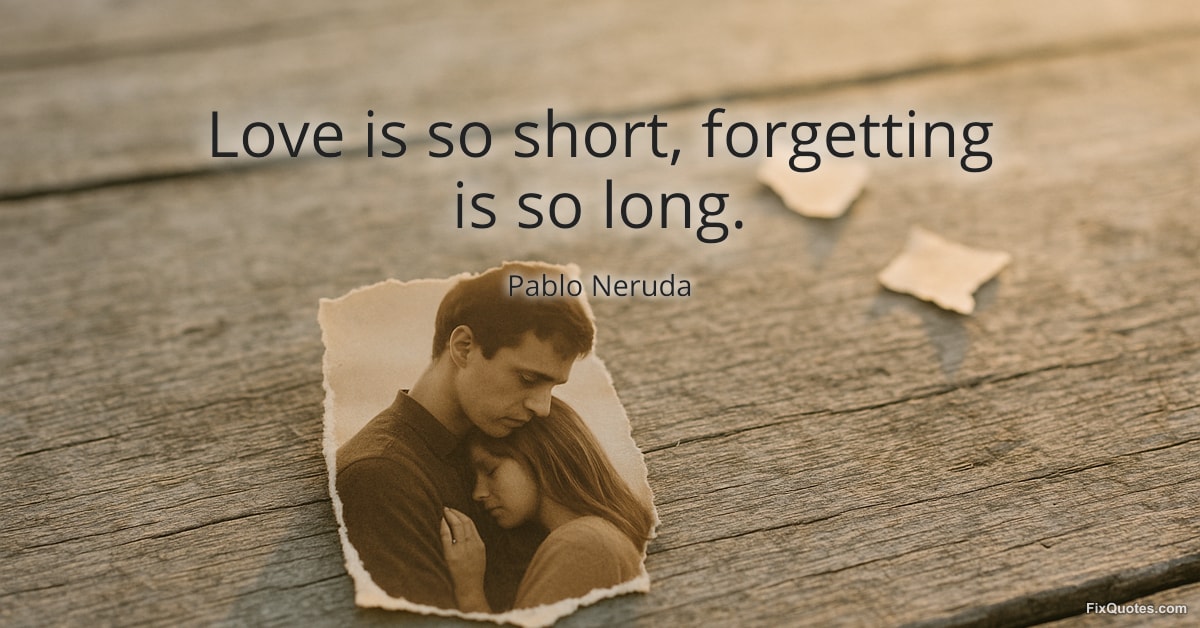
"Love is so short, forgetting is so long"
About this Quote
Neruda compresses an entire emotional lifecycle into a neat imbalance: love arrives like a flash of weather, but its aftermath settles in like climate. The line works because it refuses the comforting symmetry we’re trained to expect from romance narratives. We want love and forgetting to be matched in scale - if something is brief, the recovery should be brief too. Neruda flips that moral accounting. The heart, he implies, is a terrible bookkeeper.
The intent isn’t just to mourn a breakup; it’s to expose time as the real antagonist. “Short” isn’t only a measure of duration, it’s an accusation: love didn’t get to become what it promised. Meanwhile “forgetting” stretches, not because the speaker is sentimental, but because the mind keeps re-opening the file, rehearsing what-ifs with the stubborn energy of someone trying to rewrite a past that won’t accept edits.
Subtextually, the line also dignifies the indignity of longing. Forgetting is framed as labor, not failure. That matters in Neruda’s world, where desire and loss are often physical, tactile experiences, and memory behaves less like a diary than like a bruise you keep testing. The simplicity of the phrasing - almost childlike in its clarity - is a rhetorical trap: it sounds like a proverb, but it lands like a confession.
Context helps: Neruda’s love poetry, especially in his early work, treats intimacy as both ecstatic and destabilizing. In a 20th-century Latin American literary culture steeped in heightened lyricism, he perfects a brutal elegance: one clean sentence that makes grief feel not dramatic, but inevitable.
The intent isn’t just to mourn a breakup; it’s to expose time as the real antagonist. “Short” isn’t only a measure of duration, it’s an accusation: love didn’t get to become what it promised. Meanwhile “forgetting” stretches, not because the speaker is sentimental, but because the mind keeps re-opening the file, rehearsing what-ifs with the stubborn energy of someone trying to rewrite a past that won’t accept edits.
Subtextually, the line also dignifies the indignity of longing. Forgetting is framed as labor, not failure. That matters in Neruda’s world, where desire and loss are often physical, tactile experiences, and memory behaves less like a diary than like a bruise you keep testing. The simplicity of the phrasing - almost childlike in its clarity - is a rhetorical trap: it sounds like a proverb, but it lands like a confession.
Context helps: Neruda’s love poetry, especially in his early work, treats intimacy as both ecstatic and destabilizing. In a 20th-century Latin American literary culture steeped in heightened lyricism, he perfects a brutal elegance: one clean sentence that makes grief feel not dramatic, but inevitable.
Quote Details
| Topic | Heartbreak |
|---|---|
| Source | Unverified source: Veinte poemas de amor y una canción desesperada (Pablo Neruda, 1924)
Evidence: Poema 20 (poems are untitled in the 1924 collection; line appears within Poema 20). The English quote 'Love is so short, forgetting is so long' is a translation of Neruda’s Spanish line 'Es tan corto el amor, y es tan largo el olvido,' which occurs in Poema 20 (the poem that begins 'Puedo escribi... Other candidates (2) Pablo Neruda (Pablo Neruda) compilation95.0% rto el amor y tan largo el olvido love is so short and forgetting is so long ton A Study Guide for Pablo Neruda's "Tonight I Can Write" (Gale, Cengage Learning, 2016) compilation95.0% ... love is so short , forgetting is so long . " His poem has become a painful exercise in forgetting . In line twent... |
| Featured | This quote was our Quote of the Day on October 31, 2025 |
| Cite |
Citation Formats
APA Style (7th ed.)
Neruda, Pablo. (2026, January 12). Love is so short, forgetting is so long. FixQuotes. https://fixquotes.com/quotes/love-is-so-short-forgetting-is-so-long-115259/
Chicago Style
Neruda, Pablo. "Love is so short, forgetting is so long." FixQuotes. January 12, 2026. https://fixquotes.com/quotes/love-is-so-short-forgetting-is-so-long-115259/.
MLA Style (9th ed.)
"Love is so short, forgetting is so long." FixQuotes, 12 Jan. 2026, https://fixquotes.com/quotes/love-is-so-short-forgetting-is-so-long-115259/. Accessed 12 Feb. 2026.
More Quotes by Pablo
Add to List