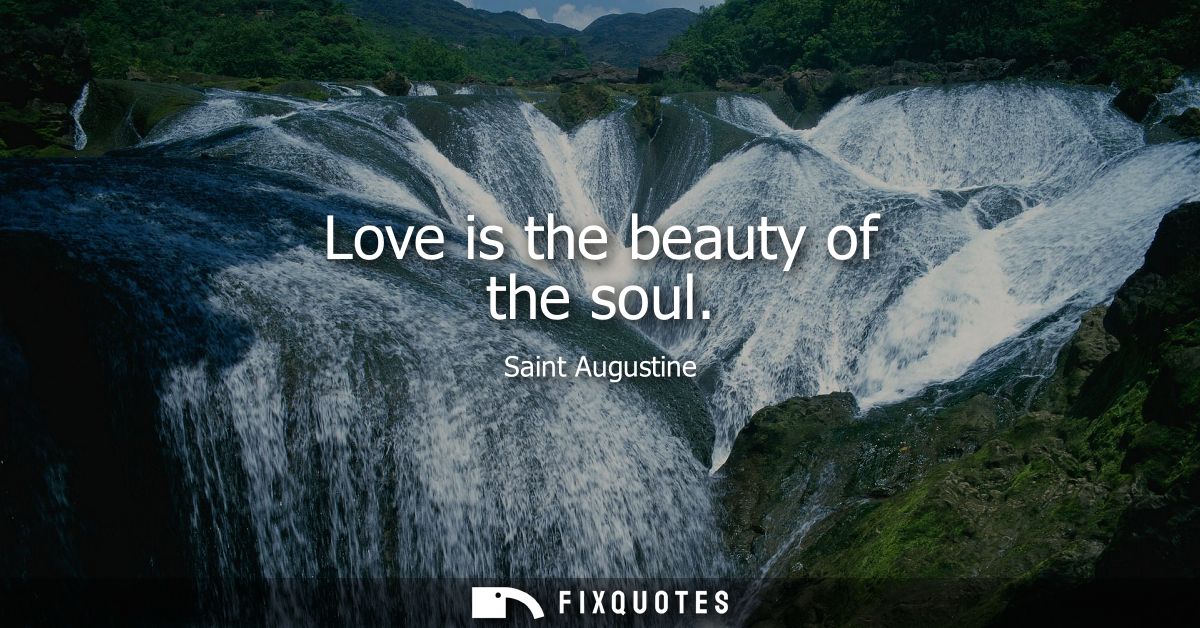
"Love is the beauty of the soul"
About this Quote
Augustine’s line is doing something sneakily radical: it relocates beauty from the body, the object, and the public gaze into the interior life. In late antiquity, “beauty” was a loaded philosophical and theological term, tied to order, harmony, and the pull of desire. Augustine doesn’t deny that pull; he tries to baptize it. Love becomes the soul’s aesthetic condition, the thing that makes a human being not merely correct, but radiant.
The intent isn’t sentimental. It’s diagnostic. For Augustine, the self is defined less by what it knows than by what it loves. That’s the subtext: you can audit a person’s soul by tracking their attachments. Love is not just an emotion but a direction of the will, an organizing principle that shapes perception, behavior, even identity. Calling it “beauty” is persuasive rhetoric: it frames moral formation as something attractive rather than merely obligatory. The good is not only right; it is compelling.
Context matters because Augustine is writing against his own past and his culture’s defaults. He knew classical ideals of beauty and the intoxicating prestige of ambition, erotic conquest, intellectual vanity. His conversion story is, at its core, a re-training of desire: from loving things that decay to loving what endures. So the line carries an implied warning: misplaced love doesn’t just lead to bad choices; it disfigures. Properly ordered love, ultimately oriented toward God and neighbor, is what restores the soul’s symmetry and shine.
It’s a spiritual aesthetic with real stakes: you become what you love.
The intent isn’t sentimental. It’s diagnostic. For Augustine, the self is defined less by what it knows than by what it loves. That’s the subtext: you can audit a person’s soul by tracking their attachments. Love is not just an emotion but a direction of the will, an organizing principle that shapes perception, behavior, even identity. Calling it “beauty” is persuasive rhetoric: it frames moral formation as something attractive rather than merely obligatory. The good is not only right; it is compelling.
Context matters because Augustine is writing against his own past and his culture’s defaults. He knew classical ideals of beauty and the intoxicating prestige of ambition, erotic conquest, intellectual vanity. His conversion story is, at its core, a re-training of desire: from loving things that decay to loving what endures. So the line carries an implied warning: misplaced love doesn’t just lead to bad choices; it disfigures. Properly ordered love, ultimately oriented toward God and neighbor, is what restores the soul’s symmetry and shine.
It’s a spiritual aesthetic with real stakes: you become what you love.
Quote Details
| Topic | Love |
|---|---|
| Source | Help us find the source |
| Cite |
Citation Formats
APA Style (7th ed.)
Augustine, Saint. (2026, January 14). Love is the beauty of the soul. FixQuotes. https://fixquotes.com/quotes/love-is-the-beauty-of-the-soul-137708/
Chicago Style
Augustine, Saint. "Love is the beauty of the soul." FixQuotes. January 14, 2026. https://fixquotes.com/quotes/love-is-the-beauty-of-the-soul-137708/.
MLA Style (9th ed.)
"Love is the beauty of the soul." FixQuotes, 14 Jan. 2026, https://fixquotes.com/quotes/love-is-the-beauty-of-the-soul-137708/. Accessed 12 Feb. 2026.
More Quotes by Saint
Add to List