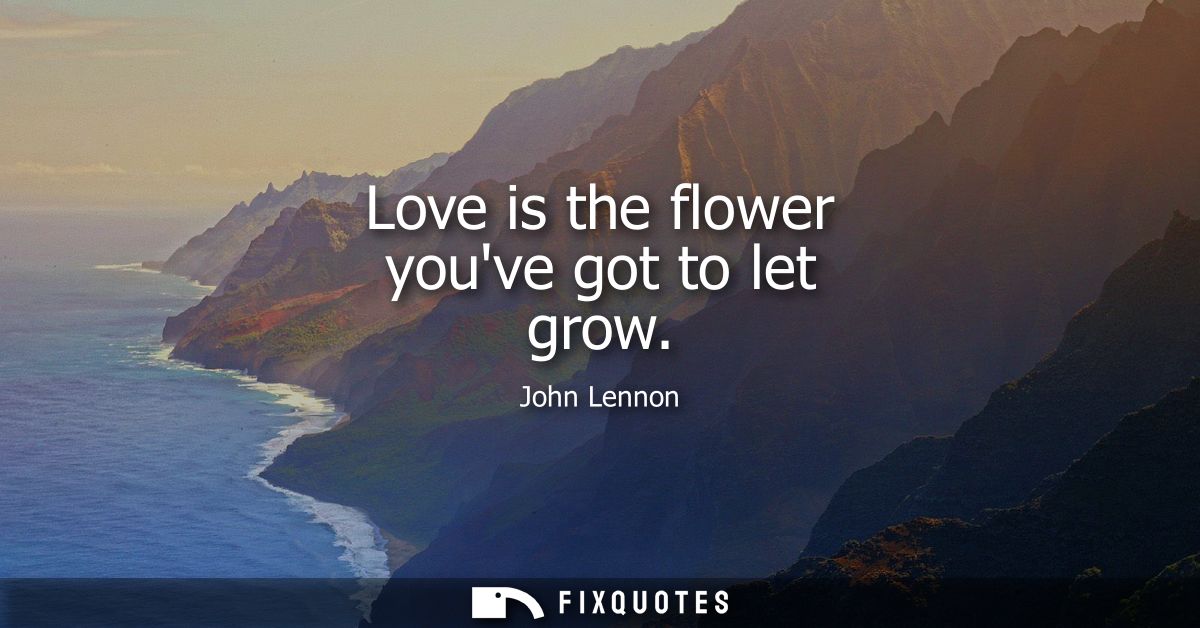
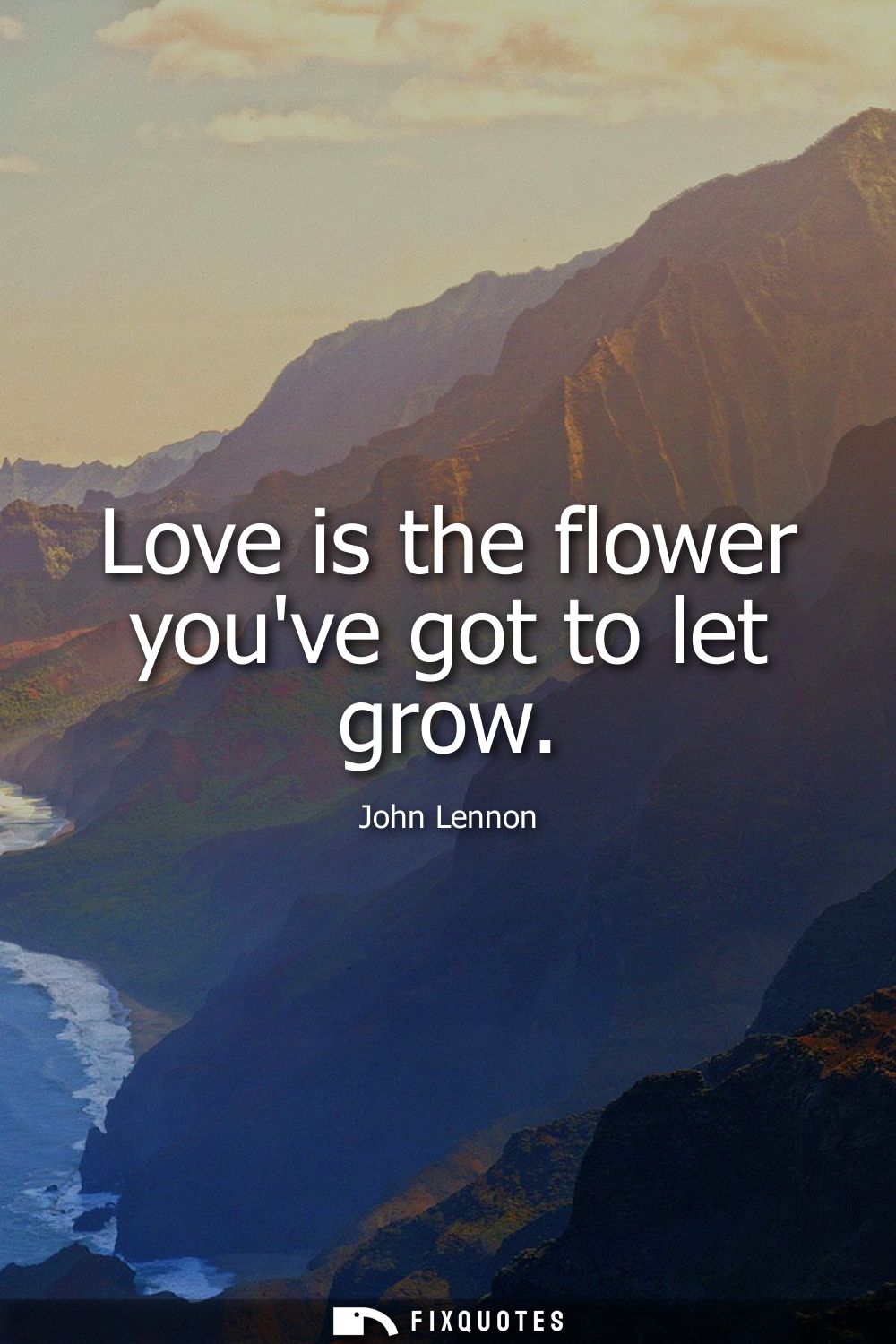
"Love is the flower you've got to let grow"
About this Quote
Lennon’s line plays like a gentle proverb, but it’s also a quiet argument against the era’s impulse to weaponize love as a slogan. “Love is the flower” borrows the language of 60s idealism and pop-spiritual optimism, yet the second half is where the muscle is: “you’ve got to let grow.” Not make grow. Not force. Let. He’s smuggling a critique of control into a seemingly soft image.
The intent feels less like romance and more like practice. Lennon is pointing at the kind of love that can’t be willed into existence through intensity, grand gestures, or public performance. A flower doesn’t respond to speeches; it responds to conditions: time, patience, attention, room. The subtext is that love is fragile under pressure and that our need to manage outcomes is often what strangles it. “You’ve got to let” implies resistance on the other side of the sentence: our habits of jealousy, possessiveness, and impatience.
Context matters because Lennon lived at the intersection of mass adoration and private unraveling. Coming out of Beatlemania, political spectacle, and his own messy transformations, he’d seen how easily “love” gets turned into merch, messaging, and moral posturing. The flower metaphor offers a reset: stop branding love as an achievement and treat it as an environment you cultivate. It’s disarmingly simple, which is why it lands; it refuses drama while still demanding responsibility.
The intent feels less like romance and more like practice. Lennon is pointing at the kind of love that can’t be willed into existence through intensity, grand gestures, or public performance. A flower doesn’t respond to speeches; it responds to conditions: time, patience, attention, room. The subtext is that love is fragile under pressure and that our need to manage outcomes is often what strangles it. “You’ve got to let” implies resistance on the other side of the sentence: our habits of jealousy, possessiveness, and impatience.
Context matters because Lennon lived at the intersection of mass adoration and private unraveling. Coming out of Beatlemania, political spectacle, and his own messy transformations, he’d seen how easily “love” gets turned into merch, messaging, and moral posturing. The flower metaphor offers a reset: stop branding love as an achievement and treat it as an environment you cultivate. It’s disarmingly simple, which is why it lands; it refuses drama while still demanding responsibility.
Quote Details
| Topic | Love |
|---|---|
| Source | "Mind Games" (song), John Lennon, 1973 , lyric: "Love is a flower, you've got to let it grow." |
| Cite |
Citation Formats
APA Style (7th ed.)
Lennon, John. (2026, January 14). Love is the flower you've got to let grow. FixQuotes. https://fixquotes.com/quotes/love-is-the-flower-youve-got-to-let-grow-13863/
Chicago Style
Lennon, John. "Love is the flower you've got to let grow." FixQuotes. January 14, 2026. https://fixquotes.com/quotes/love-is-the-flower-youve-got-to-let-grow-13863/.
MLA Style (9th ed.)
"Love is the flower you've got to let grow." FixQuotes, 14 Jan. 2026, https://fixquotes.com/quotes/love-is-the-flower-youve-got-to-let-grow-13863/. Accessed 2 Apr. 2026.
More Quotes by John
Add to List