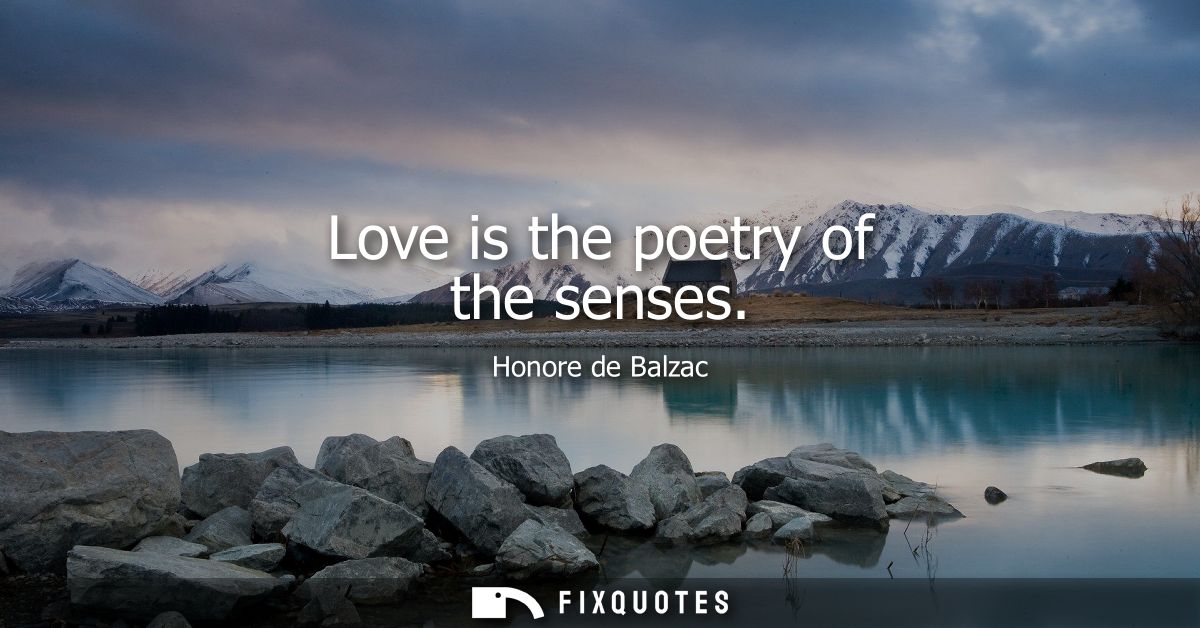
"Love is the poetry of the senses"
About this Quote
Balzac frames love not as a haloed virtue but as a kind of aesthetic technology: the senses, those blunt instruments of appetite and perception, suddenly start producing art. The line flatters desire without sanctifying it. Poetry is structured feeling; it turns raw sensation into pattern, metaphor, rhythm. By calling love the poetry of the senses, Balzac suggests that what we experience as romantic “truth” is also an act of composition - the body editing the world into something heightened, legible, exquisite.
The subtext is quietly skeptical in a Balzacian way. Poetry is beautiful, but it’s also selective and distorting. When you’re in love, the senses don’t just register; they curate. A smell becomes fate, a voice becomes character, a glance becomes a plot twist. Love doesn’t abolish material life; it rewrites it. That idea fits Balzac’s larger project in La Comedie humaine, where passion is rarely pure and never free. Desire is social, economic, reputational; it has consequences. Calling it “poetry” hints at the intoxicating illusion that makes those consequences feel worth it.
Context matters: Balzac is writing in a 19th-century France where Romantic intensity collides with the rising realism of money, class, and ambition. The phrase bridges that collision. It grants love its lyric glow while keeping it anchored in the sensory, the physical, the worldly. Love, in his view, is not an escape from reality; it’s reality experienced under a more dangerous, more beautiful form of narration.
The subtext is quietly skeptical in a Balzacian way. Poetry is beautiful, but it’s also selective and distorting. When you’re in love, the senses don’t just register; they curate. A smell becomes fate, a voice becomes character, a glance becomes a plot twist. Love doesn’t abolish material life; it rewrites it. That idea fits Balzac’s larger project in La Comedie humaine, where passion is rarely pure and never free. Desire is social, economic, reputational; it has consequences. Calling it “poetry” hints at the intoxicating illusion that makes those consequences feel worth it.
Context matters: Balzac is writing in a 19th-century France where Romantic intensity collides with the rising realism of money, class, and ambition. The phrase bridges that collision. It grants love its lyric glow while keeping it anchored in the sensory, the physical, the worldly. Love, in his view, is not an escape from reality; it’s reality experienced under a more dangerous, more beautiful form of narration.
Quote Details
| Topic | Love |
|---|---|
| Source | Help us find the source |
| Cite |
Citation Formats
APA Style (7th ed.)
Balzac, Honore de. (2026, January 17). Love is the poetry of the senses. FixQuotes. https://fixquotes.com/quotes/love-is-the-poetry-of-the-senses-24218/
Chicago Style
Balzac, Honore de. "Love is the poetry of the senses." FixQuotes. January 17, 2026. https://fixquotes.com/quotes/love-is-the-poetry-of-the-senses-24218/.
MLA Style (9th ed.)
"Love is the poetry of the senses." FixQuotes, 17 Jan. 2026, https://fixquotes.com/quotes/love-is-the-poetry-of-the-senses-24218/. Accessed 12 Feb. 2026.
More Quotes by Honore
Add to List