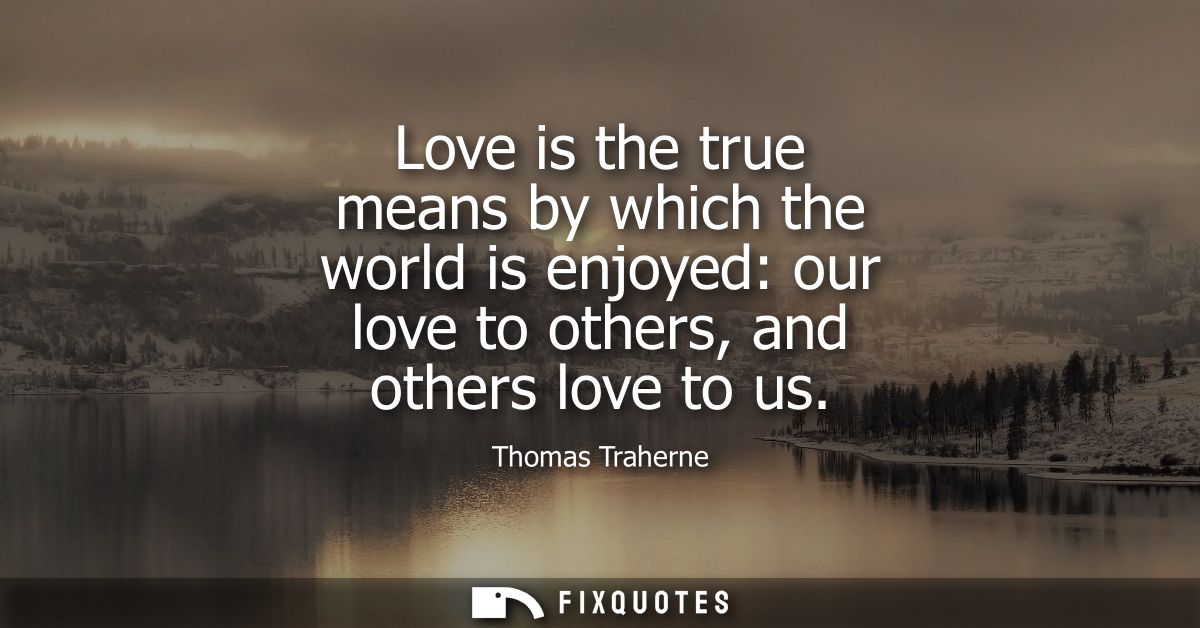
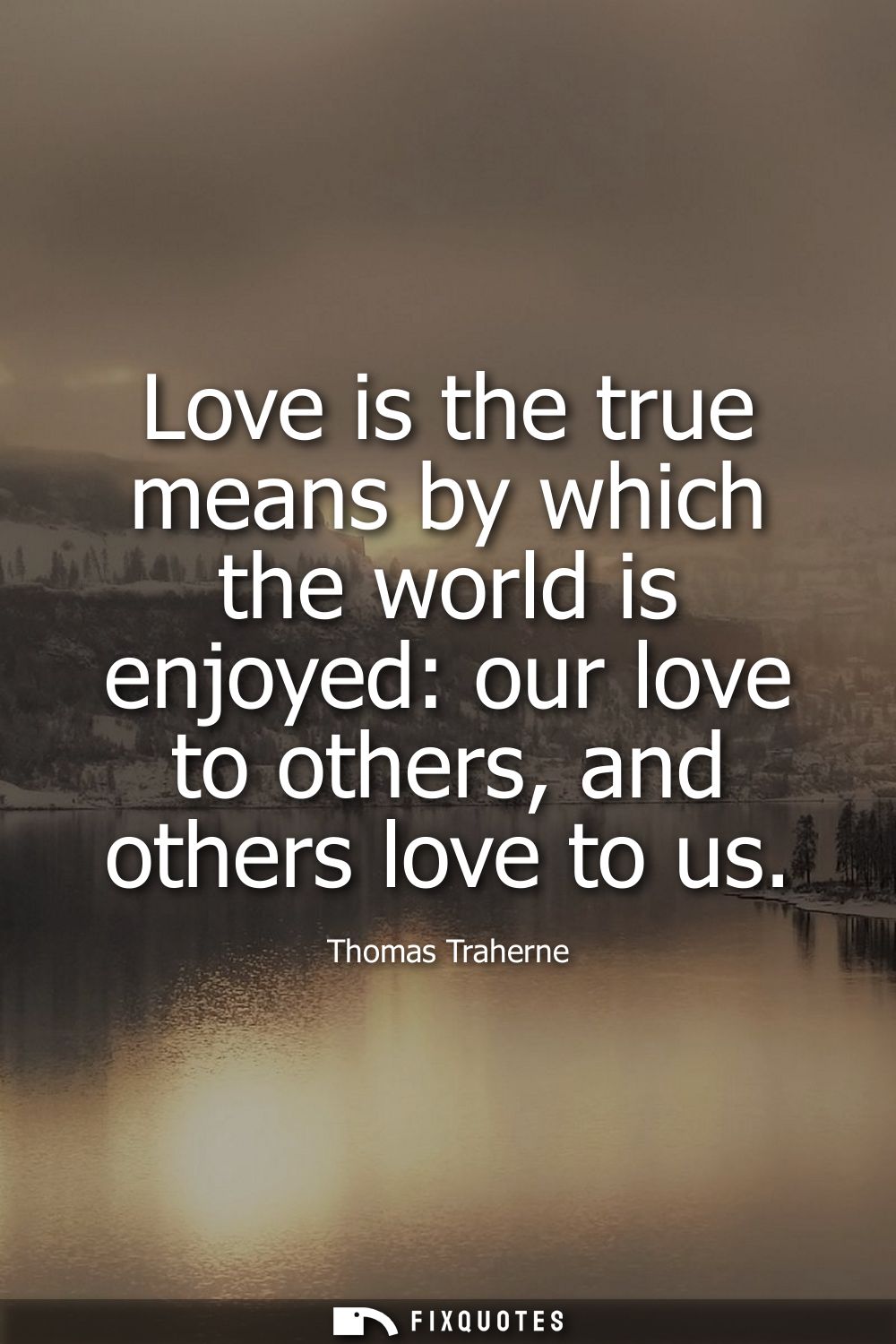
"Love is the true means by which the world is enjoyed: our love to others, and others' love to us"
About this Quote
The sentence hinges on reciprocity. Traherne doesn’t romanticize isolated virtue; he insists that love has an economy. “Our love to others” is not complete without “others love to us,” a pairing that smuggles in a theological claim: human flourishing is designed to be mutual, not heroic. That’s a subtle push against the era’s hardening individualism and the post-Civil War (English) strain of suspicion, faction, and moral austerity. Where his contemporaries often framed the world as a testing ground or a trapdoor to sin, Traherne frames it as a gift that requires the right stance to receive it.
The subtext is almost disarmingly radical: if you can’t enjoy the world, something is wrong not with the world but with the channel between you and it. Love becomes a moral discipline and a sensory one. In Traherne’s Christian context, that reciprocity also echoes divine love - grace as both model and fuel - making enjoyment not indulgence, but evidence of rightly ordered life.
Quote Details
| Topic | Love |
|---|---|
| Source | Help us find the source |
| Cite |
Citation Formats
APA Style (7th ed.)
Traherne, Thomas. (2026, February 20). Love is the true means by which the world is enjoyed: our love to others, and others' love to us. FixQuotes. https://fixquotes.com/quotes/love-is-the-true-means-by-which-the-world-is-5699/
Chicago Style
Traherne, Thomas. "Love is the true means by which the world is enjoyed: our love to others, and others' love to us." FixQuotes. February 20, 2026. https://fixquotes.com/quotes/love-is-the-true-means-by-which-the-world-is-5699/.
MLA Style (9th ed.)
"Love is the true means by which the world is enjoyed: our love to others, and others' love to us." FixQuotes, 20 Feb. 2026, https://fixquotes.com/quotes/love-is-the-true-means-by-which-the-world-is-5699/. Accessed 9 Mar. 2026.