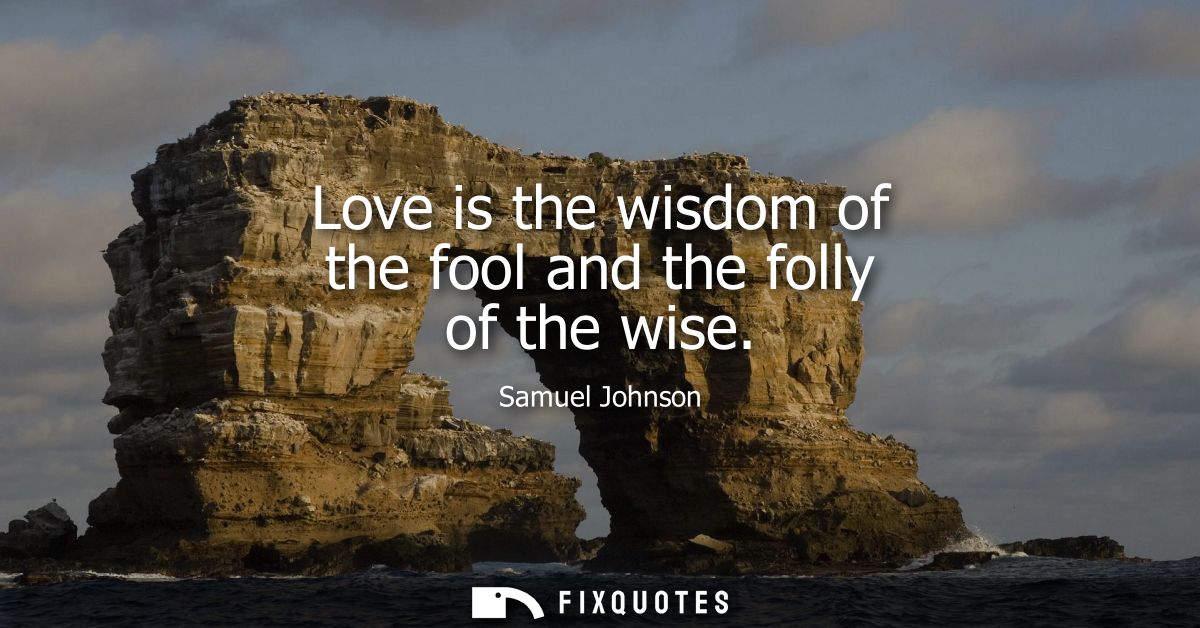
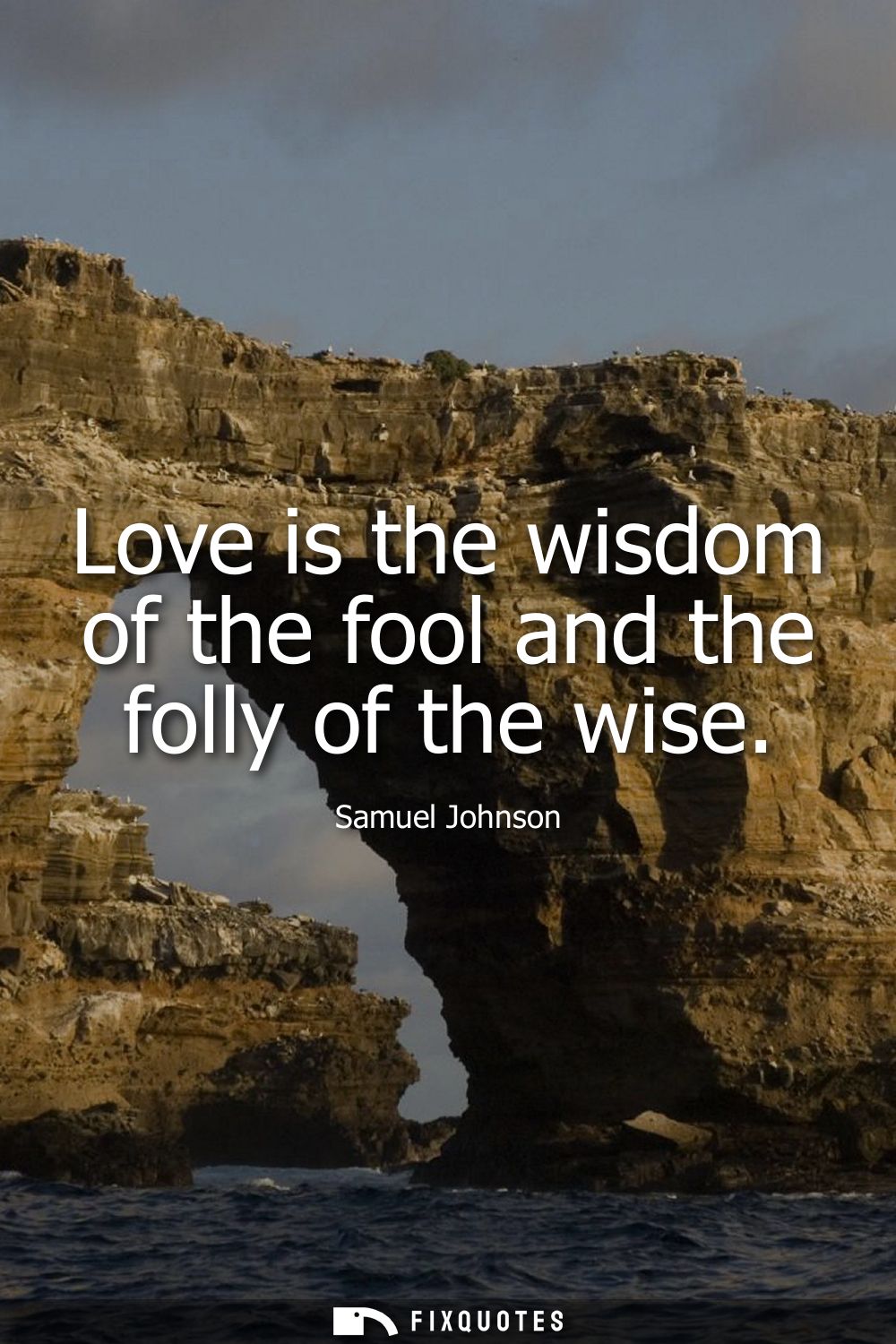
"Love is the wisdom of the fool and the folly of the wise"
About this Quote
Love, for Johnson, is a diagnostic test disguised as a feeling: it flips your supposed strengths into liabilities. The line works because it refuses romance the comfort of being “for everyone” in the same way. It assigns love a double exposure. In the “fool,” love becomes wisdom not because the fool suddenly earns insight, but because love can temporarily supply what the fool lacks: attention, discipline, a motive bigger than appetite. The fool, granted an object of devotion, stumbles into prudence the way an amateur can accidentally play the right note when the stakes are high.
Then Johnson turns the knife: in the “wise,” love becomes folly because it punctures the armor that wisdom polishes. The wise person’s identity is built on calibration, proportion, self-command. Love, by definition, is disproportionate; it invites obsession, risk, and self-deception. It makes the clever plead, the principled rationalize, the measured become theatrical. Johnson’s syntax is perfectly balanced - wisdom/folly, fool/wise - a neat couplet of opposites that mimics the very reversal he’s describing. The rhetorical symmetry is the trap: you feel the logic click into place even as the content warns you that logic is not the point.
Context matters: Johnson is an 18th-century moralist, suspicious of sentimentality and allergic to the idea that emotion is automatically ennobling. He isn’t denying love’s power; he’s demoting it from virtue to force. Love doesn’t reward merit. It redistributes it, often unfairly, and that’s precisely what makes it so socially disruptive - and so psychologically true.
Then Johnson turns the knife: in the “wise,” love becomes folly because it punctures the armor that wisdom polishes. The wise person’s identity is built on calibration, proportion, self-command. Love, by definition, is disproportionate; it invites obsession, risk, and self-deception. It makes the clever plead, the principled rationalize, the measured become theatrical. Johnson’s syntax is perfectly balanced - wisdom/folly, fool/wise - a neat couplet of opposites that mimics the very reversal he’s describing. The rhetorical symmetry is the trap: you feel the logic click into place even as the content warns you that logic is not the point.
Context matters: Johnson is an 18th-century moralist, suspicious of sentimentality and allergic to the idea that emotion is automatically ennobling. He isn’t denying love’s power; he’s demoting it from virtue to force. Love doesn’t reward merit. It redistributes it, often unfairly, and that’s precisely what makes it so socially disruptive - and so psychologically true.
Quote Details
| Topic | Love |
|---|---|
| Source | Help us find the source |
| Cite |
Citation Formats
APA Style (7th ed.)
Johnson, Samuel. (2026, January 14). Love is the wisdom of the fool and the folly of the wise. FixQuotes. https://fixquotes.com/quotes/love-is-the-wisdom-of-the-fool-and-the-folly-of-21073/
Chicago Style
Johnson, Samuel. "Love is the wisdom of the fool and the folly of the wise." FixQuotes. January 14, 2026. https://fixquotes.com/quotes/love-is-the-wisdom-of-the-fool-and-the-folly-of-21073/.
MLA Style (9th ed.)
"Love is the wisdom of the fool and the folly of the wise." FixQuotes, 14 Jan. 2026, https://fixquotes.com/quotes/love-is-the-wisdom-of-the-fool-and-the-folly-of-21073/. Accessed 27 Mar. 2026.
More Quotes by Samuel
Add to List