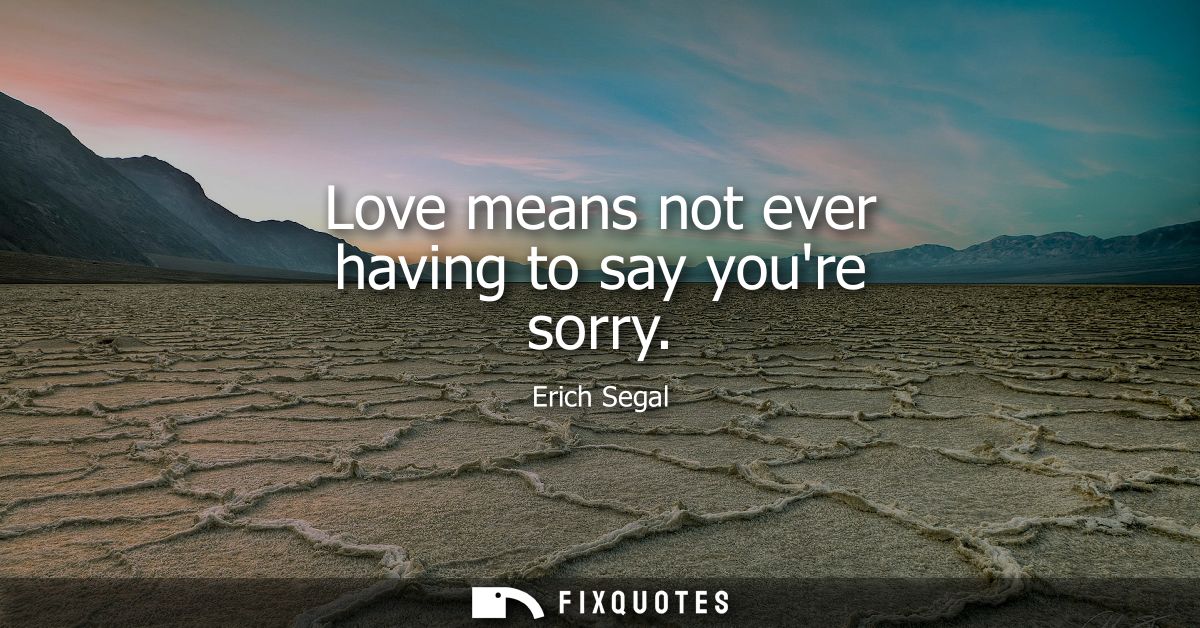
"Love means not ever having to say you're sorry"
About this Quote
A line like this doesn’t land because it’s wise; it lands because it’s intoxicating. Segal’s “Love means not ever having to say you’re sorry” is romantic maximalism dressed up as maturity, a fantasy that real intimacy erases the awkward work of accountability. It flatters the listener with an idea of perfect mutual understanding: if we truly love each other, our intentions will be so legible that harm won’t need naming, repairs won’t need negotiating, and conflict won’t leave residue. That’s not a relationship ethic so much as a promise of frictionless living.
The subtext is where the line does its real cultural labor. It recasts apology as a failure of love rather than a tool of it. “Sorry” becomes an admission that you’ve broken the spell, that you’ve forced the other person to confront you as a separate human with limits. In Segal’s hands, love is imagined as a merger: two people so fused that missteps don’t require ceremony. It’s a seductive escape hatch from the adult discomfort of saying, plainly, I hurt you and I’m accountable for it.
Context matters: Segal’s novel Love Story (and its hugely influential 1970 film adaptation) arrived in an era hungry for grand, streamlined emotion and clean myth-making about romance. The sentence is engineered for that moment: short, quotable, moral-sounding. Its durability comes from how neatly it turns yearning into a rule. Today it reads as both iconic and quietly alarming, a slogan that can blur into permission: if love is real, you’ll just understand, and I won’t have to change.
The subtext is where the line does its real cultural labor. It recasts apology as a failure of love rather than a tool of it. “Sorry” becomes an admission that you’ve broken the spell, that you’ve forced the other person to confront you as a separate human with limits. In Segal’s hands, love is imagined as a merger: two people so fused that missteps don’t require ceremony. It’s a seductive escape hatch from the adult discomfort of saying, plainly, I hurt you and I’m accountable for it.
Context matters: Segal’s novel Love Story (and its hugely influential 1970 film adaptation) arrived in an era hungry for grand, streamlined emotion and clean myth-making about romance. The sentence is engineered for that moment: short, quotable, moral-sounding. Its durability comes from how neatly it turns yearning into a rule. Today it reads as both iconic and quietly alarming, a slogan that can blur into permission: if love is real, you’ll just understand, and I won’t have to change.
Quote Details
| Topic | Romantic |
|---|---|
| Source | Love Story, novel by Erich Segal (1970) — contains the line often cited as "Love means never having to say you're sorry". |
| Cite |
Citation Formats
APA Style (7th ed.)
Segal, Erich. (2026, January 16). Love means not ever having to say you're sorry. FixQuotes. https://fixquotes.com/quotes/love-means-not-ever-having-to-say-youre-sorry-127351/
Chicago Style
Segal, Erich. "Love means not ever having to say you're sorry." FixQuotes. January 16, 2026. https://fixquotes.com/quotes/love-means-not-ever-having-to-say-youre-sorry-127351/.
MLA Style (9th ed.)
"Love means not ever having to say you're sorry." FixQuotes, 16 Jan. 2026, https://fixquotes.com/quotes/love-means-not-ever-having-to-say-youre-sorry-127351/. Accessed 12 Feb. 2026.
More Quotes by Erich
Add to List