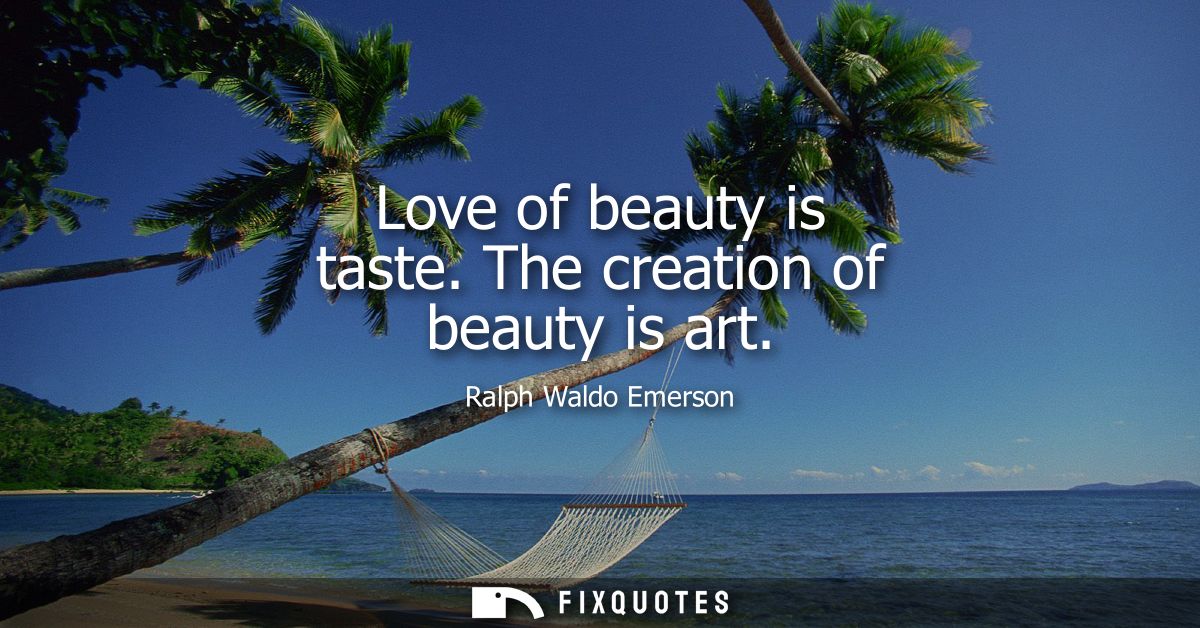
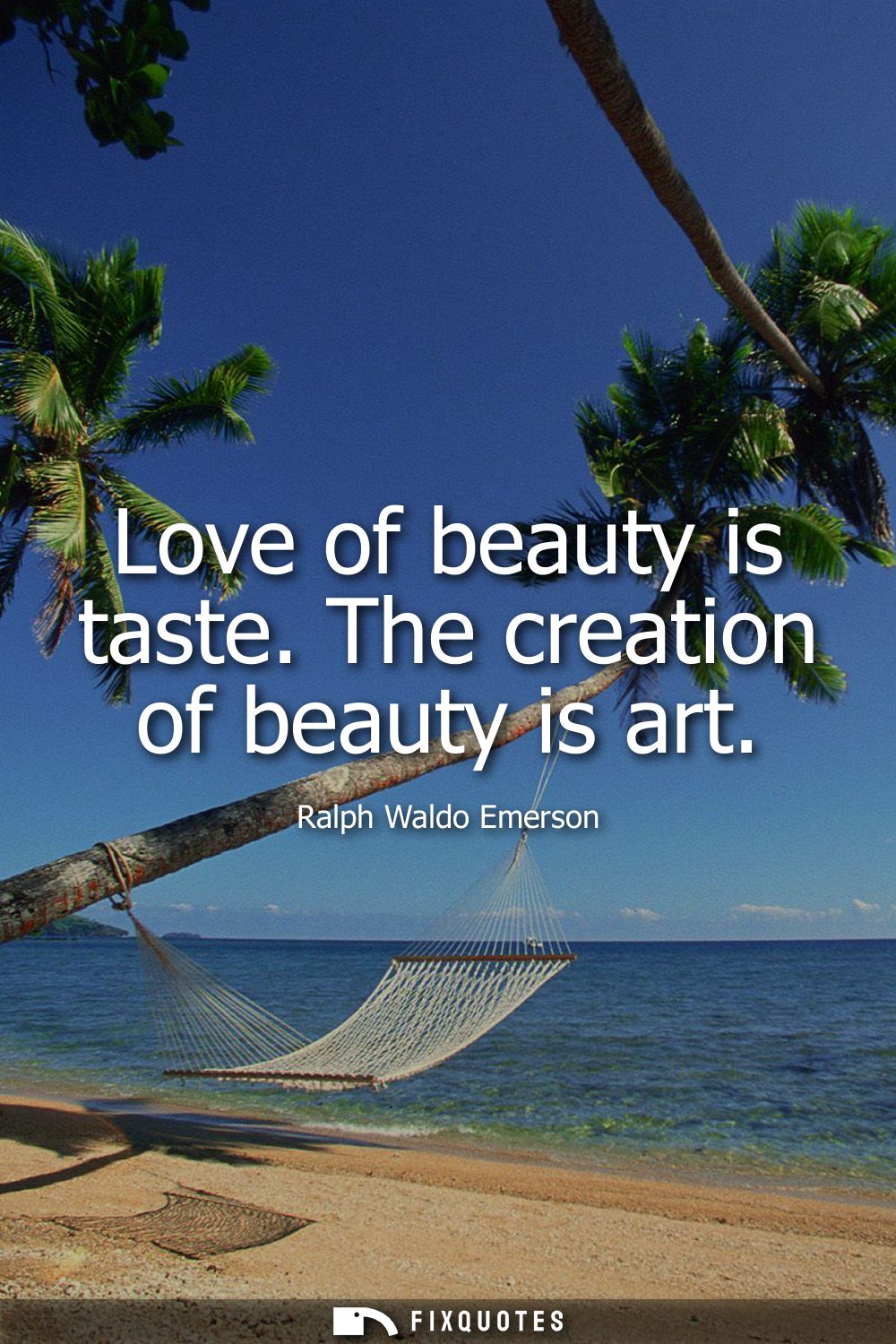
"Love of beauty is taste. The creation of beauty is art"
About this Quote
Emerson’s line is a neat piece of philosophical boundary-drawing: it flatters the admirer while quietly reserving the higher status for the maker. “Love of beauty is taste” sounds generous, even democratic; anyone can cultivate appetite and discernment. But “taste” is also a deliberately modest word. It implies receptivity, a refined kind of consumption. You can have taste and still remain, in Emerson’s moral universe, a spectator.
Then comes the pivot: “The creation of beauty is art.” Emerson treats art less as a category of objects than as an act of will - a verb disguised as a noun. That shift from appreciation to production encodes his broader Transcendentalist ethic: the self isn’t meant to merely judge the world but to generate it, to translate inner perception into outward form. Subtextually, it’s also a critique of a culture he saw drifting toward genteel connoisseurship - the parlor-room habit of admiring the beautiful as proof of one’s refinement, rather than risking the vulnerability of making something.
The aphorism works because it compresses an entire hierarchy into two clean sentences. It separates passive sensitivity from active shaping without sounding like a scold. Emerson’s era was wrestling with what “American” art could be in the shadow of Europe’s museums and canons; this is a small manifesto for creative self-reliance. Beauty isn’t a trophy to recognize. It’s a task to undertake.
Then comes the pivot: “The creation of beauty is art.” Emerson treats art less as a category of objects than as an act of will - a verb disguised as a noun. That shift from appreciation to production encodes his broader Transcendentalist ethic: the self isn’t meant to merely judge the world but to generate it, to translate inner perception into outward form. Subtextually, it’s also a critique of a culture he saw drifting toward genteel connoisseurship - the parlor-room habit of admiring the beautiful as proof of one’s refinement, rather than risking the vulnerability of making something.
The aphorism works because it compresses an entire hierarchy into two clean sentences. It separates passive sensitivity from active shaping without sounding like a scold. Emerson’s era was wrestling with what “American” art could be in the shadow of Europe’s museums and canons; this is a small manifesto for creative self-reliance. Beauty isn’t a trophy to recognize. It’s a task to undertake.
Quote Details
| Topic | Art |
|---|---|
| Source | Verified source: Nature (Ralph Waldo Emerson, 1836)
Evidence: All men are in some degree impressed by the face of the world; some men even to delight. This love of beauty is Taste. Others have the same love in such excess, that, not content with admiring, they seek to embody it in new forms. The creation of beauty is Art. (Chapter III: Beauty). This is the primary, authorial text in Ralph Waldo Emerson’s essay/book "Nature" (first published in 1836). The commonly-circulated two-sentence quote is a shortened paraphrase/extract of the longer passage above; the exact phrasing includes "This love of beauty is Taste" (not "Love of beauty is taste"). The passage appears in the "Beauty" section (Chapter III) of Nature. A secondary web source claims "Chapter III. Beauty, Page 29" for an 1836 James Munroe & Co. edition, but page numbering varies by edition/printing and should be confirmed against a scan of the specific 1836 printing you care about. Other candidates (1) Early Lectures (Ralph Waldo Emerson, 1959) compilation95.0% Ralph Waldo Emerson Stephen Emerson Whicher, Robert Ernest Spiller, Wallace E. Williams. is Art . The love of Beauty ... |
| Cite |
Citation Formats
APA Style (7th ed.)
Emerson, Ralph Waldo. (2026, February 26). Love of beauty is taste. The creation of beauty is art. FixQuotes. https://fixquotes.com/quotes/love-of-beauty-is-taste-the-creation-of-beauty-is-34175/
Chicago Style
Emerson, Ralph Waldo. "Love of beauty is taste. The creation of beauty is art." FixQuotes. February 26, 2026. https://fixquotes.com/quotes/love-of-beauty-is-taste-the-creation-of-beauty-is-34175/.
MLA Style (9th ed.)
"Love of beauty is taste. The creation of beauty is art." FixQuotes, 26 Feb. 2026, https://fixquotes.com/quotes/love-of-beauty-is-taste-the-creation-of-beauty-is-34175/. Accessed 28 Mar. 2026.
More Quotes by Ralph
Add to List