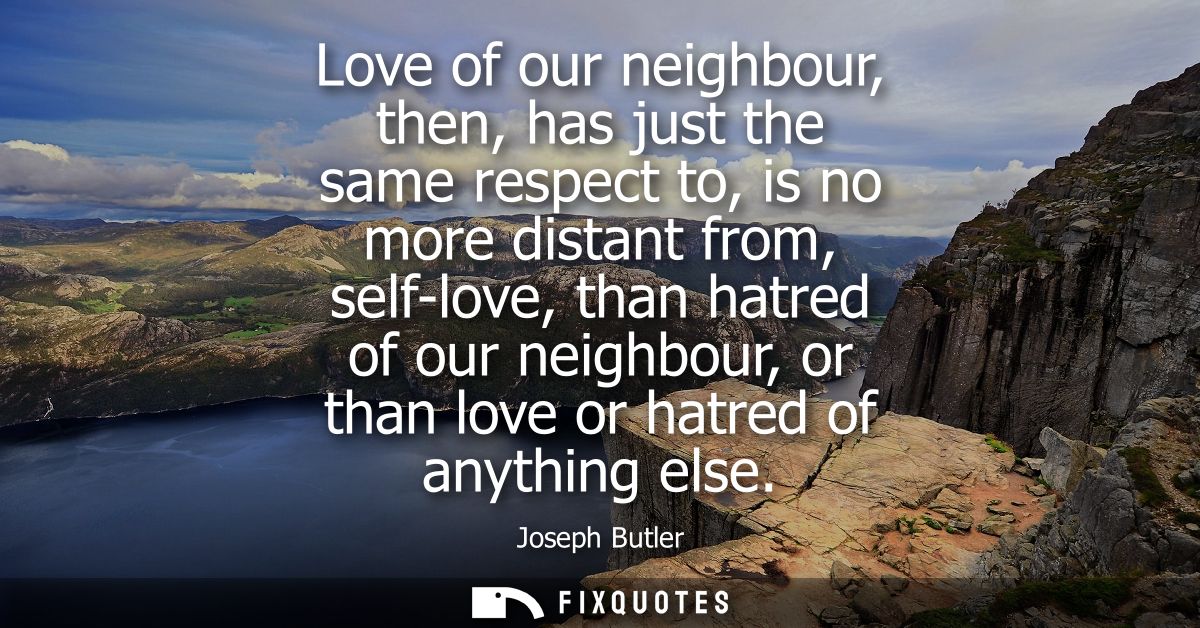
"Love of our neighbour, then, has just the same respect to, is no more distant from, self-love, than hatred of our neighbour, or than love or hatred of anything else"
About this Quote
The syntax does the work. By stacking “love” and “hatred” alongside “anything else,” Butler refuses to let neighbor-love wear a halo. It’s treated as an ordinary human affection, no more “distant” from self-love than any other passion. That phrasing is quietly polemical. He’s writing against the Hobbesian mood that reduced human motivation to self-interest, plus the cynical reading that Christian charity is either impossible or fake. Butler’s move is to concede the obvious - we are self-concerned - then argue it doesn’t follow that we can’t be genuinely other-concerned. Both can be “natural,” both can be real, and neither automatically earns moral credit.
The subtext is pastoral but also political: if you insist virtue must be self-denial, you turn ethics into a masochistic performance and make everyday decency look suspect. Butler wants morality to be psychologically plausible, not saint-only. Neighbor-love, in his framing, isn’t an escape from the self; it’s one of the self’s proper directions, disciplined by conscience rather than dramatized as a miracle.
Quote Details
| Topic | Ethics & Morality |
|---|---|
| Source | Help us find the source |
| Cite |
Citation Formats
APA Style (7th ed.)
Butler, Joseph. (2026, January 18). Love of our neighbour, then, has just the same respect to, is no more distant from, self-love, than hatred of our neighbour, or than love or hatred of anything else. FixQuotes. https://fixquotes.com/quotes/love-of-our-neighbour-then-has-just-the-same-10436/
Chicago Style
Butler, Joseph. "Love of our neighbour, then, has just the same respect to, is no more distant from, self-love, than hatred of our neighbour, or than love or hatred of anything else." FixQuotes. January 18, 2026. https://fixquotes.com/quotes/love-of-our-neighbour-then-has-just-the-same-10436/.
MLA Style (9th ed.)
"Love of our neighbour, then, has just the same respect to, is no more distant from, self-love, than hatred of our neighbour, or than love or hatred of anything else." FixQuotes, 18 Jan. 2026, https://fixquotes.com/quotes/love-of-our-neighbour-then-has-just-the-same-10436/. Accessed 5 Apr. 2026.