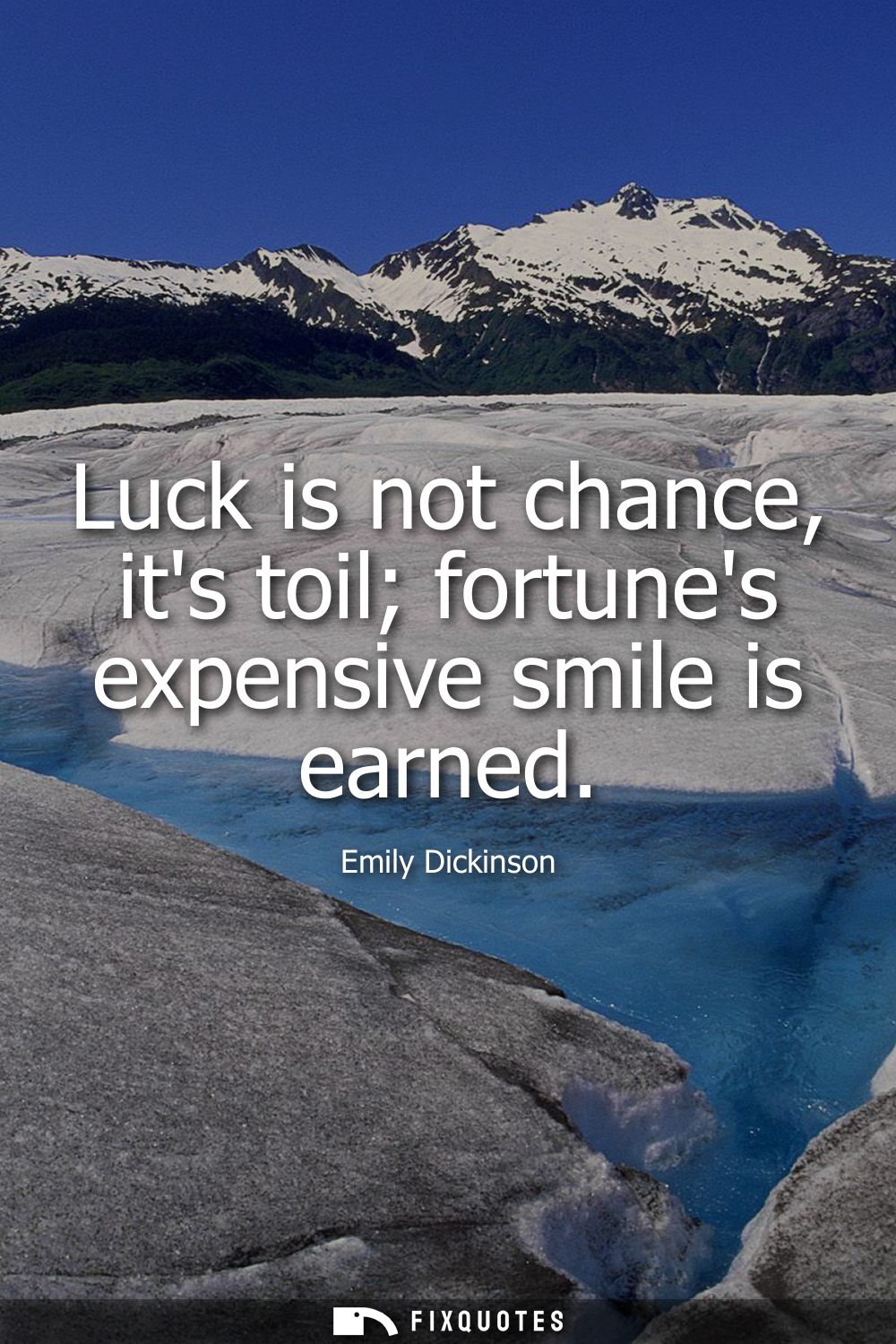
"Luck is not chance, it's toil; fortune's expensive smile is earned"
About this Quote
“Luck” usually gets treated like weather: it happens to you, it doesn’t mean anything, don’t take it personally. Dickinson flips that passive superstition into a kind of moral physics. Luck is “toil,” not “chance” - a blunt refusal of the cozy story that outcomes arrive unbidden. Then she tightens the screw with “fortune’s expensive smile,” turning good fortune into a commodity with a price tag. If fortune is smiling, it’s because you paid for it in labor, attention, and endurance.
That phrasing matters. Dickinson could have said “hard work pays off,” the bland Protestant bumper-sticker version. “Expensive smile” is sharper: it suggests an economy where success is transactional, even a little predatory. Fortune is personified as something charming but not generous. You don’t win her over with merit alone; you purchase access. The subtext is both bracing and faintly suspicious: the world rewards effort, yes, but it also makes you pay again and again for the right to be rewarded.
Context deepens the sting. Dickinson wrote from a life famously bounded - domestic space, illness, self-imposed seclusion - where “luck” could easily look like other people’s inheritance, health, or social permission. Insisting that luck is earned is a self-authorizing move: a way to claim agency in a culture that denied women public credit. Yet she doesn’t romanticize grind. By calling fortune’s smile “expensive,” she admits what hustle culture still tries to hide: even when you earn it, it costs you.
That phrasing matters. Dickinson could have said “hard work pays off,” the bland Protestant bumper-sticker version. “Expensive smile” is sharper: it suggests an economy where success is transactional, even a little predatory. Fortune is personified as something charming but not generous. You don’t win her over with merit alone; you purchase access. The subtext is both bracing and faintly suspicious: the world rewards effort, yes, but it also makes you pay again and again for the right to be rewarded.
Context deepens the sting. Dickinson wrote from a life famously bounded - domestic space, illness, self-imposed seclusion - where “luck” could easily look like other people’s inheritance, health, or social permission. Insisting that luck is earned is a self-authorizing move: a way to claim agency in a culture that denied women public credit. Yet she doesn’t romanticize grind. By calling fortune’s smile “expensive,” she admits what hustle culture still tries to hide: even when you earn it, it costs you.
Quote Details
| Topic | Work Ethic |
|---|---|
| Source | Help us find the source |
| Cite |
Citation Formats
APA Style (7th ed.)
Dickinson, Emily. (2026, January 18). Luck is not chance, it's toil; fortune's expensive smile is earned. FixQuotes. https://fixquotes.com/quotes/luck-is-not-chance-its-toil-fortunes-expensive-23490/
Chicago Style
Dickinson, Emily. "Luck is not chance, it's toil; fortune's expensive smile is earned." FixQuotes. January 18, 2026. https://fixquotes.com/quotes/luck-is-not-chance-its-toil-fortunes-expensive-23490/.
MLA Style (9th ed.)
"Luck is not chance, it's toil; fortune's expensive smile is earned." FixQuotes, 18 Jan. 2026, https://fixquotes.com/quotes/luck-is-not-chance-its-toil-fortunes-expensive-23490/. Accessed 29 Mar. 2026.
More Quotes by Emily
Add to List