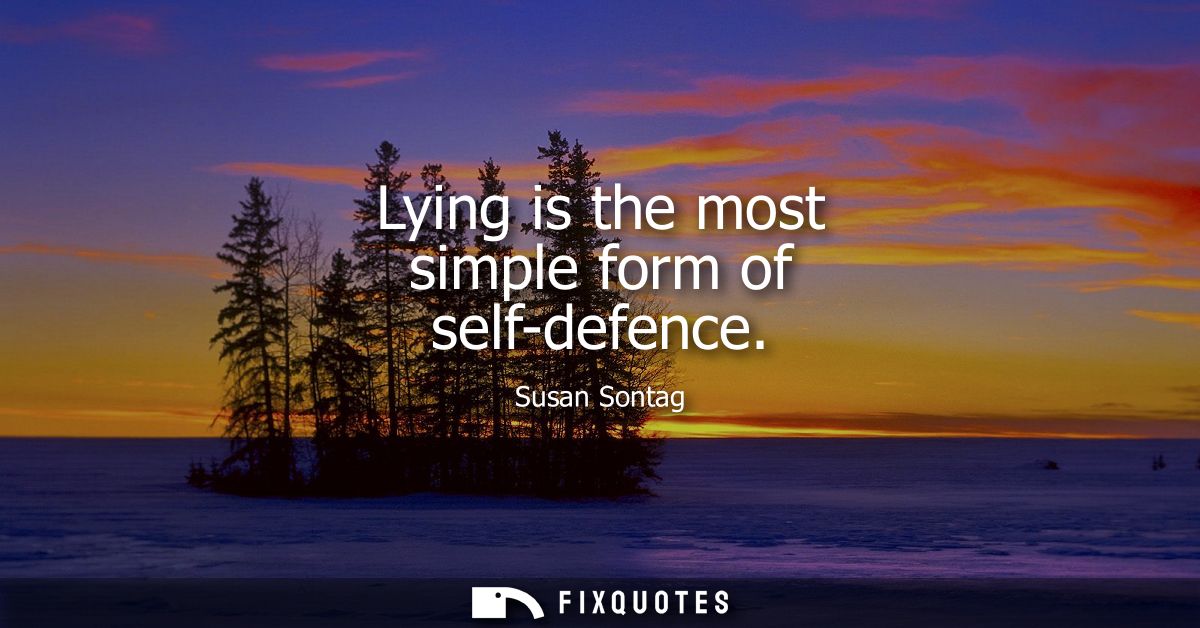
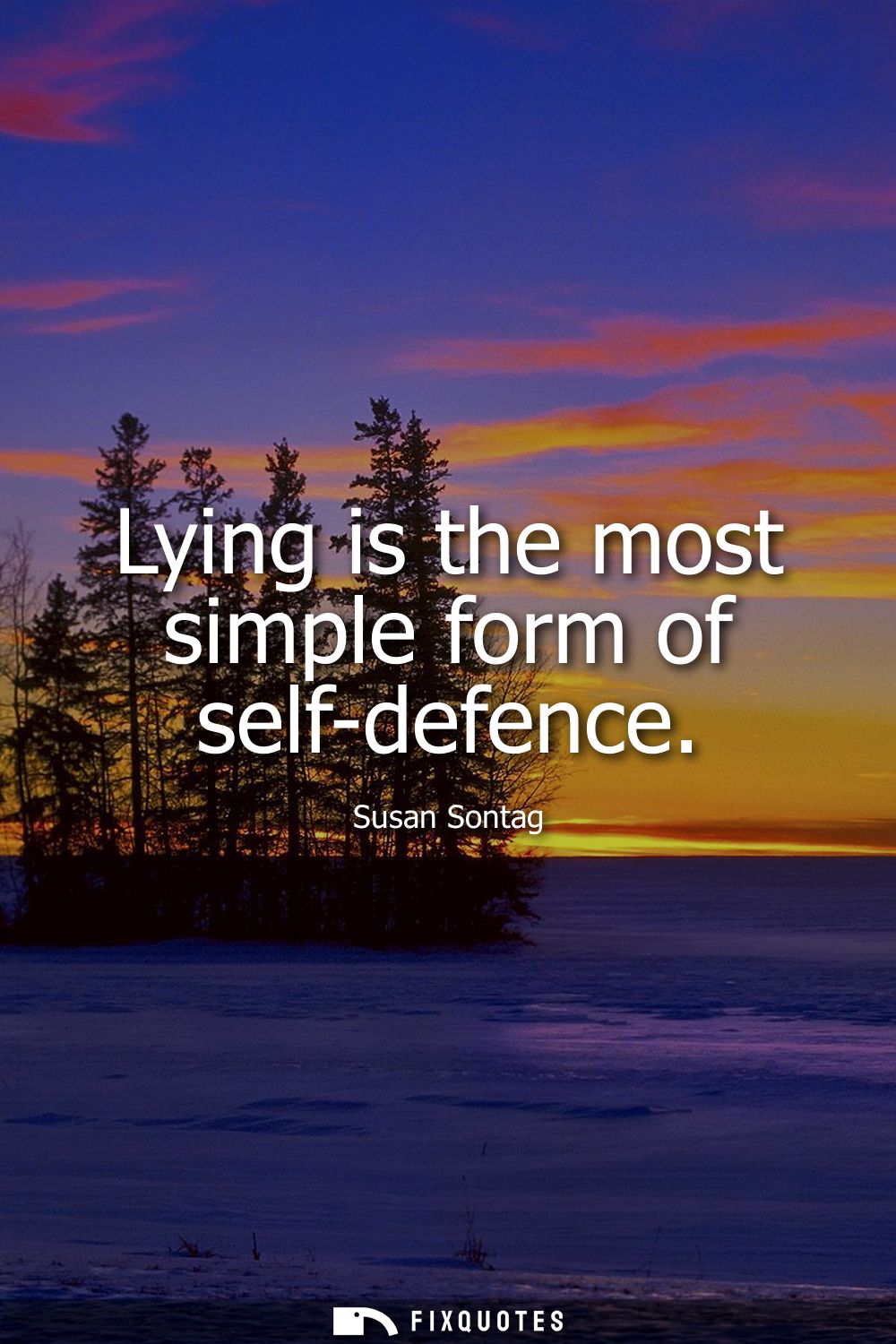
"Lying is the most simple form of self-defence"
About this Quote
Lying, for Sontag, isn’t a naughty habit so much as the body’s reflex when the world turns threatening. The line snaps with her trademark severity: she strips moral melodrama from deception and reframes it as survival technology. “Most simple” is doing quiet work here. She implies that lying sits at the bottom of a hierarchy of defenses, the cheapest move available when you lack power, privacy, or the luxury of nuance. It’s not heroic; it’s efficient.
The subtext is less “people are bad” than “people are cornered.” Sontag spent her career anatomizing how societies police bodies and stories: illness (her writing on cancer and AIDS), war imagery, the ethics of looking, the ways public narratives swallow private reality. In those arenas, truth is rarely neutral. It can be conscripted, demanded, extracted, then weaponized. If confession becomes an expectation and visibility becomes a mandate, lying starts to look like the last remaining boundary you can draw around the self.
There’s also an indictment aimed upward. Calling lying “self-defence” subtly shifts scrutiny onto whatever is doing the attacking: institutions that punish candor, relationships that trade intimacy for control, cultures that reward the right story over the true one. Sontag isn’t absolving the liar; she’s interrogating the conditions that make dishonesty feel safer than speech. The sting is that a society that fetishizes “authenticity” can still be structured so that honesty is a liability. Under that pressure, the simplest defense is also the saddest one: shrinking the self into a manageable fiction.
The subtext is less “people are bad” than “people are cornered.” Sontag spent her career anatomizing how societies police bodies and stories: illness (her writing on cancer and AIDS), war imagery, the ethics of looking, the ways public narratives swallow private reality. In those arenas, truth is rarely neutral. It can be conscripted, demanded, extracted, then weaponized. If confession becomes an expectation and visibility becomes a mandate, lying starts to look like the last remaining boundary you can draw around the self.
There’s also an indictment aimed upward. Calling lying “self-defence” subtly shifts scrutiny onto whatever is doing the attacking: institutions that punish candor, relationships that trade intimacy for control, cultures that reward the right story over the true one. Sontag isn’t absolving the liar; she’s interrogating the conditions that make dishonesty feel safer than speech. The sting is that a society that fetishizes “authenticity” can still be structured so that honesty is a liability. Under that pressure, the simplest defense is also the saddest one: shrinking the self into a manageable fiction.
Quote Details
| Topic | Honesty & Integrity |
|---|---|
| Source | Help us find the source |
| Cite |
Citation Formats
APA Style (7th ed.)
Sontag, Susan. (2026, January 15). Lying is the most simple form of self-defence. FixQuotes. https://fixquotes.com/quotes/lying-is-the-most-simple-form-of-self-defence-156062/
Chicago Style
Sontag, Susan. "Lying is the most simple form of self-defence." FixQuotes. January 15, 2026. https://fixquotes.com/quotes/lying-is-the-most-simple-form-of-self-defence-156062/.
MLA Style (9th ed.)
"Lying is the most simple form of self-defence." FixQuotes, 15 Jan. 2026, https://fixquotes.com/quotes/lying-is-the-most-simple-form-of-self-defence-156062/. Accessed 31 Mar. 2026.
More Quotes by Susan
Add to List