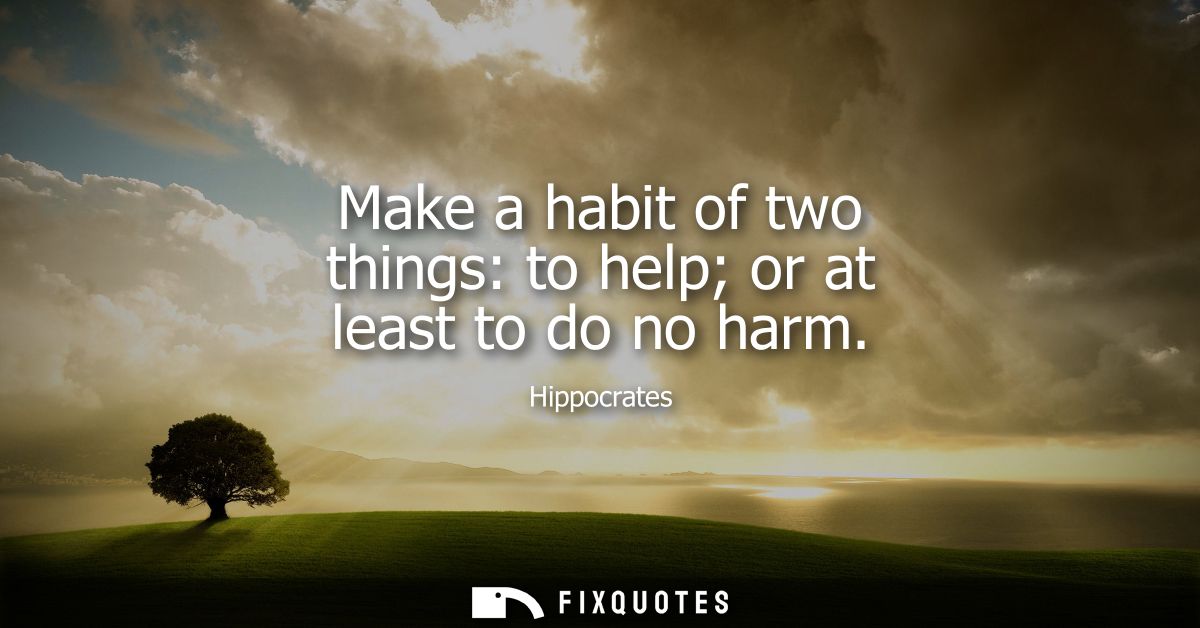
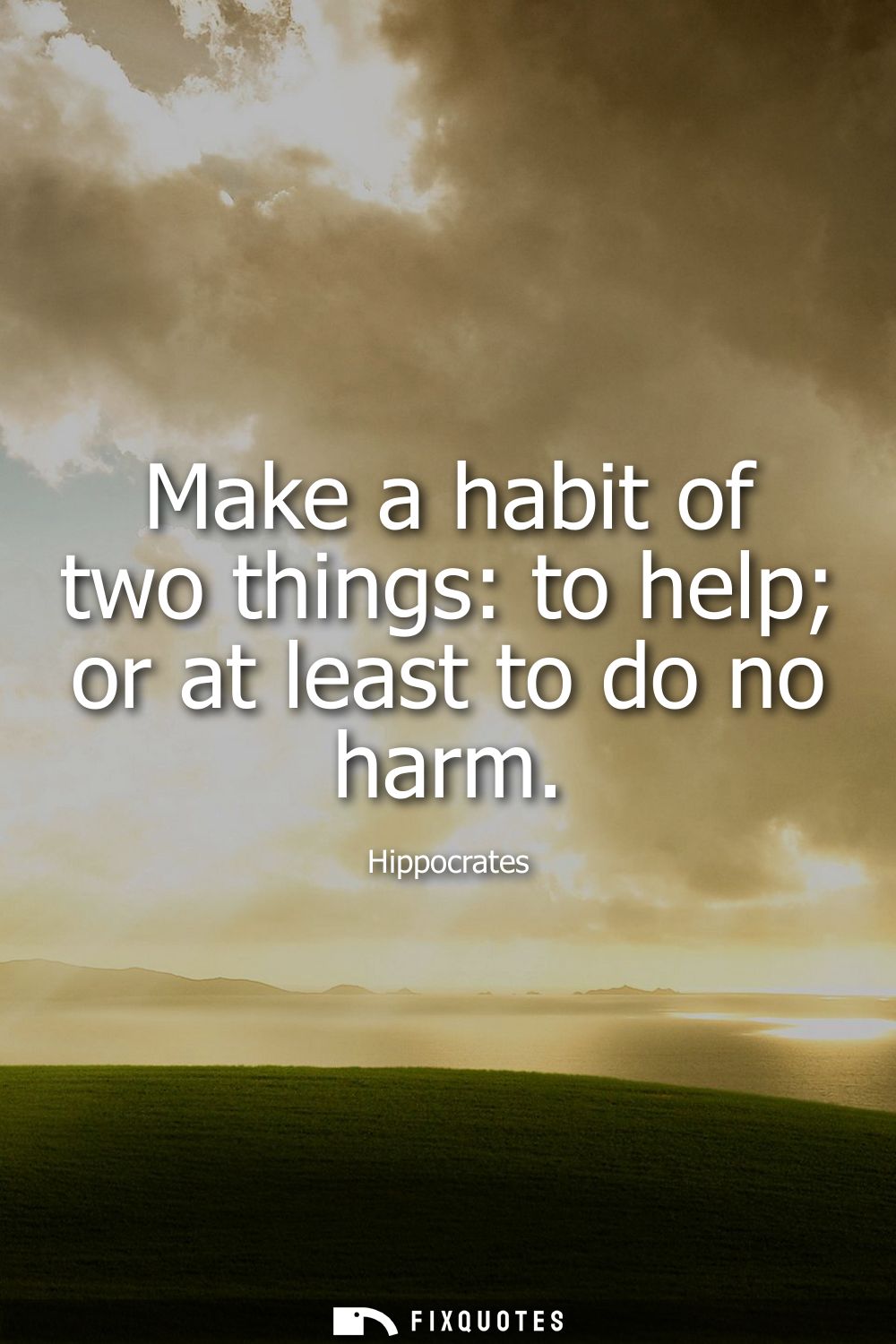
"Make a habit of two things: to help; or at least to do no harm"
About this Quote
A physician’s ethic distilled into a training regimen: not a lofty aspiration, but a habit. Hippocrates frames morality as muscle memory, something practiced until it becomes automatic under pressure. That’s a clinical insight disguised as guidance. In medicine, the hardest moments aren’t philosophical; they’re busy, ambiguous, and consequence-heavy. “Make a habit” concedes human fallibility. You won’t always have time to deliberate your way to virtue, so build defaults that steer you away from catastrophe.
The pairing is sharp: “to help; or at least to do no harm.” The semicolon works like a diagnostic pause, lowering the bar without lowering the stakes. Hippocrates acknowledges that “help” is not always available. Treatments fail, knowledge is incomplete, outcomes are uncertain. So the minimum ethical standard becomes restraint: don’t compound suffering with ego, haste, or experimentation masquerading as care. Subtext: medicine is powerful enough to hurt people even when intentions are good, especially when confidence outruns evidence.
Context matters. Hippocrates is writing at the dawn of Western clinical practice, when healing blended observation, superstition, and social authority. This line pushes against the swagger of the healer-priest. It also creates a professional identity: the good doctor isn’t the miracle worker; it’s the disciplined practitioner who knows the dangers of intervention.
Read now, it lands beyond medicine. It’s a template for power in any field: if you can’t make things better, at least stop making them worse. That’s not modesty. It’s accountability.
The pairing is sharp: “to help; or at least to do no harm.” The semicolon works like a diagnostic pause, lowering the bar without lowering the stakes. Hippocrates acknowledges that “help” is not always available. Treatments fail, knowledge is incomplete, outcomes are uncertain. So the minimum ethical standard becomes restraint: don’t compound suffering with ego, haste, or experimentation masquerading as care. Subtext: medicine is powerful enough to hurt people even when intentions are good, especially when confidence outruns evidence.
Context matters. Hippocrates is writing at the dawn of Western clinical practice, when healing blended observation, superstition, and social authority. This line pushes against the swagger of the healer-priest. It also creates a professional identity: the good doctor isn’t the miracle worker; it’s the disciplined practitioner who knows the dangers of intervention.
Read now, it lands beyond medicine. It’s a template for power in any field: if you can’t make things better, at least stop making them worse. That’s not modesty. It’s accountability.
Quote Details
| Topic | Ethics & Morality |
|---|---|
| Source | Help us find the source |
| Cite |
Citation Formats
APA Style (7th ed.)
Hippocrates. (2026, January 15). Make a habit of two things: to help; or at least to do no harm. FixQuotes. https://fixquotes.com/quotes/make-a-habit-of-two-things-to-help-or-at-least-to-31556/
Chicago Style
Hippocrates. "Make a habit of two things: to help; or at least to do no harm." FixQuotes. January 15, 2026. https://fixquotes.com/quotes/make-a-habit-of-two-things-to-help-or-at-least-to-31556/.
MLA Style (9th ed.)
"Make a habit of two things: to help; or at least to do no harm." FixQuotes, 15 Jan. 2026, https://fixquotes.com/quotes/make-a-habit-of-two-things-to-help-or-at-least-to-31556/. Accessed 20 Mar. 2026.
More Quotes by Hippocrates
Add to List