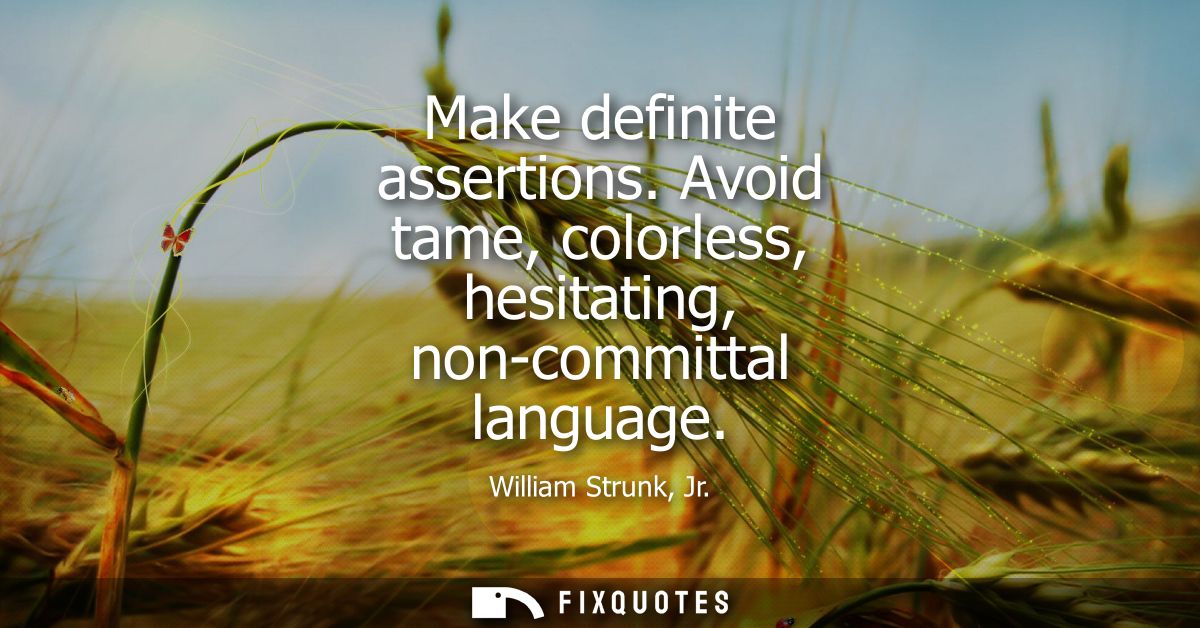
"Make definite assertions. Avoid tame, colorless, hesitating, non-committal language"
About this Quote
The intent is practical - clarity, economy, force - but the subtext is moral. To Strunk, weak prose signals weak thinking, or at least a willingness to let the reader do the heavy lifting. Definite assertions create accountability: if you claim something, you can be challenged, revised, disproved. Hedging becomes a way to look careful while dodging responsibility.
Context sharpens the edge. Strunk wrote in an era that prized plain style and institutional authority: newspapers consolidating, universities professionalizing, bureaucracy expanding. “Non-committal language” was becoming the house dialect of organizations - the memo, the committee report, the polite academic shrug. His admonition is a defense of the sentence as a unit of decision-making, not just description.
Of course, the irony is that modern writers often hedge for good reasons: uncertainty is real, and overstatement is its own vice. Strunk’s line endures because it’s less a ban on nuance than a demand for intention. If you’re going to qualify, do it with purpose - not because you’re afraid to be wrong.
Quote Details
| Topic | Writing |
|---|---|
| Source | William Strunk, Jr., The Elements of Style (original pamphlet, 1918), ‘‘Elementary Principles of Composition’’ — rule: “Make definite assertions. Avoid tame, colorless, hesitating, non-committal language.” |
| Cite |
Citation Formats
APA Style (7th ed.)
Jr., William Strunk,. (2026, January 16). Make definite assertions. Avoid tame, colorless, hesitating, non-committal language. FixQuotes. https://fixquotes.com/quotes/make-definite-assertions-avoid-tame-colorless-100258/
Chicago Style
Jr., William Strunk,. "Make definite assertions. Avoid tame, colorless, hesitating, non-committal language." FixQuotes. January 16, 2026. https://fixquotes.com/quotes/make-definite-assertions-avoid-tame-colorless-100258/.
MLA Style (9th ed.)
"Make definite assertions. Avoid tame, colorless, hesitating, non-committal language." FixQuotes, 16 Jan. 2026, https://fixquotes.com/quotes/make-definite-assertions-avoid-tame-colorless-100258/. Accessed 12 Mar. 2026.