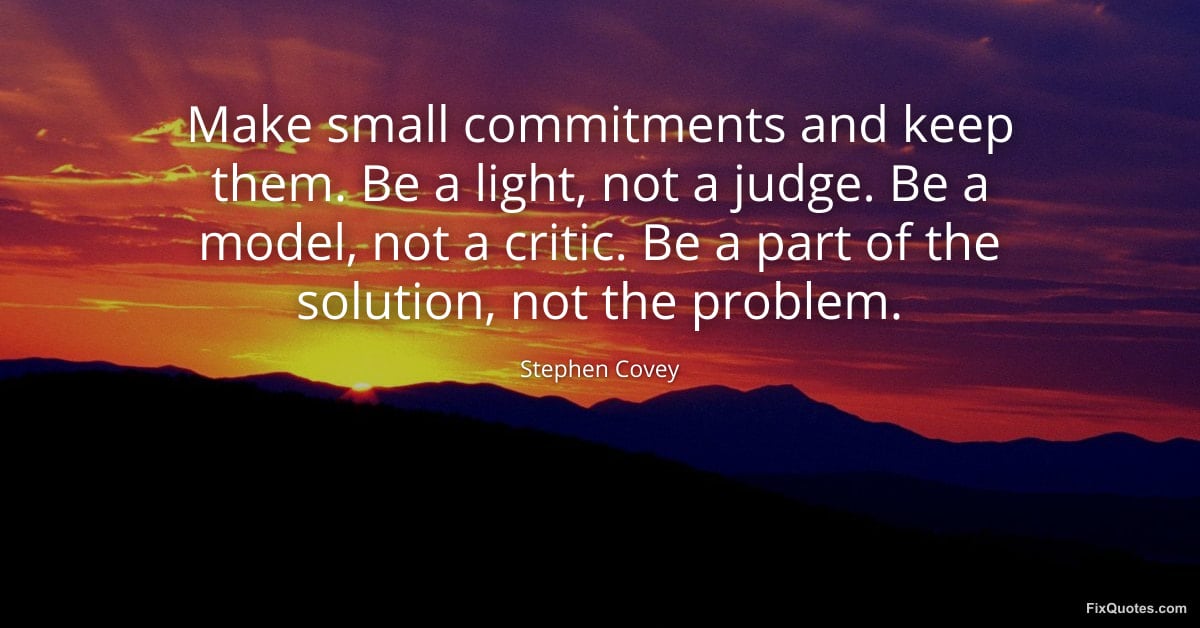
"Make small commitments and keep them. Be a light, not a judge. Be a model, not a critic. Be a part of the solution, not the problem"
About this Quote
Then he pivots from behavior to posture: “Be a light, not a judge.” That metaphor recasts leadership as illumination rather than evaluation. The subtext is an indictment of the default corporate reflex: critique-as-control. Covey is arguing that judgment might feel like rigor, but it often functions as ego protection and social dominance. A “light” makes others more capable; a “judge” makes them more cautious.
“Be a model, not a critic” tightens the screw. Modeling is costly because it requires consistency when nobody is watching; criticism is cheap because it can be performed without competence. Covey isn’t anti-standards; he’s anti-performative standards. He’s pushing leaders (and colleagues) to convert opinions into examples.
Finally, “Be a part of the solution, not the problem” is the motivational poster line people roll their eyes at, yet it lands because it frames accountability as participation. You don’t get to opt out with cynicism. In the late-20th-century business culture Covey spoke to - status meetings, compliance theater, blame spirals - this reads like a quiet rebuke: stop auditioning for moral superiority and start being useful.
Quote Details
| Topic | Self-Improvement |
|---|---|
| Source | Help us find the source |
| Cite |
Citation Formats
APA Style (7th ed.)
Covey, Stephen. (2026, January 11). Make small commitments and keep them. Be a light, not a judge. Be a model, not a critic. Be a part of the solution, not the problem. FixQuotes. https://fixquotes.com/quotes/make-small-commitments-and-keep-them-be-a-light-183958/
Chicago Style
Covey, Stephen. "Make small commitments and keep them. Be a light, not a judge. Be a model, not a critic. Be a part of the solution, not the problem." FixQuotes. January 11, 2026. https://fixquotes.com/quotes/make-small-commitments-and-keep-them-be-a-light-183958/.
MLA Style (9th ed.)
"Make small commitments and keep them. Be a light, not a judge. Be a model, not a critic. Be a part of the solution, not the problem." FixQuotes, 11 Jan. 2026, https://fixquotes.com/quotes/make-small-commitments-and-keep-them-be-a-light-183958/. Accessed 12 Feb. 2026.