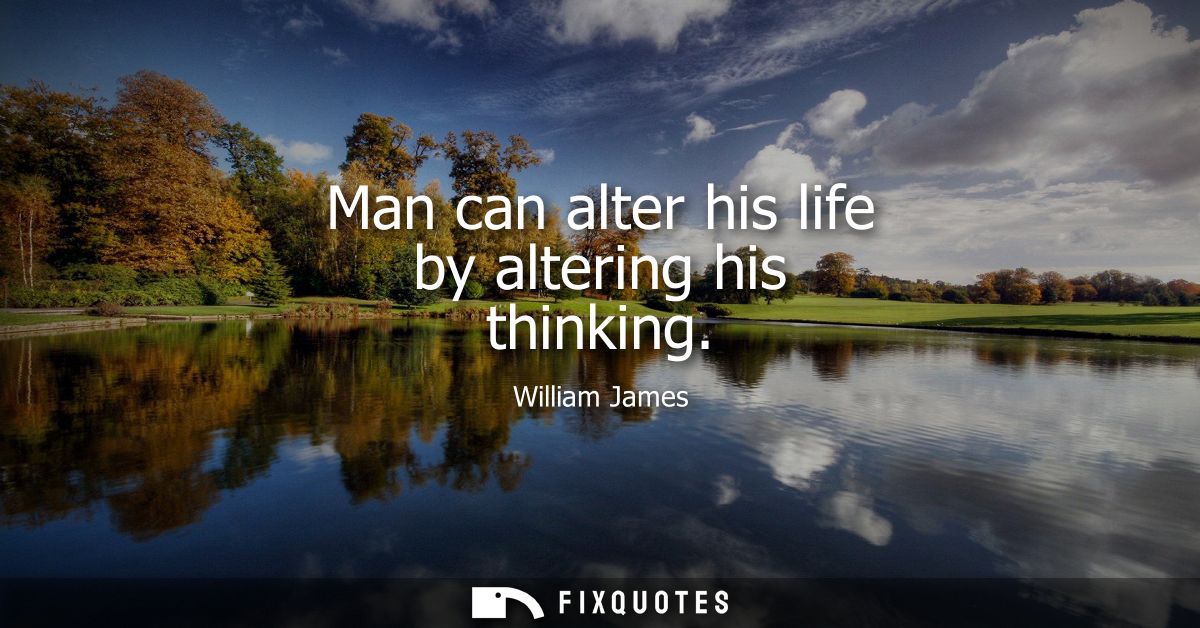
"Man can alter his life by altering his thinking"
About this Quote
A little self-help grenade disguised as philosophy, William James's line lands because it refuses both mysticism and fatalism. "Man can alter his life by altering his thinking" sounds like a pep talk, but its real target is the 19th-century obsession with fixed character: temperament as destiny, social role as script, biology as sentence. James, the father of American pragmatism, is arguing that ideas aren't decorative. They're instruments. Change the instrument, you change what your life can do.
The word "alter" matters: not "escape", not "transcend", but modify. James isn't selling a magic trick where positive thoughts conjure a better world. He's describing a feedback loop between attention, interpretation, and action. If you reframe what counts as a threat, a possibility, a failure, you don't just feel different; you behave differently, which changes what happens next. Thinking becomes a lever, not a mirror.
Subtextually, it's also a moral claim. If inner life has causal power, then agency is not an illusion you indulge to feel virtuous. It's a practice you cultivate. That aligns with James's interest in habit, will, and religious experience: belief as something you can choose into, then live into, until it becomes real in its consequences.
The line works because it courts optimism while keeping its hands clean of sentimentality. It offers responsibility without promising control. You can't rewrite the world, but you can rewrite the mind that meets it - and that rewrite is often where history, politics, and personal survival quietly begin.
The word "alter" matters: not "escape", not "transcend", but modify. James isn't selling a magic trick where positive thoughts conjure a better world. He's describing a feedback loop between attention, interpretation, and action. If you reframe what counts as a threat, a possibility, a failure, you don't just feel different; you behave differently, which changes what happens next. Thinking becomes a lever, not a mirror.
Subtextually, it's also a moral claim. If inner life has causal power, then agency is not an illusion you indulge to feel virtuous. It's a practice you cultivate. That aligns with James's interest in habit, will, and religious experience: belief as something you can choose into, then live into, until it becomes real in its consequences.
The line works because it courts optimism while keeping its hands clean of sentimentality. It offers responsibility without promising control. You can't rewrite the world, but you can rewrite the mind that meets it - and that rewrite is often where history, politics, and personal survival quietly begin.
Quote Details
| Topic | Self-Improvement |
|---|---|
| Source | Help us find the source |
| Cite |
Citation Formats
APA Style (7th ed.)
James, William. (2026, January 15). Man can alter his life by altering his thinking. FixQuotes. https://fixquotes.com/quotes/man-can-alter-his-life-by-altering-his-thinking-25095/
Chicago Style
James, William. "Man can alter his life by altering his thinking." FixQuotes. January 15, 2026. https://fixquotes.com/quotes/man-can-alter-his-life-by-altering-his-thinking-25095/.
MLA Style (9th ed.)
"Man can alter his life by altering his thinking." FixQuotes, 15 Jan. 2026, https://fixquotes.com/quotes/man-can-alter-his-life-by-altering-his-thinking-25095/. Accessed 12 Feb. 2026.
More Quotes by William
Add to List