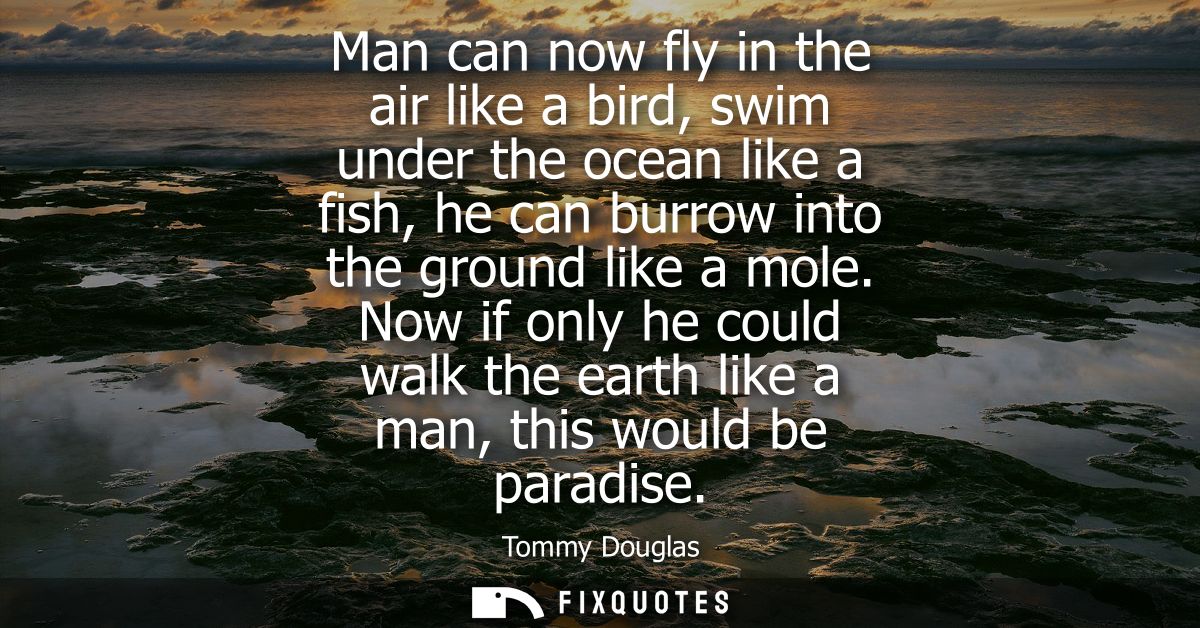
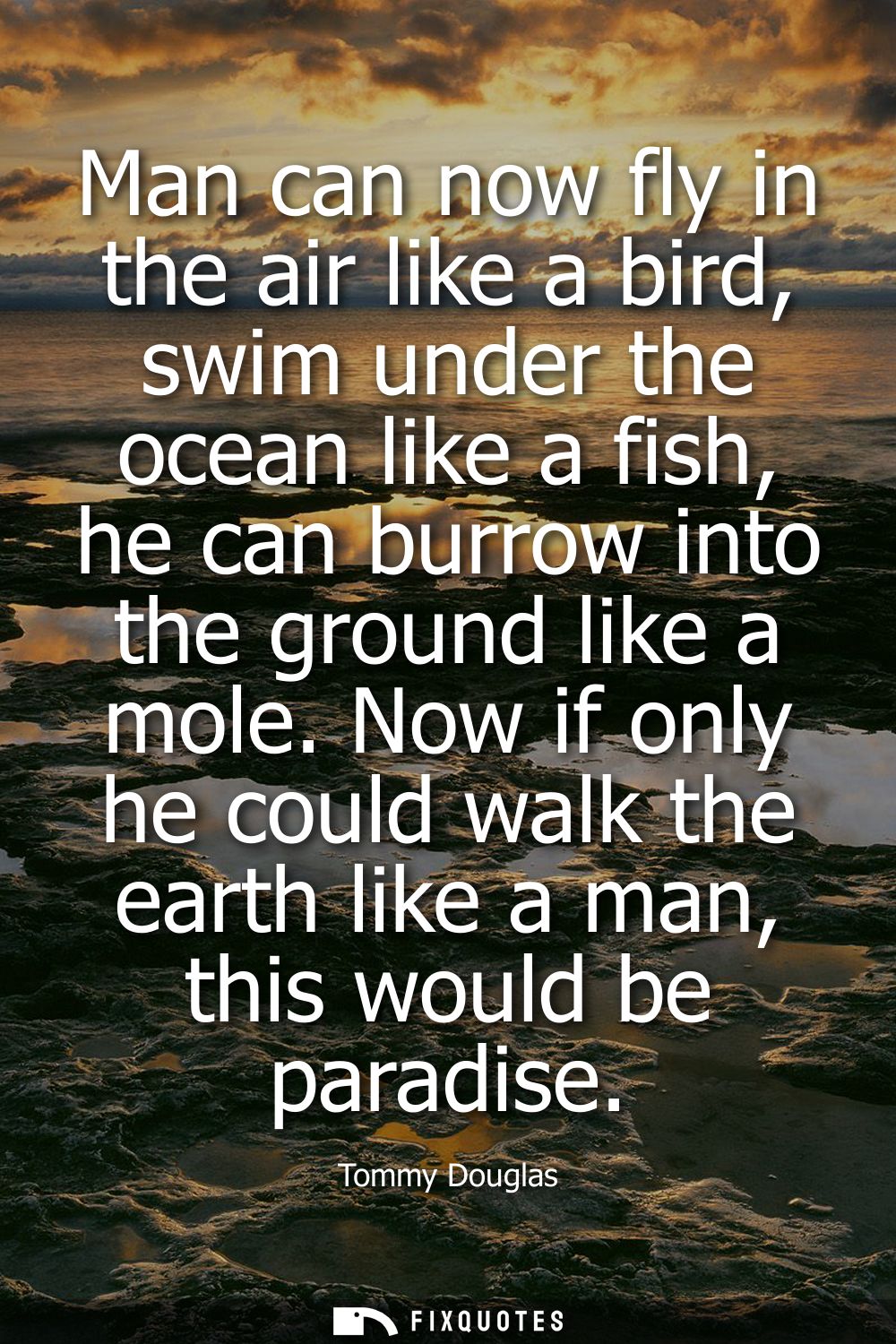
"Man can now fly in the air like a bird, swim under the ocean like a fish, he can burrow into the ground like a mole. Now if only he could walk the earth like a man, this would be paradise"
About this Quote
The subtext is theological without being pious. “Paradise” isn’t a promise of afterlife comfort; it’s a diagnosis of what’s missing in public life: dignity, solidarity, restraint, justice. As a clergyman who also moved in the thick of social reform politics, Douglas is aiming at a 20th-century world intoxicated by progress - aviation, submarines, industrial expansion - while tolerating poverty, war, racism, and the everyday humiliations of class. The animals are telling: birds, fish, moles act according to their nature; humans, supposedly the moral species, keep failing at theirs.
The sting is in the conditional: “if only.” It frames ethical maturity as the last, most stubborn frontier. Douglas isn’t anti-science; he’s anti-self-congratulation. He’s warning that a society can be technologically miraculous and spiritually barbaric at the same time - and that “paradise” is less a miracle than a decision.
Quote Details
| Topic | Ethics & Morality |
|---|---|
| Source | Help us find the source |
| Cite |
Citation Formats
APA Style (7th ed.)
Douglas, Tommy. (2026, January 16). Man can now fly in the air like a bird, swim under the ocean like a fish, he can burrow into the ground like a mole. Now if only he could walk the earth like a man, this would be paradise. FixQuotes. https://fixquotes.com/quotes/man-can-now-fly-in-the-air-like-a-bird-swim-under-107836/
Chicago Style
Douglas, Tommy. "Man can now fly in the air like a bird, swim under the ocean like a fish, he can burrow into the ground like a mole. Now if only he could walk the earth like a man, this would be paradise." FixQuotes. January 16, 2026. https://fixquotes.com/quotes/man-can-now-fly-in-the-air-like-a-bird-swim-under-107836/.
MLA Style (9th ed.)
"Man can now fly in the air like a bird, swim under the ocean like a fish, he can burrow into the ground like a mole. Now if only he could walk the earth like a man, this would be paradise." FixQuotes, 16 Jan. 2026, https://fixquotes.com/quotes/man-can-now-fly-in-the-air-like-a-bird-swim-under-107836/. Accessed 3 Apr. 2026.