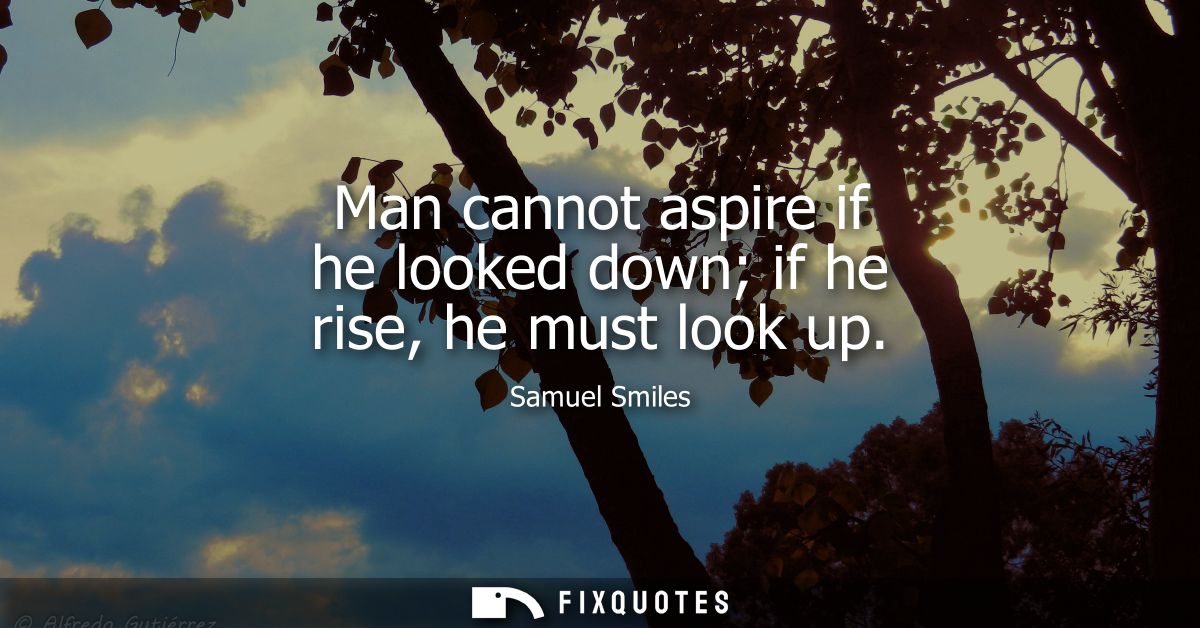
"Man cannot aspire if he looked down; if he rise, he must look up"
About this Quote
Ambition, Smiles insists, is a matter of posture before its a matter of policy. The line turns aspiration into a physical act: looking down pins you to what is already there; looking up creates a horizon. That simple spatial metaphor does a lot of ideological work. It flatters the reader with agency (your angle of vision is your choice) while quietly scolding anyone who stays fixated on their lot as complicit in their own stagnation.
Smiles wrote in the high-Victorian moment when Britains industrial economy was minting new fortunes and new anxieties, and he became the houses best-selling advocate for self-help: discipline, thrift, moral seriousness, upward mobility as personal project. The quote fits that program perfectly. Its not about dreaming; its about training attention. Look up, and you will rise. Keep your eyes on the ground, and you will stay among the dust of complaint, envy, and excuse.
The subtext is bracing and, depending on your politics, borderline cruel. By locating aspiration in the individual gaze, Smiles sidelines structural constraints: class, education, labor conditions, illness, bad luck. The promise is empowering precisely because it is reductive. It offers a clean, portable rule that converts messy social reality into a private ethic.
Rhetorically, the sentence works because it is built like a maxim: balanced clauses, conditional logic, no ornament. It reads like common sense, which is how moral ideology spreads best. The uplift comes pre-packaged with blame.
Smiles wrote in the high-Victorian moment when Britains industrial economy was minting new fortunes and new anxieties, and he became the houses best-selling advocate for self-help: discipline, thrift, moral seriousness, upward mobility as personal project. The quote fits that program perfectly. Its not about dreaming; its about training attention. Look up, and you will rise. Keep your eyes on the ground, and you will stay among the dust of complaint, envy, and excuse.
The subtext is bracing and, depending on your politics, borderline cruel. By locating aspiration in the individual gaze, Smiles sidelines structural constraints: class, education, labor conditions, illness, bad luck. The promise is empowering precisely because it is reductive. It offers a clean, portable rule that converts messy social reality into a private ethic.
Rhetorically, the sentence works because it is built like a maxim: balanced clauses, conditional logic, no ornament. It reads like common sense, which is how moral ideology spreads best. The uplift comes pre-packaged with blame.
Quote Details
| Topic | Motivational |
|---|
More Quotes by Samuel
Add to List