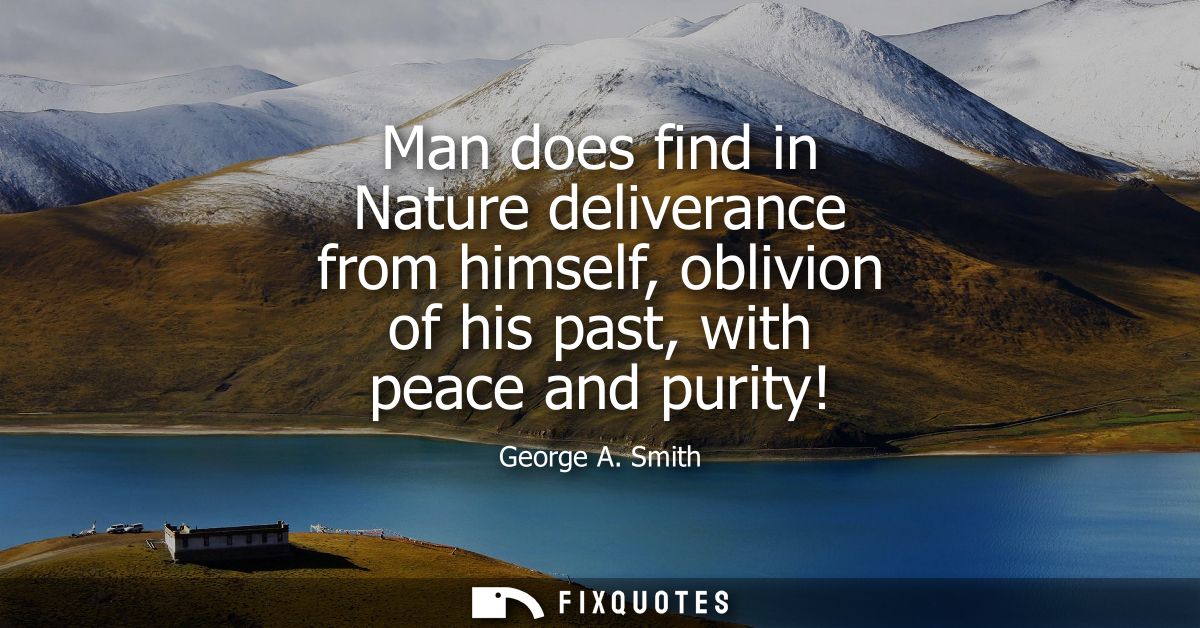
"Man does find in Nature deliverance from himself, oblivion of his past, with peace and purity!"
About this Quote
The sentence works because it stacks escapes in escalating intimacy. “Deliverance” implies bondage; “oblivion” implies the specific chain is guilt; “peace and purity” land as the emotional and moral afterglow. Nature becomes a kind of externalized grace, an unargued goodness that doesn’t require you to narrate your failures. The subtext is almost therapeutic before therapy had cultural status: step outside the cramped loop of self-scrutiny and let the nonhuman world interrupt you.
There’s also a quiet negotiation with nineteenth-century Romanticism. Emerson and the Transcendentalists were turning Nature into a theology; Smith, as a clergyman, borrows the mood while keeping the moral telos. Nature doesn’t replace God, but it functions as God’s understudy: a place where the mind can be cleaned without being interrogated. That blend of consolation and correction is the line’s real intent: to remind readers that salvation isn’t only a doctrine to assent to, it’s a felt release from the tyranny of one’s own inner noise.
Quote Details
| Topic | Nature |
|---|---|
| Source | Help us find the source |
| Cite |
Citation Formats
APA Style (7th ed.)
Smith, George A. (2026, January 15). Man does find in Nature deliverance from himself, oblivion of his past, with peace and purity! FixQuotes. https://fixquotes.com/quotes/man-does-find-in-nature-deliverance-from-himself-149356/
Chicago Style
Smith, George A. "Man does find in Nature deliverance from himself, oblivion of his past, with peace and purity!" FixQuotes. January 15, 2026. https://fixquotes.com/quotes/man-does-find-in-nature-deliverance-from-himself-149356/.
MLA Style (9th ed.)
"Man does find in Nature deliverance from himself, oblivion of his past, with peace and purity!" FixQuotes, 15 Jan. 2026, https://fixquotes.com/quotes/man-does-find-in-nature-deliverance-from-himself-149356/. Accessed 28 Mar. 2026.