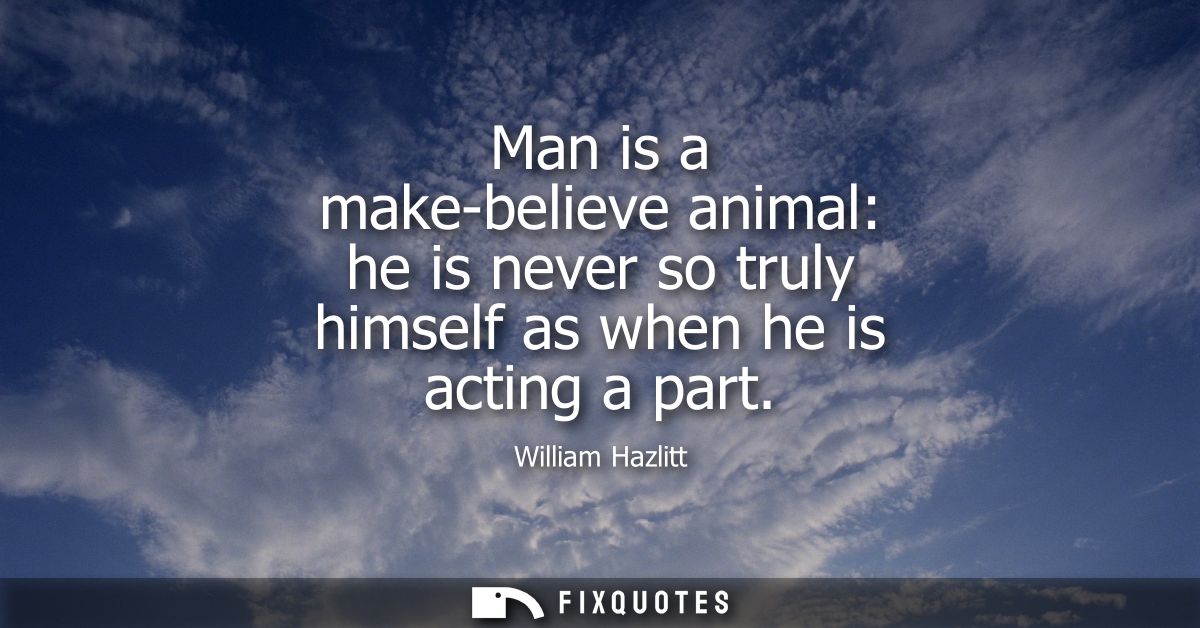
"Man is a make-believe animal: he is never so truly himself as when he is acting a part"
About this Quote
The phrasing is doing quiet work. “Never so truly himself” gives “truly” the shock of an adverb in the wrong place. Truth is supposed to live in privacy, in unguarded candor, in the offstage. Hazlitt drags it into the footlights. “Acting a part” is broad enough to mean theater, manners, politics, flirtation, even philosophical posture. That elasticity matters: he’s pointing at a culture where identity is assembled in public, through voice and gesture, where sincerity can be another costume - and where the costume can reveal more than it hides.
Context sharpens the barb. As a Romantic-era critic, Hazlitt watched a Britain obsessed with oratory, celebrity actors, and a rapidly expanding public sphere. His critical mind distrusted the pieties of “natural” virtue and “authentic” feeling; he’d seen how easily people mythologize themselves. The subtext isn’t that everyone is fake. It’s harsher and more modern: the self is a social art form, and the most revealing moments come when we commit fully to the mask we’ve chosen.
Quote Details
| Topic | Wisdom |
|---|---|
| Source | Verified source: Notes of a Journey Through France and Italy (William Hazlitt, 1826)
Evidence: Popery is said to be a make-believe religion: man is a make-believe animal, he is never so truly himself as when he is acting a part; he is ever at war with himself, his theory with his practice, what he would be (and therefore pretends to be) with what he is; ... (Chapter XVI (book ed. 1826); p. 246 (one 1826 printing) / p. 244 (another scan)). This wording appears in Hazlitt’s own text in Notes of a Journey through France and Italy, in the passage discussing “Popery” as “a make-believe religion.” Project Gutenberg reproduces the text from the 1903 Dent collected works volume, which includes the work and notes that it was originally published in book form in 1826 (and that the material had appeared earlier in the Morning Chronicle in 1824–1825). The quote is located in Chapter XVI in the standard chapter-based citation; Google Books scans of 1826 editions place it around pp. 244–246 depending on the specific printing/scan. Other candidates (1) If Ignorance Is Bliss, Why Aren't There More Happy People? (John Lloyd, John Mitchinson, 2009) compilation94.4% ... Man is a make - believe animal - he is never so truly himself as when he is acting a part . WILLIAM HAZLITT The q... |
| Cite |
Citation Formats
APA Style (7th ed.)
Hazlitt, William. (2026, February 8). Man is a make-believe animal: he is never so truly himself as when he is acting a part. FixQuotes. https://fixquotes.com/quotes/man-is-a-make-believe-animal-he-is-never-so-truly-151652/
Chicago Style
Hazlitt, William. "Man is a make-believe animal: he is never so truly himself as when he is acting a part." FixQuotes. February 8, 2026. https://fixquotes.com/quotes/man-is-a-make-believe-animal-he-is-never-so-truly-151652/.
MLA Style (9th ed.)
"Man is a make-believe animal: he is never so truly himself as when he is acting a part." FixQuotes, 8 Feb. 2026, https://fixquotes.com/quotes/man-is-a-make-believe-animal-he-is-never-so-truly-151652/. Accessed 14 Mar. 2026.