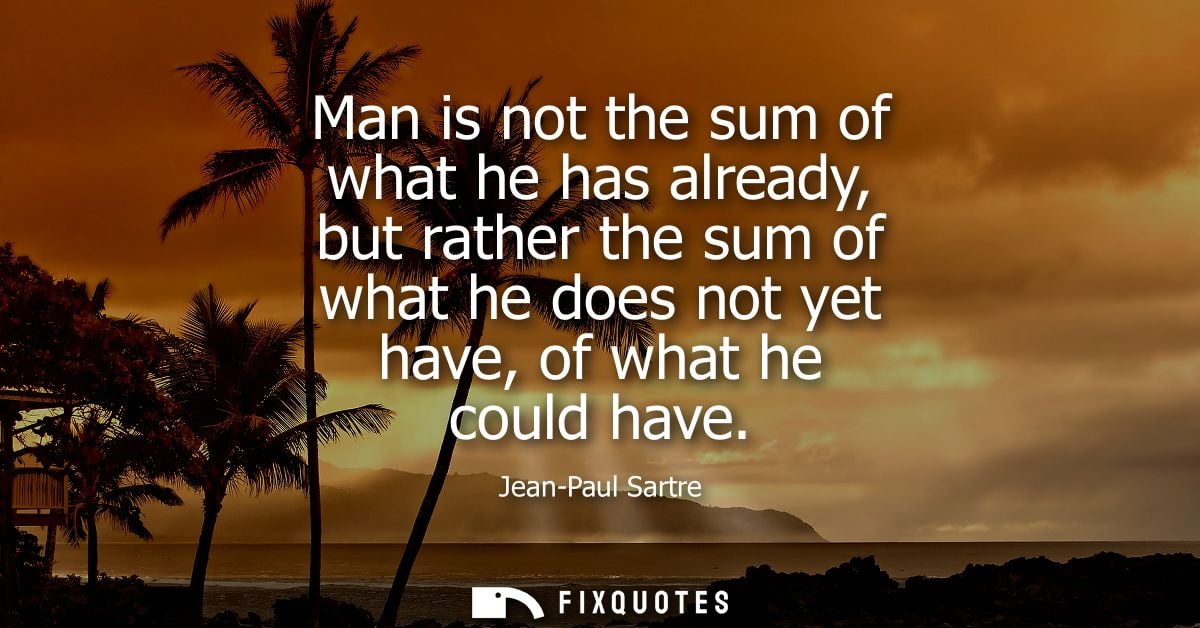
"Man is not the sum of what he has already, but rather the sum of what he does not yet have, of what he could have"
About this Quote
The intent is polemical as much as philosophical. Sartre is taking aim at every system that treats human beings as fixed objects: bourgeois respectability, psychological determinism, even the lazy fatalism of “that’s just who I am.” In his framework, you’re condemned to freedom: you can’t hide behind your résumé, your upbringing, or your label. Even refusing to choose is a choice, and it still counts.
The subtext is more anxious than inspirational. If you are “the sum” of unrealized possibilities, then you are also the sum of your evasions. Potential becomes an ethical demand. Your life is measured not only by what you did, but by what you could have done and didn’t - the careers not pursued, the apologies not made, the solidarities not shown.
Context matters: postwar France, rubble in the streets and compromised consciences in the room. Sartre’s existentialism isn’t self-help; it’s a moral reckoning after Occupation, when excuses were plentiful and responsibility was the only scarce resource. The line works because it offers no refuge: it flatters you with possibility, then indicts you with it.
Quote Details
| Topic | Wisdom |
|---|---|
| Source | Unverified source: Situations I (Jean-Paul Sartre, 1947)
Evidence: L'homme n'est point la somme de ce qu'il a, mais la totalité de ce qu'il n'a pas encore, de ce qu'il pourrait avoir. (Essay: "La temporalité chez Faulkner" (originally dated "Juillet 1939"), page 74 in the consulted text). This line appears in Sartre’s essay “La temporalité chez Faulkner,” includ... Other candidates (1) Wisdom for the Soul (Larry Chang, 2006) compilation96.9% ... Man is not the sum of what he has already , but rather the sum of what he does not yet have , of what he could ha... |
| Cite |
Citation Formats
APA Style (7th ed.)
Sartre, Jean-Paul. (2026, February 9). Man is not the sum of what he has already, but rather the sum of what he does not yet have, of what he could have. FixQuotes. https://fixquotes.com/quotes/man-is-not-the-sum-of-what-he-has-already-but-7611/
Chicago Style
Sartre, Jean-Paul. "Man is not the sum of what he has already, but rather the sum of what he does not yet have, of what he could have." FixQuotes. February 9, 2026. https://fixquotes.com/quotes/man-is-not-the-sum-of-what-he-has-already-but-7611/.
MLA Style (9th ed.)
"Man is not the sum of what he has already, but rather the sum of what he does not yet have, of what he could have." FixQuotes, 9 Feb. 2026, https://fixquotes.com/quotes/man-is-not-the-sum-of-what-he-has-already-but-7611/. Accessed 12 Feb. 2026.