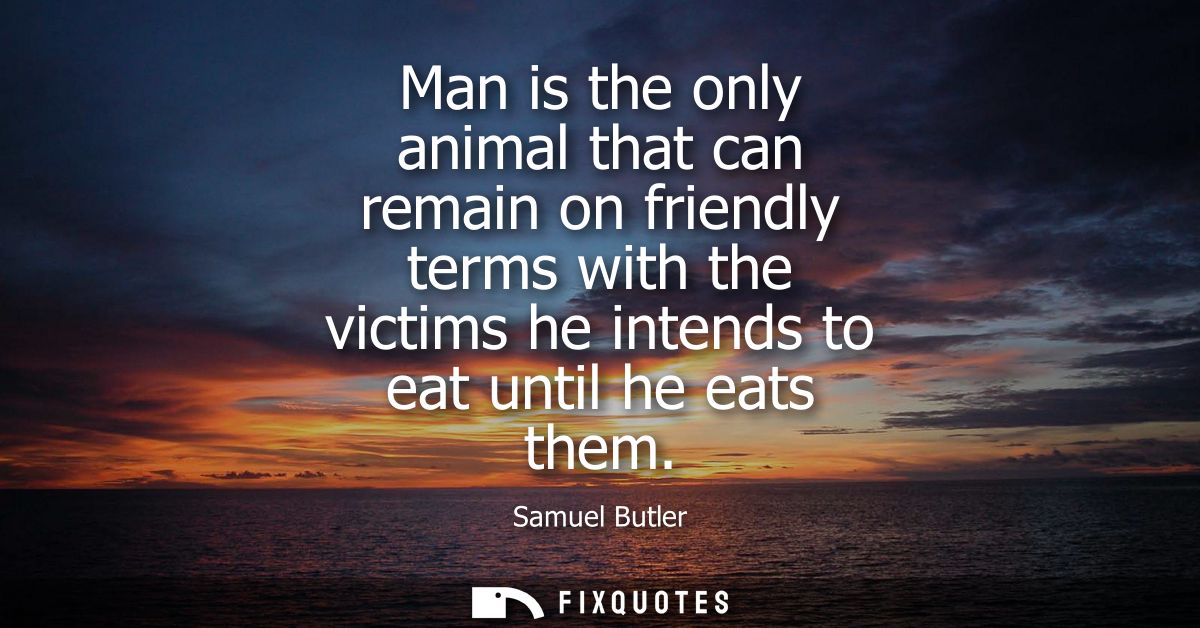
"Man is the only animal that can remain on friendly terms with the victims he intends to eat until he eats them"
About this Quote
The intent isn’t simply to scold meat-eaters (though vegetarian critique hovers nearby in Victorian Britain, where industrial slaughter and imperial extraction were increasingly out of sight). It’s to diagnose a broader human talent for moral compartmentalization. We can name the lamb, praise its sweetness, pet it, and still treat its death as scheduled. That ability to keep “friendly terms” until the final moment is a form of narrative control: we manage the victim’s comfort, and more importantly, our own self-image.
Butler’s subtext bites at the social order that taught gentility as a kind of camouflage. Polite society prides itself on sympathy, yet it routinely pairs empathy with entitlement: the colonizer who “civilizes,” the employer who calls workers “like family,” the respectable diner who refuses to picture the killing. The line endures because it’s not about hunger; it’s about the human knack for turning domination into something that feels like decency right up to the point it can’t.
Quote Details
| Topic | Witty One-Liners |
|---|---|
| Source | Verified source: The Note-Books of Samuel Butler (Samuel Butler, 1912)
Evidence: Man is the only animal that can remain on friendly terms with the victims he intends to eat until he eats them. (Chapter VI, "Mind and Matter" (book page begins at p. 74; exact page for the note not verified in the web text)). Primary-text appearance located in the 1912 printed volume edited/arranged by Henry Festing Jones and published by A. C. Fifield. In the book it appears as a short note under the heading "Assimilation and Persecution" within Chapter VI ("Mind and Matter"). The Project Gutenberg transcription is explicitly taken from the 1912 A. C. Fifield edition. This verifies an early print publication, but NOT necessarily the first time Butler wrote/said it (the editor states the underlying notebooks themselves were private and the printed book does not provide verifiable notebook-location references for each note). Other candidates (1) Animal Ethics in the Age of Humans (Bernice Bovenkerk, Jozef Keulartz, 2016) compilation96.6% ... Samuel Butler in the nineteenth century made a slightly different but equally admonishing distinction ... Man is ... |
| Cite |
Citation Formats
APA Style (7th ed.)
Butler, Samuel. (2026, February 28). Man is the only animal that can remain on friendly terms with the victims he intends to eat until he eats them. FixQuotes. https://fixquotes.com/quotes/man-is-the-only-animal-that-can-remain-on-18146/
Chicago Style
Butler, Samuel. "Man is the only animal that can remain on friendly terms with the victims he intends to eat until he eats them." FixQuotes. February 28, 2026. https://fixquotes.com/quotes/man-is-the-only-animal-that-can-remain-on-18146/.
MLA Style (9th ed.)
"Man is the only animal that can remain on friendly terms with the victims he intends to eat until he eats them." FixQuotes, 28 Feb. 2026, https://fixquotes.com/quotes/man-is-the-only-animal-that-can-remain-on-18146/. Accessed 7 Mar. 2026.