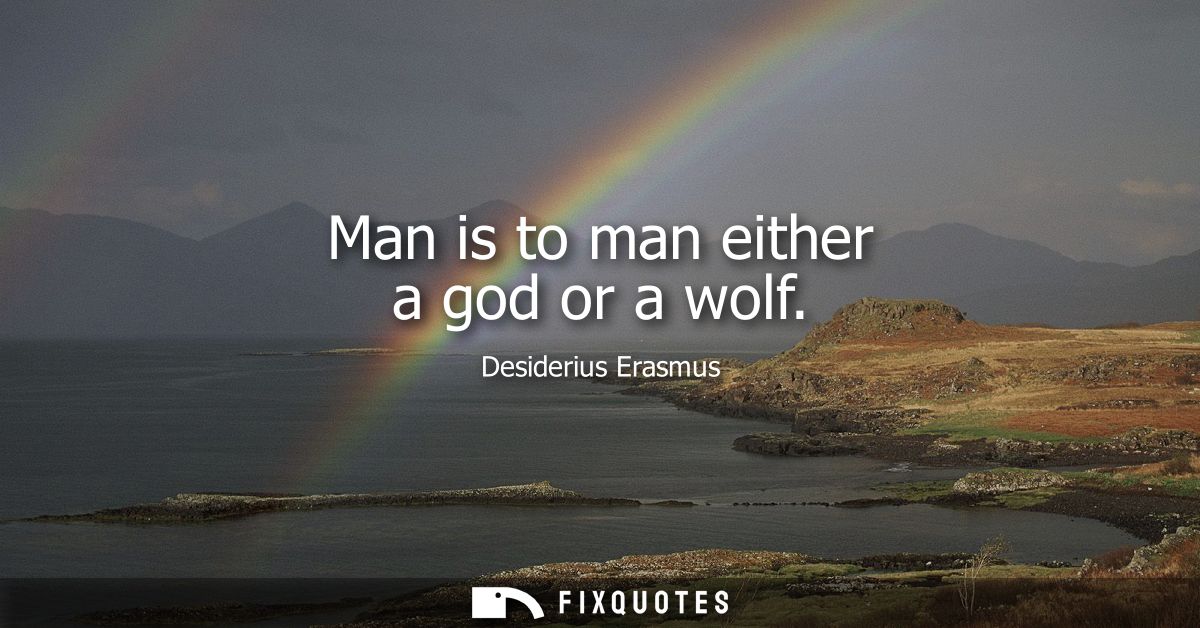
"Man is to man either a god or a wolf"
About this Quote
A neat piece of Renaissance razoring: Erasmus takes the pious optimism of Christian humanism and jams a blade into it. "Man is to man either a god or a wolf" refuses the comfortable middle. In four words of contrast, it stages a moral trial: we are capable of reverence-level care and predation-level cruelty, and which one shows up depends less on lofty doctrine than on the everyday conditions that let conscience thrive or rot.
The line works because "god" and "wolf" aren’t just opposites; they’re social roles. To be a god to another person is to act with protection, generosity, even a kind of creative power - the ability to lift someone into safety, dignity, education. To be a wolf is to treat the other as prey, to justify appetite as necessity. Erasmus is writing in a Europe where religious reform is cracking the old certainties, where institutions claim holiness while practicing domination. The subtext is aimed upward as much as outward: if supposedly Christian societies keep behaving like wolves, perhaps the problem isn’t human nature alone but the systems and leaders that sanctify violence.
It’s also a rebuttal to easy cynicism. Erasmus doesn’t say man is a wolf; he says either/or. That conditional structure is the point: human beings are not doomed, but we are not innocent. In an era flirting with absolutism and sectarian bloodletting, he frames ethics as a choice with consequences, not a trait you’re born with or a slogan you inherit.
The line works because "god" and "wolf" aren’t just opposites; they’re social roles. To be a god to another person is to act with protection, generosity, even a kind of creative power - the ability to lift someone into safety, dignity, education. To be a wolf is to treat the other as prey, to justify appetite as necessity. Erasmus is writing in a Europe where religious reform is cracking the old certainties, where institutions claim holiness while practicing domination. The subtext is aimed upward as much as outward: if supposedly Christian societies keep behaving like wolves, perhaps the problem isn’t human nature alone but the systems and leaders that sanctify violence.
It’s also a rebuttal to easy cynicism. Erasmus doesn’t say man is a wolf; he says either/or. That conditional structure is the point: human beings are not doomed, but we are not innocent. In an era flirting with absolutism and sectarian bloodletting, he frames ethics as a choice with consequences, not a trait you’re born with or a slogan you inherit.
Quote Details
| Topic | Ethics & Morality |
|---|---|
| Source | Help us find the source |
More Quotes by Desiderius
Add to List