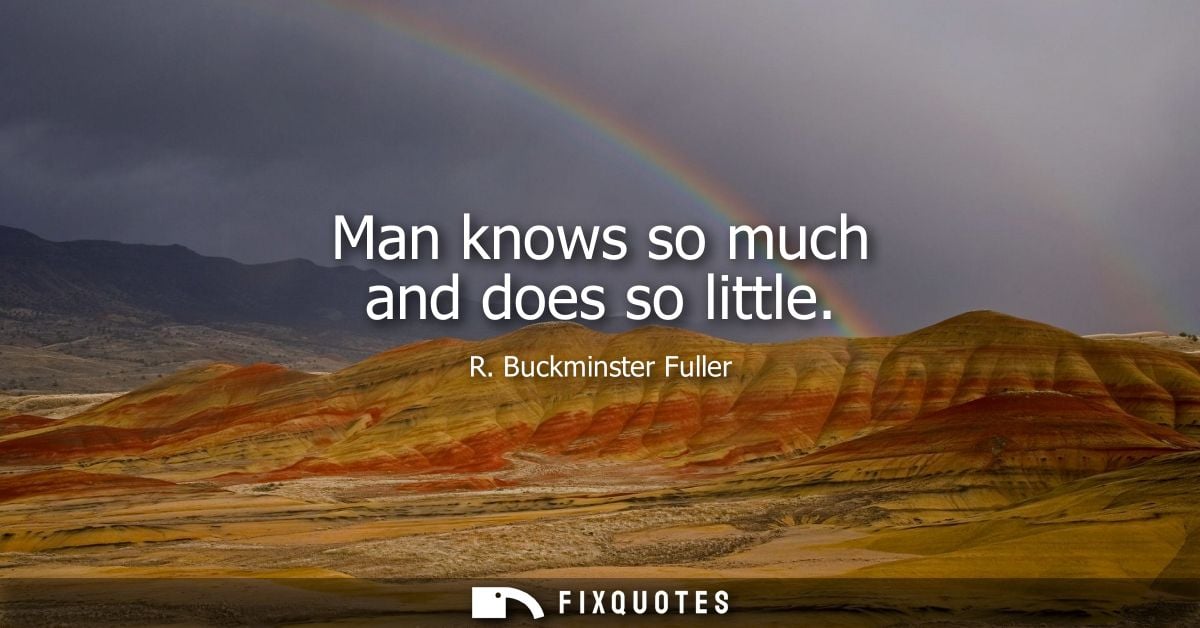
"Man knows so much and does so little"
About this Quote
A quiet scolding hides inside Fuller’s plain sentence: humanity isn’t failing for lack of information, but for lack of follow-through. “Man knows so much” reads like a concession to modernity’s triumphs - science, engineering, systems thinking - before the knife turns in “and does so little.” The line works because it refuses to flatter progress. It treats knowledge as moral neutral until it’s converted into action, design, and equitable outcomes.
Fuller, the inventor-philosopher of the 20th century, lived through the century’s most brutal proof that intelligence doesn’t guarantee wisdom: industrialized war, mass production harnessed for destruction, then a postwar boom that could feed millions yet often didn’t. His broader project - from geodesic domes to “Spaceship Earth” - was essentially an argument that the world’s problems were engineering problems with political and ethical bottlenecks. The subtext is a systems critique: we’re drowning in capability while trapped in incentives, institutions, and habits that keep capability from becoming lived improvement.
The phrasing is also strategically anthropological. “Man” isn’t one person’s laziness; it’s a species-level diagnosis, aimed at the collective gap between what we can prove in labs and what we can implement in cities, schools, housing, climate policy. Fuller isn’t romantic about ignorance, and he’s not anti-intellectual. He’s impatient with knowledge as credential, trivia, or status. The sting is that “little” isn’t zero - it’s worse: enough action to claim we tried, not enough to change the trajectory.
Fuller, the inventor-philosopher of the 20th century, lived through the century’s most brutal proof that intelligence doesn’t guarantee wisdom: industrialized war, mass production harnessed for destruction, then a postwar boom that could feed millions yet often didn’t. His broader project - from geodesic domes to “Spaceship Earth” - was essentially an argument that the world’s problems were engineering problems with political and ethical bottlenecks. The subtext is a systems critique: we’re drowning in capability while trapped in incentives, institutions, and habits that keep capability from becoming lived improvement.
The phrasing is also strategically anthropological. “Man” isn’t one person’s laziness; it’s a species-level diagnosis, aimed at the collective gap between what we can prove in labs and what we can implement in cities, schools, housing, climate policy. Fuller isn’t romantic about ignorance, and he’s not anti-intellectual. He’s impatient with knowledge as credential, trivia, or status. The sting is that “little” isn’t zero - it’s worse: enough action to claim we tried, not enough to change the trajectory.
Quote Details
| Topic | Wisdom |
|---|---|
| Source | Help us find the source |
| Cite |
Citation Formats
APA Style (7th ed.)
Fuller, R. Buckminster. (2026, January 18). Man knows so much and does so little. FixQuotes. https://fixquotes.com/quotes/man-knows-so-much-and-does-so-little-9654/
Chicago Style
Fuller, R. Buckminster. "Man knows so much and does so little." FixQuotes. January 18, 2026. https://fixquotes.com/quotes/man-knows-so-much-and-does-so-little-9654/.
MLA Style (9th ed.)
"Man knows so much and does so little." FixQuotes, 18 Jan. 2026, https://fixquotes.com/quotes/man-knows-so-much-and-does-so-little-9654/. Accessed 12 Feb. 2026.
More Quotes by Buckminster Fuller
Add to List