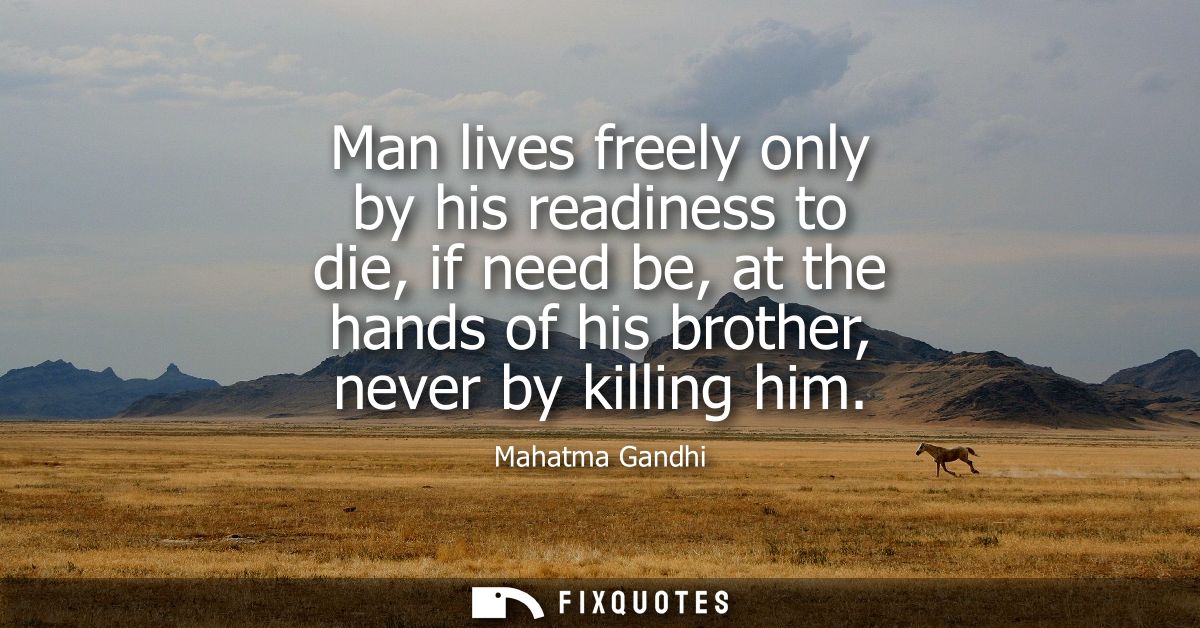
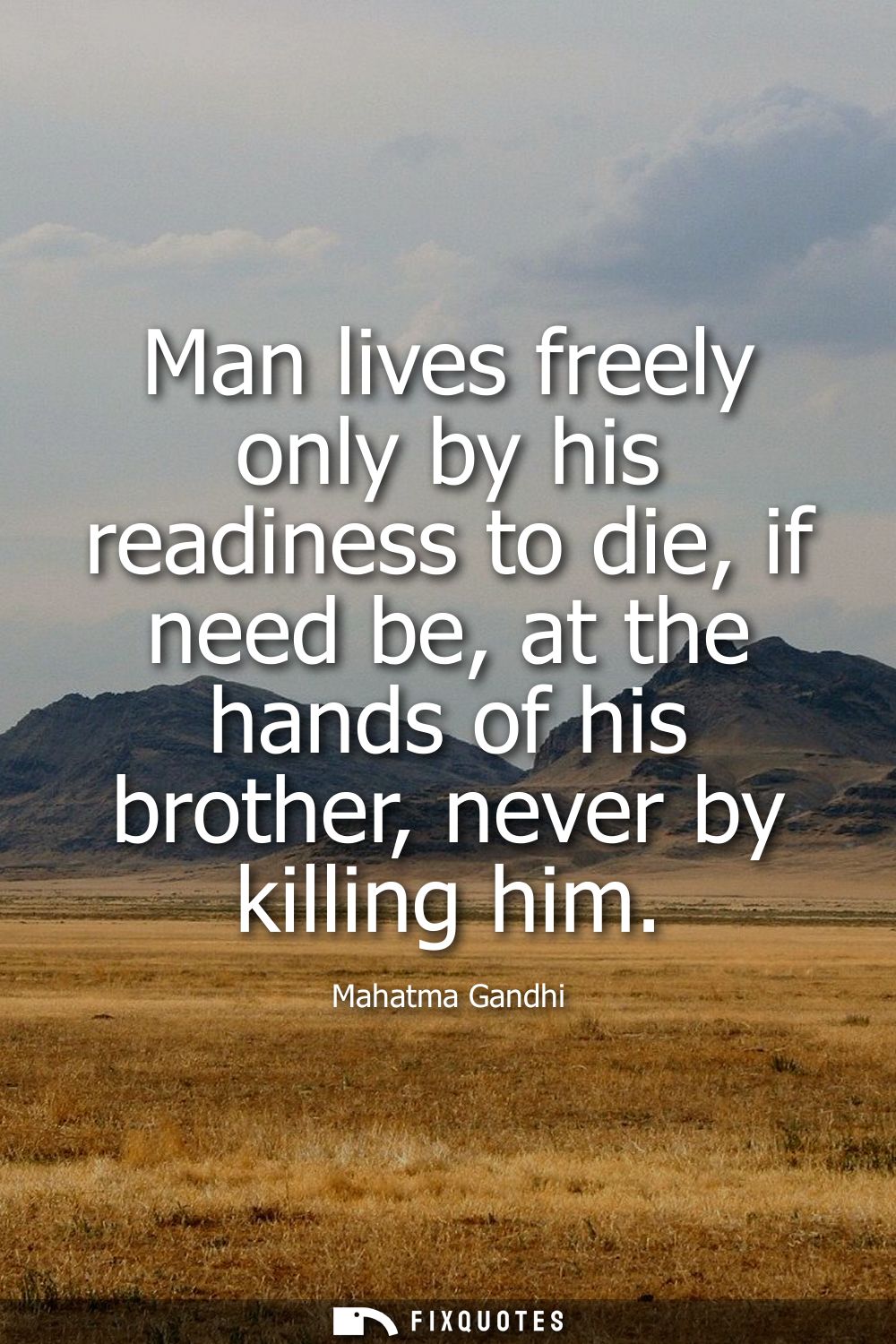
"Man lives freely only by his readiness to die, if need be, at the hands of his brother, never by killing him"
About this Quote
That word "brother" is the hinge. Gandhi is not letting anyone outsource cruelty to an abstract foe. Colonial rulers, rival communities, political opponents - he folds them into the same human family, forcing the listener to feel the ethical cost of treating another person as disposable. The subtext is aimed as much at his own side as at the British: nationalism that needs blood to validate itself is just another empire in training.
Context makes the provocation sharper. Gandhi was trying to weld mass politics to nonviolence in a century intoxicated by militarism, from world wars to revolutionary terror. He had seen how quickly righteous causes learn to enjoy force, and how communal tensions in India could turn neighbors into targets. So he frames courage not as domination but as restraint under pressure: readiness to accept suffering rather than distribute it.
Its also strategic. By refusing to kill, you deny the state its favorite justification - that order requires repression. You make violence look like what it is: a choice, not a necessity.
Quote Details
| Topic | Freedom |
|---|---|
| Source | Help us find the source |
| Cite |
Citation Formats
APA Style (7th ed.)
Gandhi, Mahatma. (2026, January 15). Man lives freely only by his readiness to die, if need be, at the hands of his brother, never by killing him. FixQuotes. https://fixquotes.com/quotes/man-lives-freely-only-by-his-readiness-to-die-if-26084/
Chicago Style
Gandhi, Mahatma. "Man lives freely only by his readiness to die, if need be, at the hands of his brother, never by killing him." FixQuotes. January 15, 2026. https://fixquotes.com/quotes/man-lives-freely-only-by-his-readiness-to-die-if-26084/.
MLA Style (9th ed.)
"Man lives freely only by his readiness to die, if need be, at the hands of his brother, never by killing him." FixQuotes, 15 Jan. 2026, https://fixquotes.com/quotes/man-lives-freely-only-by-his-readiness-to-die-if-26084/. Accessed 29 Mar. 2026.