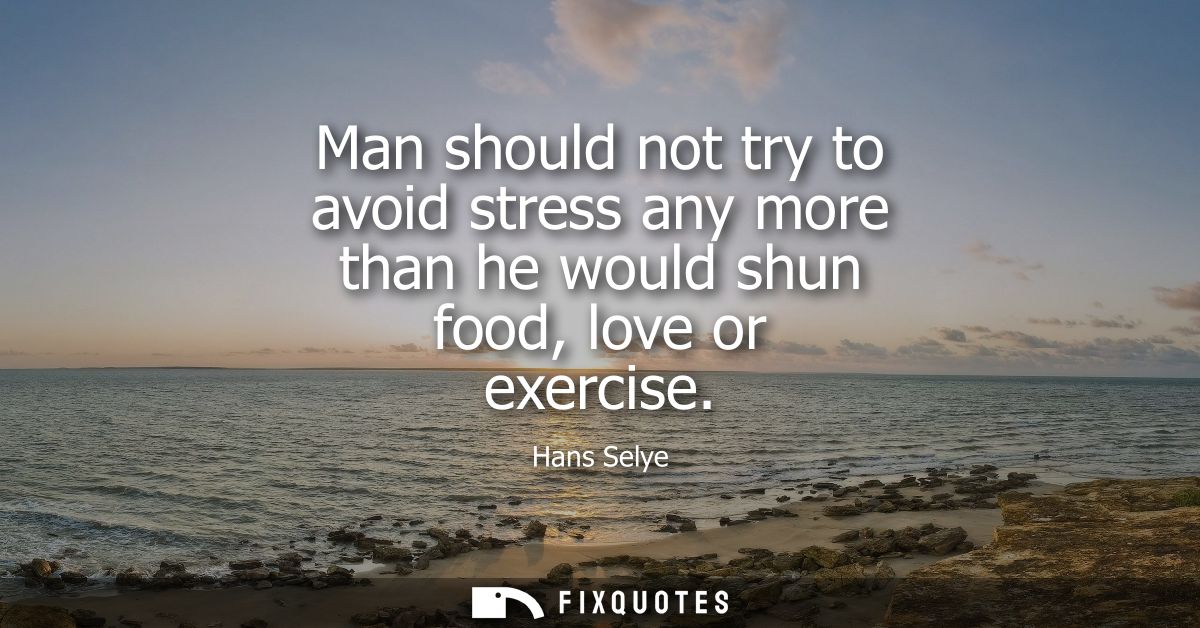
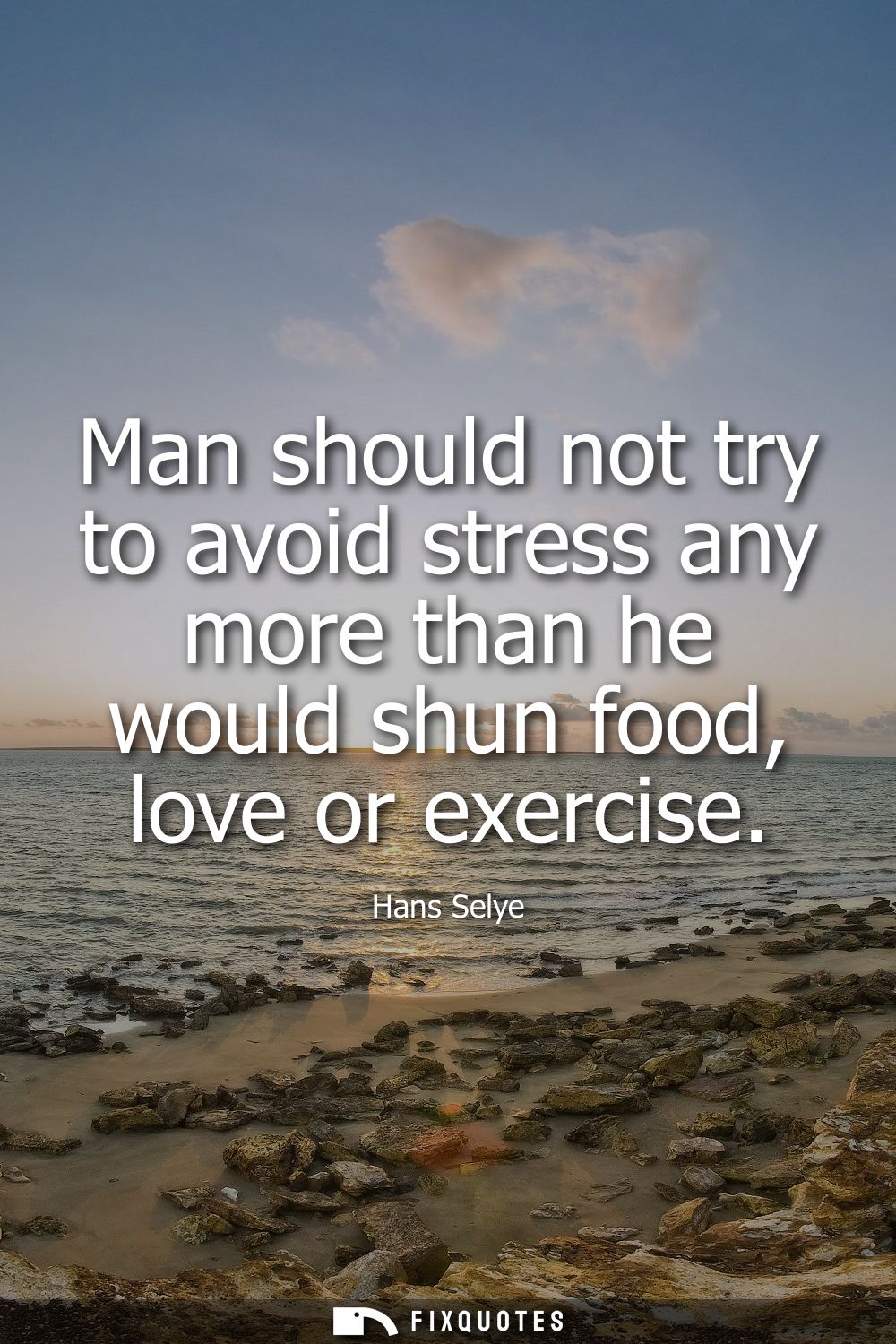
"Man should not try to avoid stress any more than he would shun food, love or exercise"
About this Quote
Selye’s intent isn’t to romanticize burnout; it’s to normalize strain as a biological signal and a developmental ingredient. Stress is not just damage. It’s mobilization. It’s the system switching on. The subtext reads like an argument against the fantasy of frictionless living: a life engineered to eliminate stress would also eliminate the conditions that produce competence, intimacy, and physical capacity. You don’t get strength without resistance; you don’t get attachment without vulnerability; you don’t get meaning without stakes.
Context matters because Selye wrote in an era when medicine was mapping the body as a set of measurable responses. His “general adaptation syndrome” framed stress as a patterned physiological process, not a personal failing. The quote borrows that authority to make a cultural critique: stop treating stress as shame. Start treating it as dosage. Like calories, like training, like love, what matters is the kind, the duration, and whether you recover.
Quote Details
| Topic | Stress |
|---|---|
| Source | Help us find the source |
| Cite |
Citation Formats
APA Style (7th ed.)
Selye, Hans. (2026, January 17). Man should not try to avoid stress any more than he would shun food, love or exercise. FixQuotes. https://fixquotes.com/quotes/man-should-not-try-to-avoid-stress-any-more-than-53918/
Chicago Style
Selye, Hans. "Man should not try to avoid stress any more than he would shun food, love or exercise." FixQuotes. January 17, 2026. https://fixquotes.com/quotes/man-should-not-try-to-avoid-stress-any-more-than-53918/.
MLA Style (9th ed.)
"Man should not try to avoid stress any more than he would shun food, love or exercise." FixQuotes, 17 Jan. 2026, https://fixquotes.com/quotes/man-should-not-try-to-avoid-stress-any-more-than-53918/. Accessed 13 Feb. 2026.