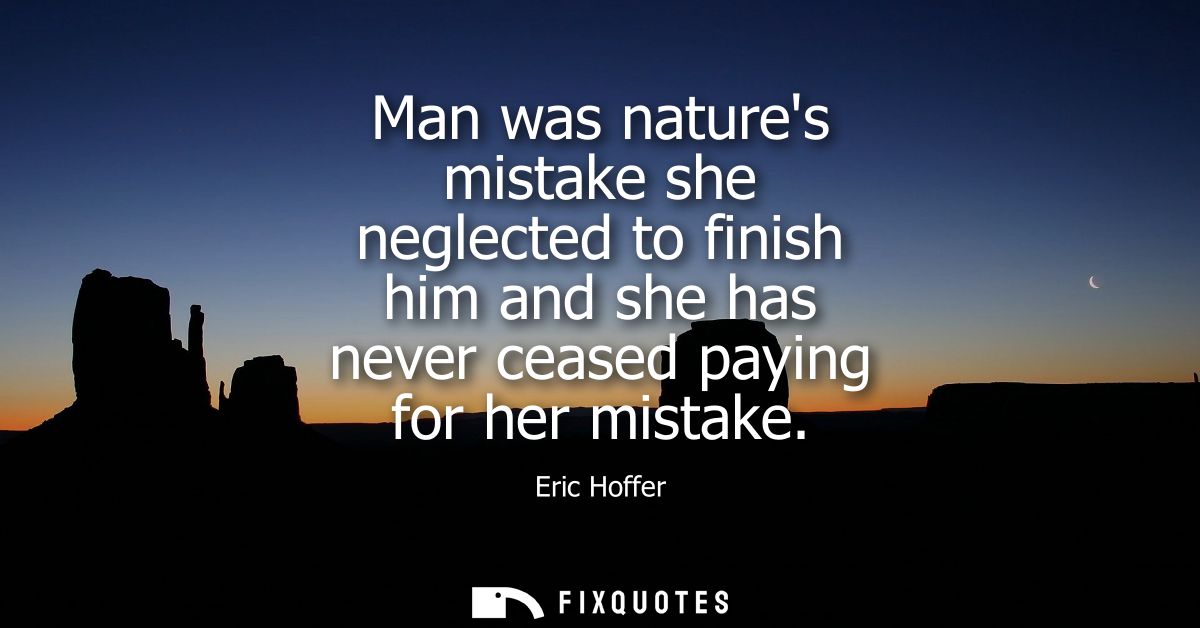
"Man was nature's mistake; she neglected to finish him, and she has never ceased paying for her mistake"
About this Quote
The pronoun “she” matters. Nature becomes a weary parent or indifferent artist, which sharpens the indictment: our destructiveness isn’t an anomaly; it’s the bill that comes due for a creature made too flexible, too suggestible, too restless. Hoffer’s broader work on mass movements and true believers sits behind this. If humans feel unfinished, they’ll reach for completion kits: ideologies, tribes, crusades, identities that promise coherence. The “mistake” isn’t that we err; it’s that we can’t stop trying to correct ourselves by force, often at scale.
Contextually, Hoffer is writing in a century that made human “unfinishedness” impossible to romanticize. Industrial war, propaganda, genocide, the bureaucratic efficiency of cruelty: these are nature “paying” through us, not despite us. The sentence is bleak, but it’s also a dare. If we are unfinished, then ethics isn’t a veneer; it’s the missing organ we have to build on purpose.
Quote Details
| Topic | Sarcastic |
|---|---|
| Source | Help us find the source |
| Cite |
Citation Formats
APA Style (7th ed.)
Hoffer, Eric. (2026, February 20). Man was nature's mistake; she neglected to finish him, and she has never ceased paying for her mistake. FixQuotes. https://fixquotes.com/quotes/man-was-natures-mistake-she-neglected-to-finish-15672/
Chicago Style
Hoffer, Eric. "Man was nature's mistake; she neglected to finish him, and she has never ceased paying for her mistake." FixQuotes. February 20, 2026. https://fixquotes.com/quotes/man-was-natures-mistake-she-neglected-to-finish-15672/.
MLA Style (9th ed.)
"Man was nature's mistake; she neglected to finish him, and she has never ceased paying for her mistake." FixQuotes, 20 Feb. 2026, https://fixquotes.com/quotes/man-was-natures-mistake-she-neglected-to-finish-15672/. Accessed 7 Apr. 2026.