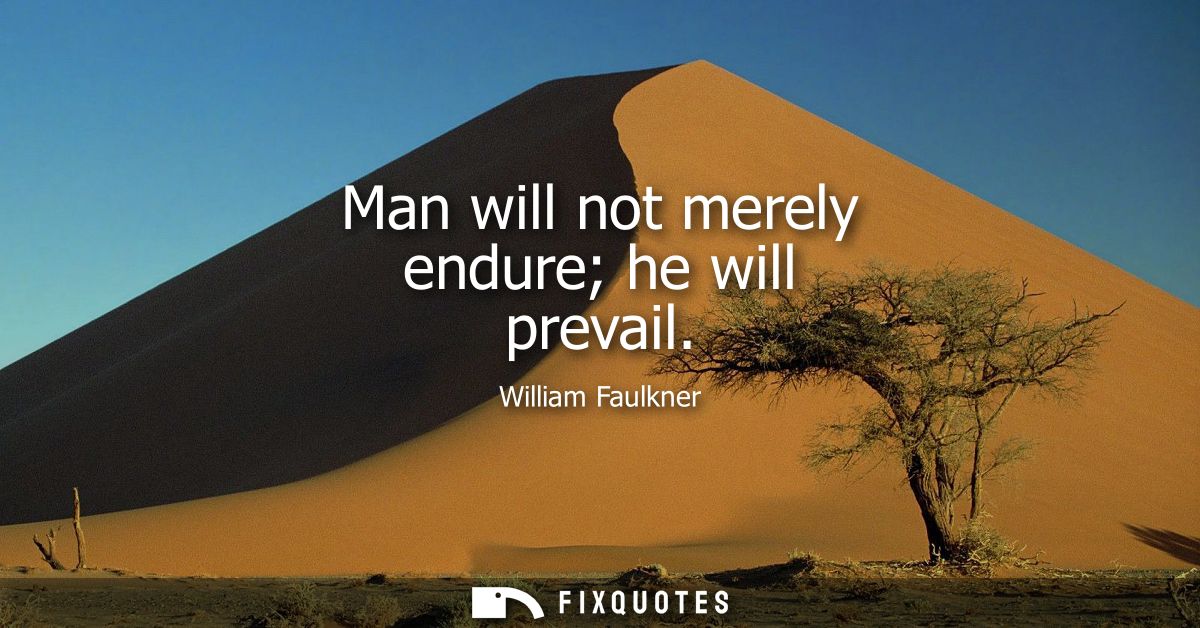
"Man will not merely endure; he will prevail"
About this Quote
Faulkner’s line is bravado with a bruise under it. “Endure” is the low bar: survival as grim persistence, the human animal hanging on. “Prevail” raises the stakes to something almost theological - not just living through catastrophe, but asserting meaning over it. Coming from Faulkner, that escalation isn’t inspirational poster talk; it’s a writer testing whether literature can still justify faith in the species after the 20th century’s mass violence and moral collapse.
The phrasing does a clever two-step. “Will not merely” implies that endurance is expected, even commonplace; the real claim is the surplus, the extra ounce of spirit that refuses to be reduced to biology. It’s a wager on consciousness: that humans don’t just experience suffering, they metabolize it into story, ritual, memory, and stubborn self-interpretation. Faulkner’s novels are crowded with people who are crushed by history - the South’s defeat, racism, poverty, family rot - yet still claw for dignity. “Prevail” doesn’t mean win cleanly; it means persist with voice, with witness, with the refusal to let brutality be the final author.
The context matters: Faulkner delivered this in his Nobel Prize speech (1950), at the dawn of the nuclear age, when “endurance” felt like a temporary reprieve. He’s also pitching a job description for the writer: to traffic not in fashionable despair, but in “the old verities” - courage, compassion, sacrifice - because without them, prevailing is impossible. It’s hope, but sharpened into a demand.
The phrasing does a clever two-step. “Will not merely” implies that endurance is expected, even commonplace; the real claim is the surplus, the extra ounce of spirit that refuses to be reduced to biology. It’s a wager on consciousness: that humans don’t just experience suffering, they metabolize it into story, ritual, memory, and stubborn self-interpretation. Faulkner’s novels are crowded with people who are crushed by history - the South’s defeat, racism, poverty, family rot - yet still claw for dignity. “Prevail” doesn’t mean win cleanly; it means persist with voice, with witness, with the refusal to let brutality be the final author.
The context matters: Faulkner delivered this in his Nobel Prize speech (1950), at the dawn of the nuclear age, when “endurance” felt like a temporary reprieve. He’s also pitching a job description for the writer: to traffic not in fashionable despair, but in “the old verities” - courage, compassion, sacrifice - because without them, prevailing is impossible. It’s hope, but sharpened into a demand.
Quote Details
| Topic | Perseverance |
|---|---|
| Source | Nobel Lecture, William Faulkner, 1950 — contains line "I believe that man will not merely endure; he will prevail." |
| Cite |
Citation Formats
APA Style (7th ed.)
Faulkner, William. (2026, January 18). Man will not merely endure; he will prevail. FixQuotes. https://fixquotes.com/quotes/man-will-not-merely-endure-he-will-prevail-11193/
Chicago Style
Faulkner, William. "Man will not merely endure; he will prevail." FixQuotes. January 18, 2026. https://fixquotes.com/quotes/man-will-not-merely-endure-he-will-prevail-11193/.
MLA Style (9th ed.)
"Man will not merely endure; he will prevail." FixQuotes, 18 Jan. 2026, https://fixquotes.com/quotes/man-will-not-merely-endure-he-will-prevail-11193/. Accessed 25 Mar. 2026.
More Quotes by William
Add to List