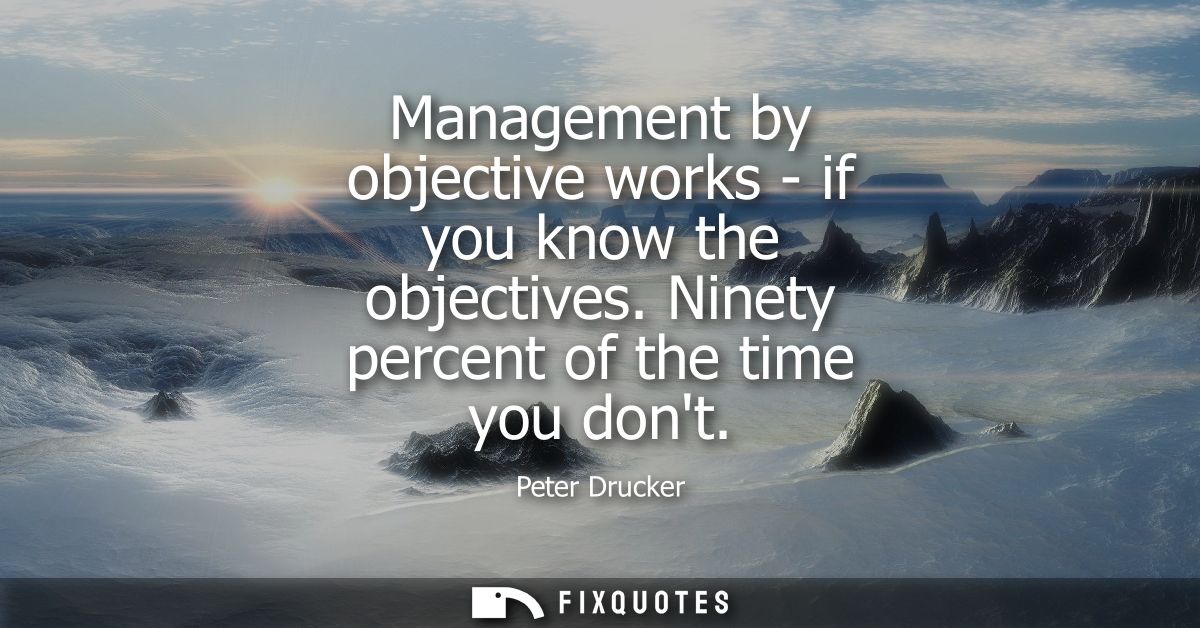
"Management by objective works - if you know the objectives. Ninety percent of the time you don't"
About this Quote
The intent is practical and corrective. Drucker watched businesses adopt managerial fashions as if naming a method were the same as doing the work. “Objectives” are treated like a box to check, a poster to print, a slide to present. His subtext: most firms substitute measurable targets for meaningful direction, then act surprised when teams optimize the metric and miss the mission. In that sense, the quote prefigures today’s OKR-era pathologies: chasing numbers that are clean, comparable, and meaningless; confusing activity with progress; letting what’s easy to count become what matters.
Context matters because Drucker wrote in the age of the modern corporation, when “management” was becoming a profession and systems thinking promised control. The line punctures that promise. It suggests that the hardest part of leadership isn’t enforcement, incentives, or dashboards - it’s epistemic: deciding what success even is, under uncertainty, across competing stakeholders. “Ninety percent of the time” is also a warning about power. If objectives are vague, whoever controls interpretation controls reality. That’s not a process flaw; it’s a political one.
Quote Details
| Topic | Management |
|---|---|
| Source | Help us find the source |
| Cite |
Citation Formats
APA Style (7th ed.)
Drucker, Peter. (2026, January 15). Management by objective works - if you know the objectives. Ninety percent of the time you don't. FixQuotes. https://fixquotes.com/quotes/management-by-objective-works-if-you-know-the-27326/
Chicago Style
Drucker, Peter. "Management by objective works - if you know the objectives. Ninety percent of the time you don't." FixQuotes. January 15, 2026. https://fixquotes.com/quotes/management-by-objective-works-if-you-know-the-27326/.
MLA Style (9th ed.)
"Management by objective works - if you know the objectives. Ninety percent of the time you don't." FixQuotes, 15 Jan. 2026, https://fixquotes.com/quotes/management-by-objective-works-if-you-know-the-27326/. Accessed 27 Mar. 2026.