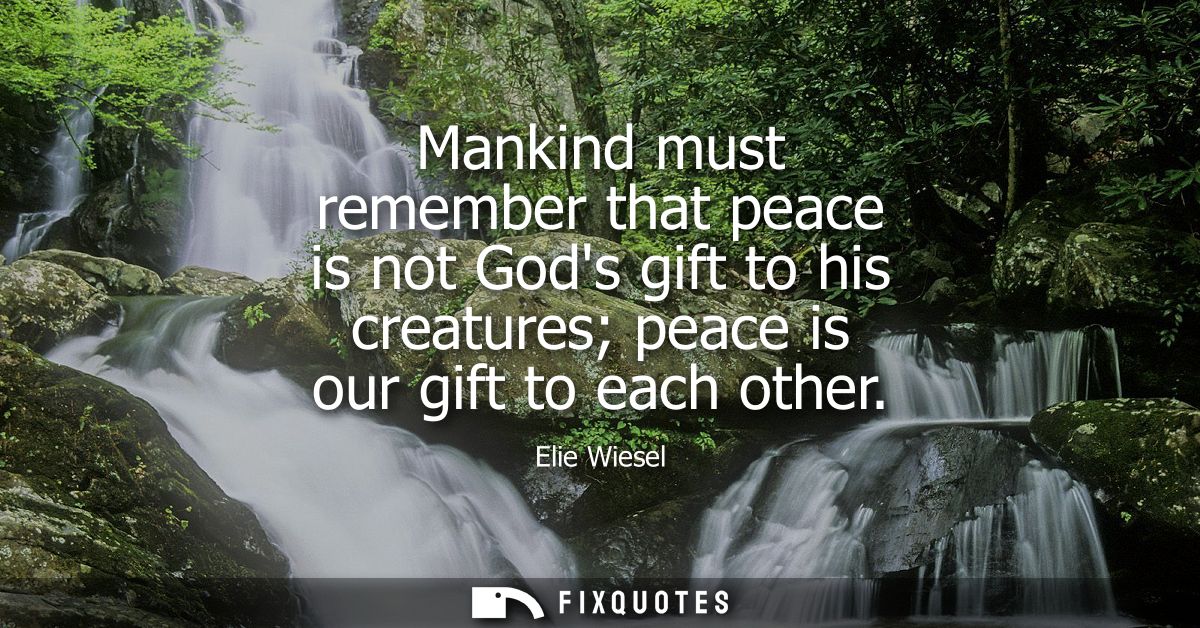
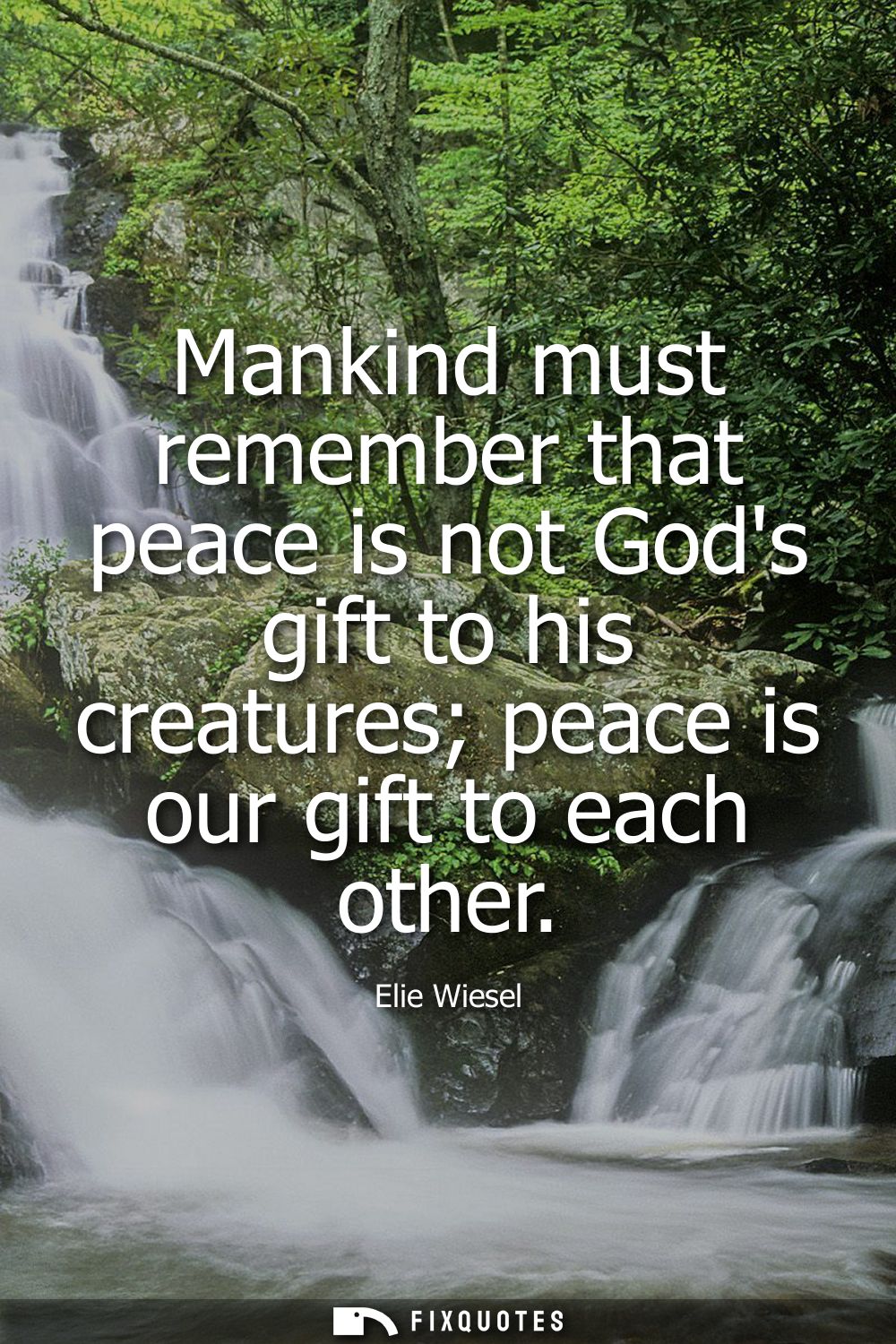
"Mankind must remember that peace is not God's gift to his creatures; peace is our gift to each other"
About this Quote
The subtext carries Holocaust freight without naming it. After an era when civilized Europe proved it could industrialize cruelty, appealing to God as guarantor of harmony can sound less like faith than evasion. Wiesel's formulation quietly rebukes the pious alibi: if catastrophe was possible in full view of heaven, then peace can't be treated as heaven's routine maintenance. It has to be manufactured by human choices - laws, institutions, restraint, witness, solidarity.
Calling peace a "gift" is strategic, too. Gifts are voluntary, relational, and costly; they imply agency and sacrifice. Peace isn't framed as a treaty or a ceasefire but as something you actively give - to neighbors, to enemies, to strangers whose safety you decide matters. Wiesel's intent is to move listeners from sentiment to accountability, replacing the question "Why doesn't God bring peace?" with the harder one: "What are we withholding from one another that keeps violence viable?"
Quote Details
| Topic | Peace |
|---|---|
| Source | Help us find the source |
| Cite |
Citation Formats
APA Style (7th ed.)
Wiesel, Elie. (2026, January 17). Mankind must remember that peace is not God's gift to his creatures; peace is our gift to each other. FixQuotes. https://fixquotes.com/quotes/mankind-must-remember-that-peace-is-not-gods-gift-30973/
Chicago Style
Wiesel, Elie. "Mankind must remember that peace is not God's gift to his creatures; peace is our gift to each other." FixQuotes. January 17, 2026. https://fixquotes.com/quotes/mankind-must-remember-that-peace-is-not-gods-gift-30973/.
MLA Style (9th ed.)
"Mankind must remember that peace is not God's gift to his creatures; peace is our gift to each other." FixQuotes, 17 Jan. 2026, https://fixquotes.com/quotes/mankind-must-remember-that-peace-is-not-gods-gift-30973/. Accessed 30 Mar. 2026.