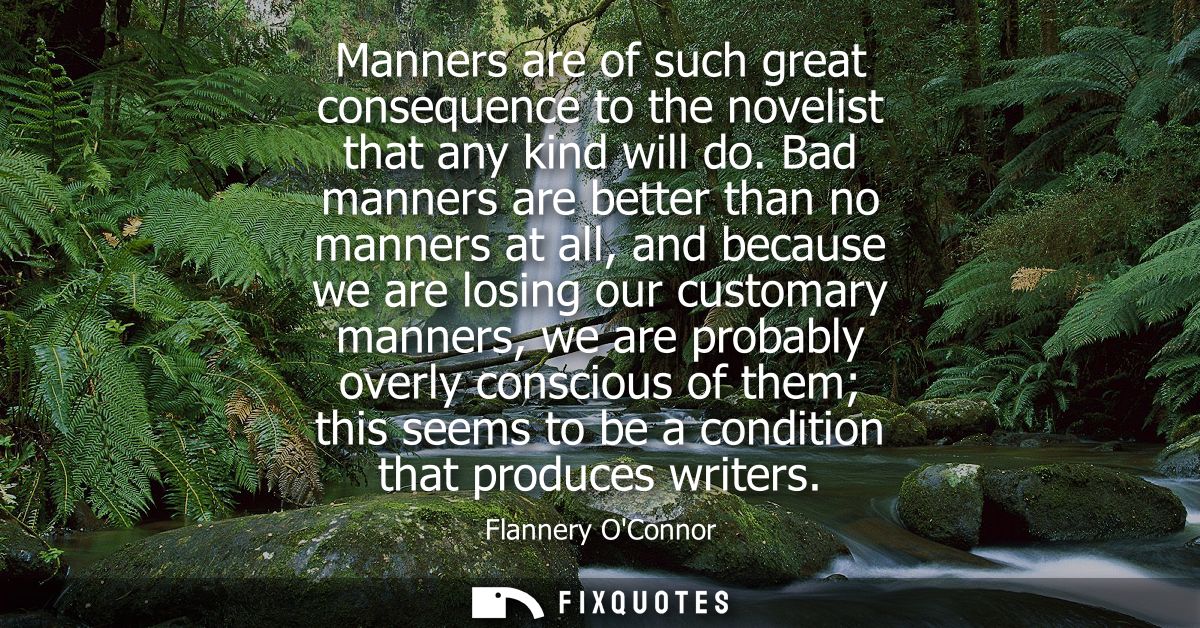
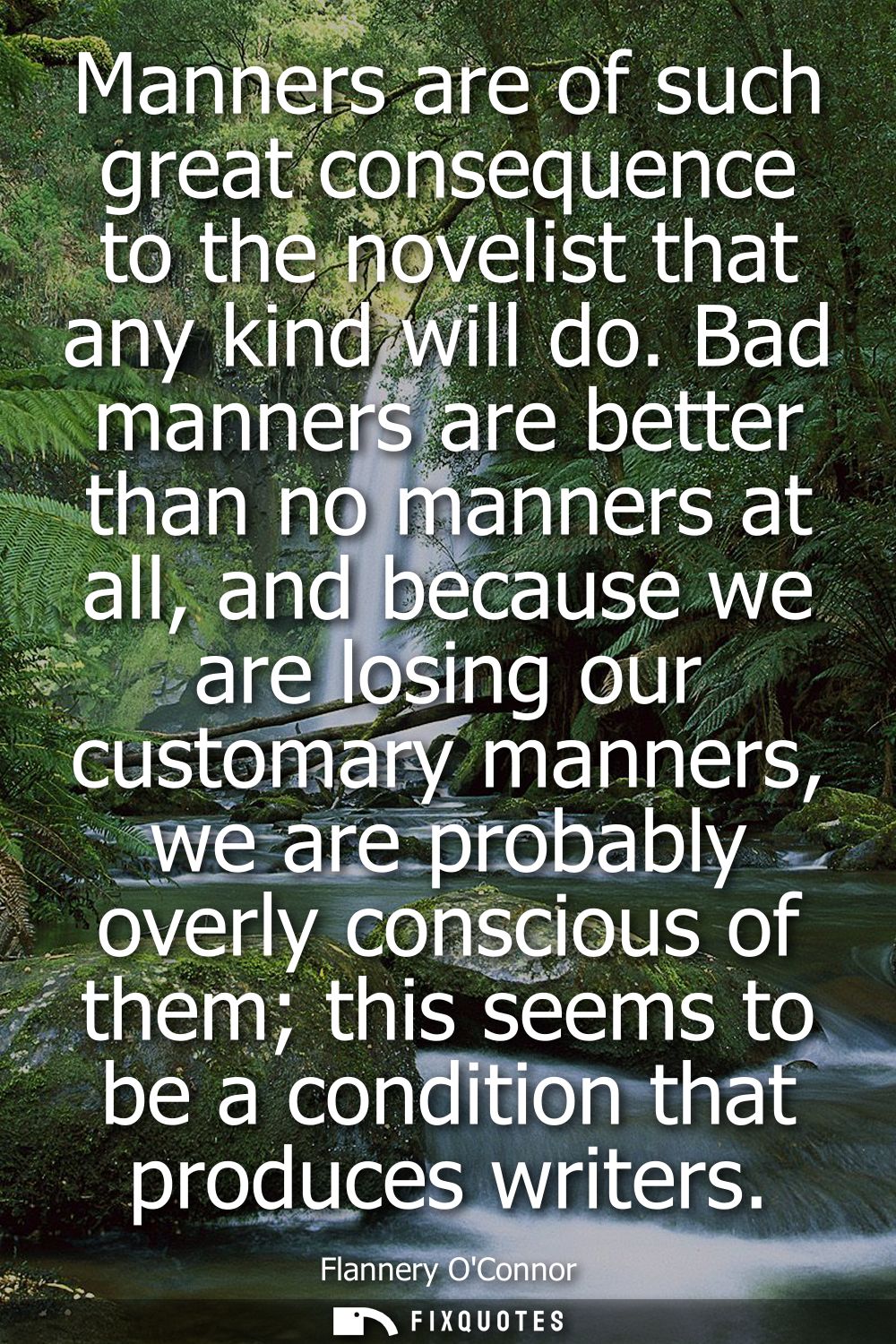
"Manners are of such great consequence to the novelist that any kind will do. Bad manners are better than no manners at all, and because we are losing our customary manners, we are probably overly conscious of them; this seems to be a condition that produces writers"
About this Quote
The wicked little twist is her preference for “bad manners” over “no manners at all.” Bad manners still presuppose a standard you can violate; they generate friction, judgment, and consequence. “No manners” is a flatter world: if nothing is expected, nothing can be transgressed, and the writer loses a reliable engine for conflict and moral pressure.
Her final claim - that we’re “losing our customary manners” and therefore becoming “overly conscious” of them - reads like a diagnosis of modernity. When etiquette is stable, it’s invisible. When it’s eroding, everyone suddenly notices the seams: who gets interrupted, whose pain is accommodated, whose speech is policed. That heightened self-scrutiny becomes material. Writers are born in the gap between rule and rupture, when people can’t stop watching themselves and each other perform.
For O’Connor, whose work thrives on social ritual colliding with grotesque truth, manners aren’t decorative. They’re the stage directions for grace, violence, and revelation.
Quote Details
| Topic | Writing |
|---|---|
| Source | Help us find the source |
| Cite |
Citation Formats
APA Style (7th ed.)
O'Connor, Flannery. (2026, January 17). Manners are of such great consequence to the novelist that any kind will do. Bad manners are better than no manners at all, and because we are losing our customary manners, we are probably overly conscious of them; this seems to be a condition that produces writers. FixQuotes. https://fixquotes.com/quotes/manners-are-of-such-great-consequence-to-the-31161/
Chicago Style
O'Connor, Flannery. "Manners are of such great consequence to the novelist that any kind will do. Bad manners are better than no manners at all, and because we are losing our customary manners, we are probably overly conscious of them; this seems to be a condition that produces writers." FixQuotes. January 17, 2026. https://fixquotes.com/quotes/manners-are-of-such-great-consequence-to-the-31161/.
MLA Style (9th ed.)
"Manners are of such great consequence to the novelist that any kind will do. Bad manners are better than no manners at all, and because we are losing our customary manners, we are probably overly conscious of them; this seems to be a condition that produces writers." FixQuotes, 17 Jan. 2026, https://fixquotes.com/quotes/manners-are-of-such-great-consequence-to-the-31161/. Accessed 30 Mar. 2026.