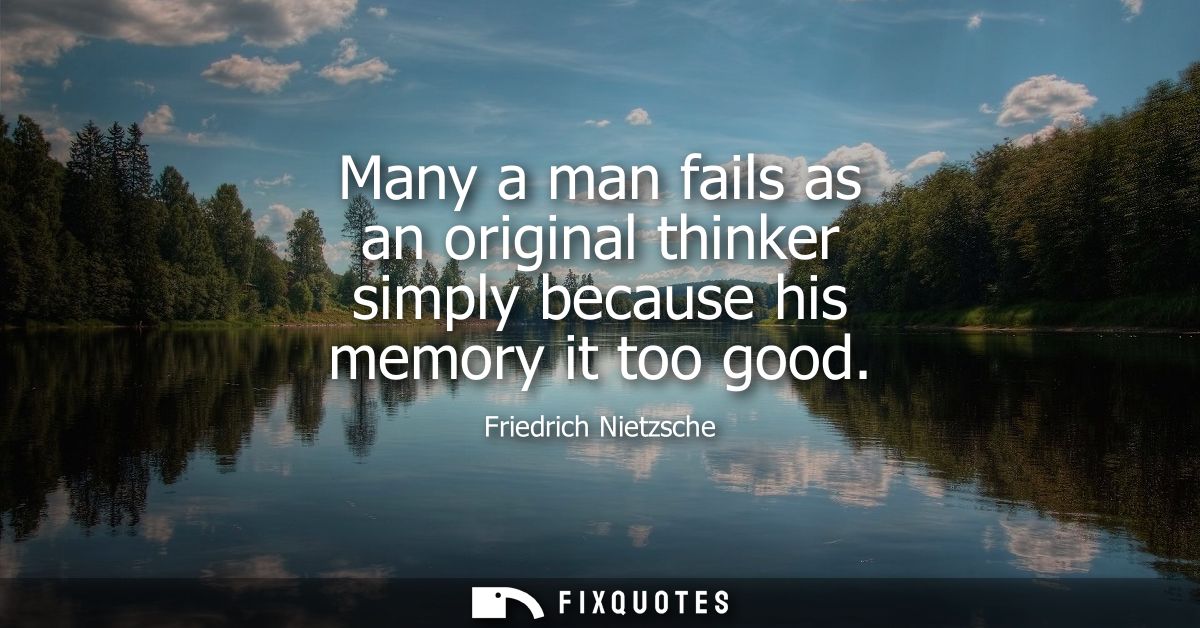
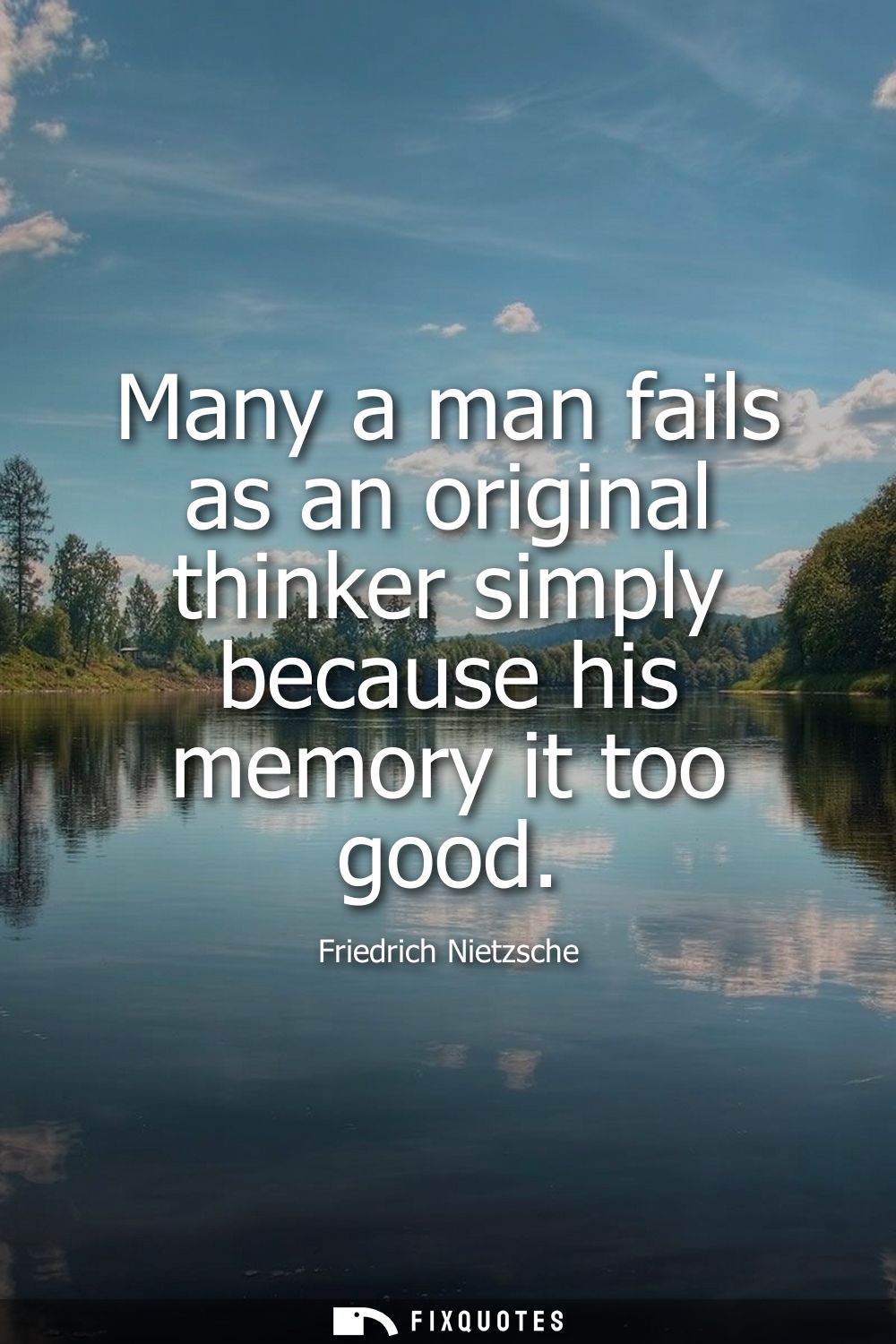
"Many a man fails as an original thinker simply because his memory, it too good"
About this Quote
The subtext is less anti-knowledge than anti-secondhand living. Nietzsche’s quarrel is with minds that treat tradition as a safety rail: systems, moral codes, and metaphysical comforts that spare you the humiliating work of generating new values. A “too good” memory makes you fluent in the already-validated. It helps you win arguments and exams, but it can also make you allergic to the disorienting blankness where new concepts begin. Original thought, in Nietzsche’s view, requires a selective forgetfulness: the capacity to drop dead weight, to misread creatively, to refuse the reflex of deference.
Context matters: late-19th-century German intellectual life prized philology, scholarship, and reverence for canonical texts. Nietzsche himself was trained as a philologist, then turned against the academic machinery that rewards footnotes over vision. The line is also a self-aimed warning. His project depended on breaking the spell of cultural memory - Christianity’s moral inheritance, Europe’s philosophical habits - to make room for revaluation. Memory preserves; Nietzsche wants thinking that can endanger what’s preserved.
Quote Details
| Topic | Wisdom |
|---|---|
| Source | Later attribution: The Very Best of Friedrich Nietzsche (David Graham, 2014) modern compilationID: ClGVBAAAQBAJ
Evidence:
... be an idiot , a bad apple , is annoyed when it turns out in the end that he isn't . " " Many a man fails as an original thinker simply because his memory it too good . " * " What can everyone do ? Praise and blame About Mankind. |
| Cite |
Citation Formats
APA Style (7th ed.)
Nietzsche, Friedrich. (2026, February 21). Many a man fails as an original thinker simply because his memory, it too good. FixQuotes. https://fixquotes.com/quotes/many-a-man-fails-as-an-original-thinker-simply-133876/
Chicago Style
Nietzsche, Friedrich. "Many a man fails as an original thinker simply because his memory, it too good." FixQuotes. February 21, 2026. https://fixquotes.com/quotes/many-a-man-fails-as-an-original-thinker-simply-133876/.
MLA Style (9th ed.)
"Many a man fails as an original thinker simply because his memory, it too good." FixQuotes, 21 Feb. 2026, https://fixquotes.com/quotes/many-a-man-fails-as-an-original-thinker-simply-133876/. Accessed 21 Mar. 2026.