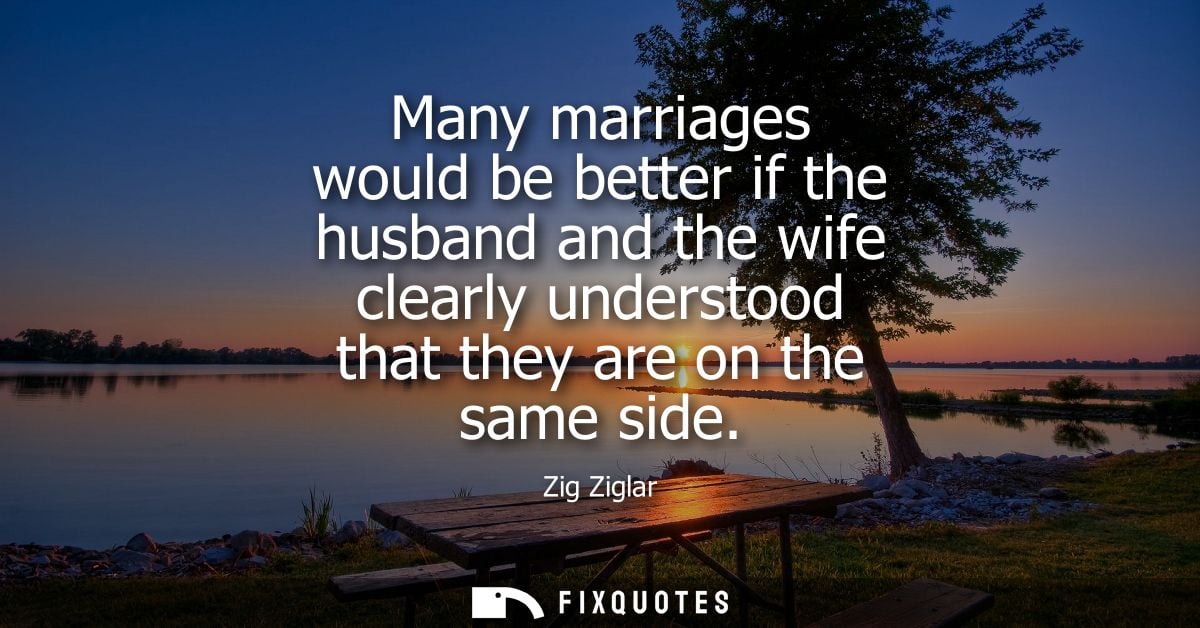
"Many marriages would be better if the husband and the wife clearly understood that they are on the same side"
About this Quote
The intent is corrective, not romantic. Ziglar isn’t selling soulmates; he’s selling alignment. Coming out of the late-20th-century self-help and motivational circuit, he spoke to an audience trained to think in goals, performance, and mindset. “Same side” reframes a marriage from a series of disputes to a shared mission, a narrative device that makes compromise feel less like surrender and more like strategy.
The subtext is that conflict in marriage often isn’t about the presenting issue (money, chores, sex, in-laws) but about misrecognition: feeling unseen, disrespected, or cast as the obstacle. By insisting on “clearly” understanding the alliance, Ziglar implies that love alone doesn’t prevent adversarial habits; you need a conscious story about what you’re doing together. It’s also a subtle nudge toward humility: if you’re on the same side, your partner’s “wrong” becomes a problem to solve, not a person to defeat.
Culturally, the quote sits in a moment when marriage advice increasingly borrowed from corporate management and sports metaphors. It works because it offers a simple, repeatable rule that interrupts escalation mid-fight - not profound, but practical enough to change behavior.
Quote Details
| Topic | Husband & Wife |
|---|---|
| Source | Help us find the source |
| Cite |
Citation Formats
APA Style (7th ed.)
Ziglar, Zig. (2026, January 17). Many marriages would be better if the husband and the wife clearly understood that they are on the same side. FixQuotes. https://fixquotes.com/quotes/many-marriages-would-be-better-if-the-husband-and-26453/
Chicago Style
Ziglar, Zig. "Many marriages would be better if the husband and the wife clearly understood that they are on the same side." FixQuotes. January 17, 2026. https://fixquotes.com/quotes/many-marriages-would-be-better-if-the-husband-and-26453/.
MLA Style (9th ed.)
"Many marriages would be better if the husband and the wife clearly understood that they are on the same side." FixQuotes, 17 Jan. 2026, https://fixquotes.com/quotes/many-marriages-would-be-better-if-the-husband-and-26453/. Accessed 28 Mar. 2026.