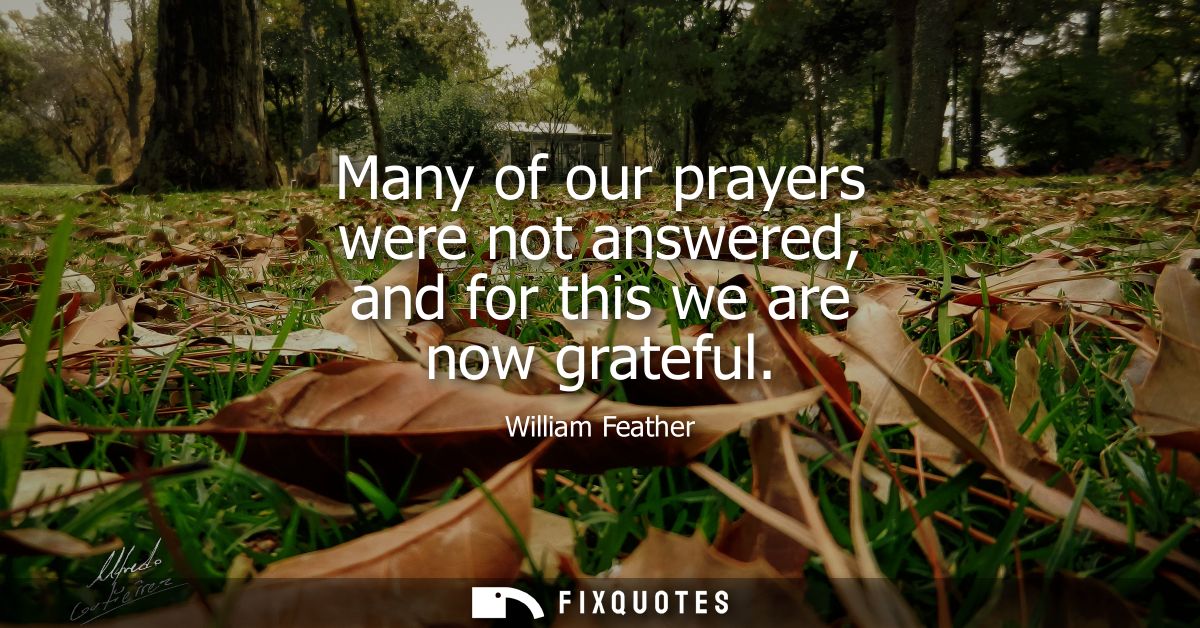
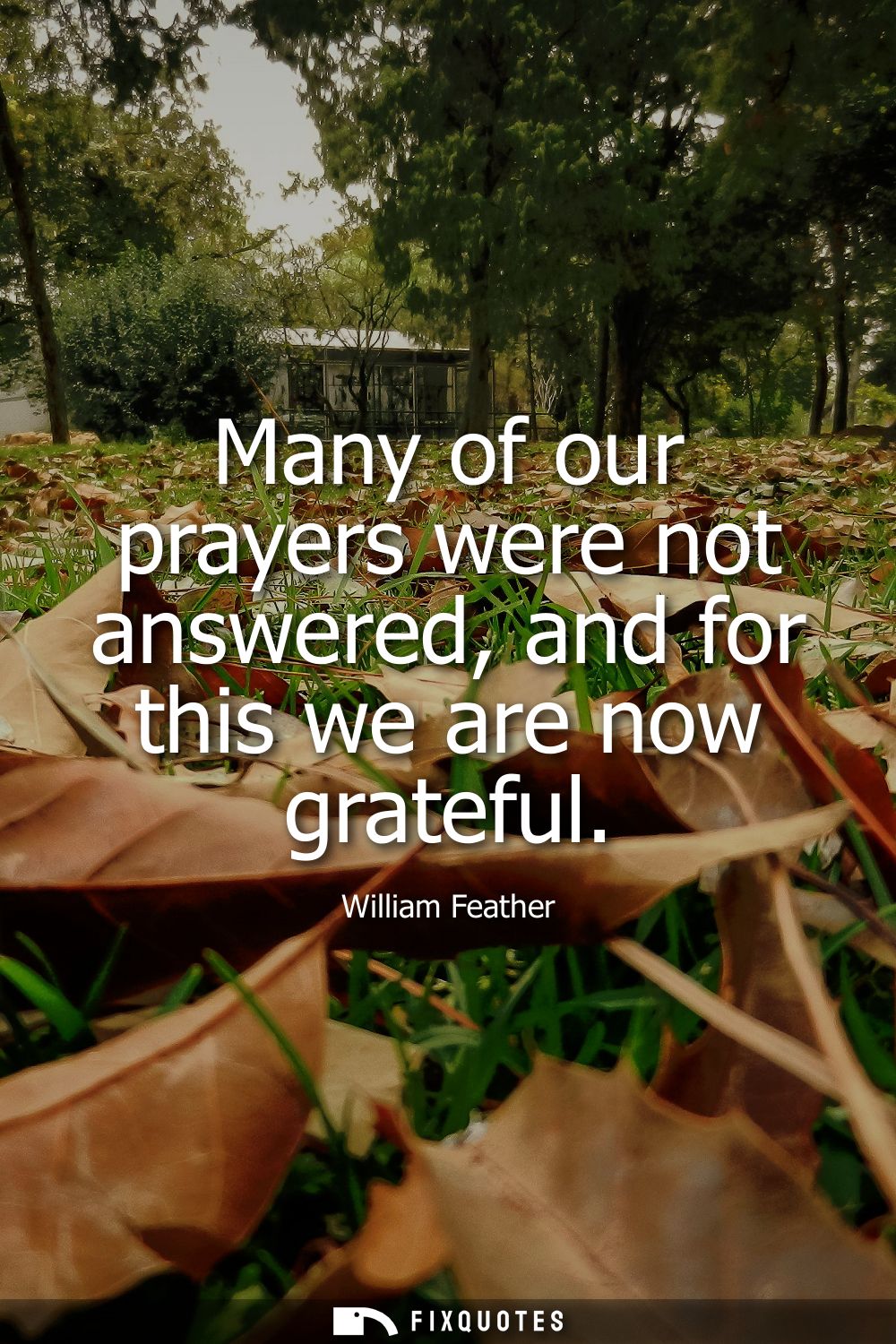
"Many of our prayers were not answered, and for this we are now grateful"
About this Quote
Gratitude for a refusal is a quiet piece of American pragmatism, and Feather lands it with a gentle twist of the knife. The line takes the familiar posture of piety - prayers, answered or not - then swaps the expected grievance for retrospective relief. It works because it admits what most people only confess in private: the self asking for things is not the self who has to live with the consequences.
Feather wrote in an era that treated optimism as both civic duty and personal branding. His gift was the aphorism as moral corrective: short, clean sentences that reframe sentimentality into something sturdier. Here, the subtext is an argument against the mythology of perfect personal knowing. We’re encouraged to narrate life as a string of wins, manifestations, and “meant to be” moments; Feather insists that luck often looks like disappointment at first. The gratitude isn’t just religious. It’s psychological: a mature recognition that desire is a bad planner.
The phrasing also makes the reader complicit. “Many of our prayers” doesn’t point at a single fool; it implicates the whole crowd. And “now grateful” is the punchline’s timing mechanism, locating wisdom not in the moment of asking, but in the long, embarrassing audit afterward. It’s a sentence built to puncture entitlement without scolding, offering consolation to anyone who’s watched a door slam and later realized it was a fire exit.
Feather wrote in an era that treated optimism as both civic duty and personal branding. His gift was the aphorism as moral corrective: short, clean sentences that reframe sentimentality into something sturdier. Here, the subtext is an argument against the mythology of perfect personal knowing. We’re encouraged to narrate life as a string of wins, manifestations, and “meant to be” moments; Feather insists that luck often looks like disappointment at first. The gratitude isn’t just religious. It’s psychological: a mature recognition that desire is a bad planner.
The phrasing also makes the reader complicit. “Many of our prayers” doesn’t point at a single fool; it implicates the whole crowd. And “now grateful” is the punchline’s timing mechanism, locating wisdom not in the moment of asking, but in the long, embarrassing audit afterward. It’s a sentence built to puncture entitlement without scolding, offering consolation to anyone who’s watched a door slam and later realized it was a fire exit.
Quote Details
| Topic | Gratitude |
|---|---|
| Source | Help us find the source |
| Cite | Cite this Quote |
Citation Formats
APA Style (7th ed.)
Feather, William. (n.d.). Many of our prayers were not answered, and for this we are now grateful. FixQuotes. https://fixquotes.com/quotes/many-of-our-prayers-were-not-answered-and-for-151636/
Chicago Style
Feather, William. "Many of our prayers were not answered, and for this we are now grateful." FixQuotes. Accessed February 2, 2026. https://fixquotes.com/quotes/many-of-our-prayers-were-not-answered-and-for-151636/.
MLA Style (9th ed.)
"Many of our prayers were not answered, and for this we are now grateful." FixQuotes, https://fixquotes.com/quotes/many-of-our-prayers-were-not-answered-and-for-151636/. Accessed 2 Feb. 2026.
More Quotes by William
Add to List