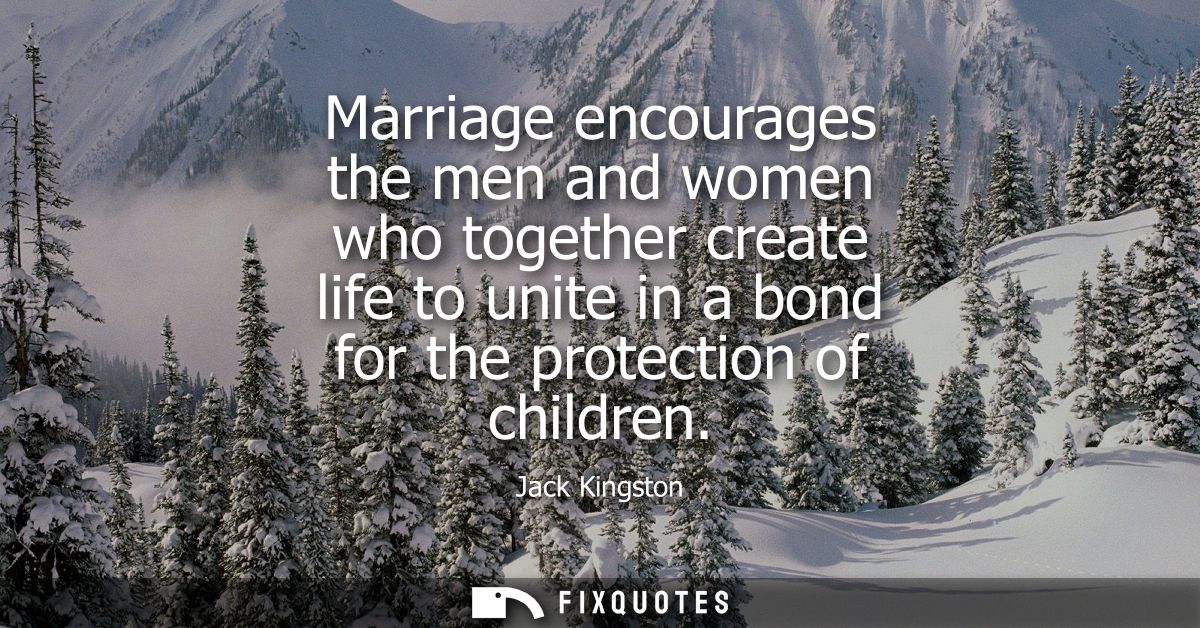
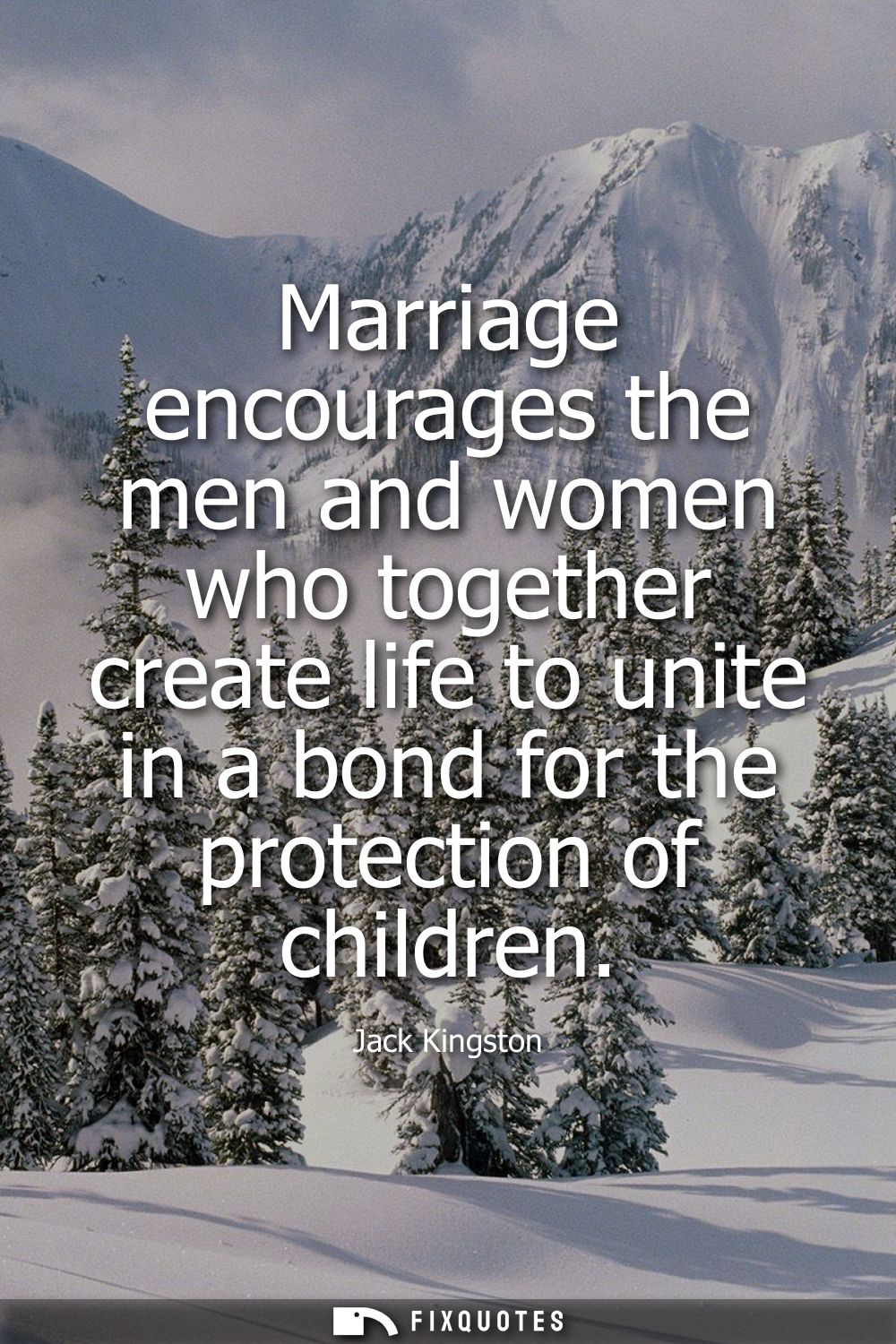
"Marriage encourages the men and women who together create life to unite in a bond for the protection of children"
About this Quote
The sentence also does quiet rhetorical work by making children the moral center of gravity. “Protection of children” is a near-unassailable rationale, a phrase designed to short-circuit objections by shifting the debate from adult autonomy to child welfare. You can hear the subtext: if you oppose the policy being sold as “marriage,” you’re implicitly opposing kids’ safety. It’s a move that turns a contested social institution into a protective blanket no decent person would pull away.
Context matters because Kingston is speaking from a conservative, family-values tradition where marriage functions as a stabilizing civic institution. The line is also conspicuously narrow: it defines marriage through reproduction (“create life”) and a two-parent unit (“men and women”), leaving little room for marriages that are childless, queer, or chosen primarily for companionship. That exclusion isn’t accidental; it’s the premise doing political work, recasting a cultural debate as a matter of children’s needs rather than adults’ rights.
Quote Details
| Topic | Marriage |
|---|---|
| Source | Help us find the source |
| Cite |
Citation Formats
APA Style (7th ed.)
Kingston, Jack. (2026, January 16). Marriage encourages the men and women who together create life to unite in a bond for the protection of children. FixQuotes. https://fixquotes.com/quotes/marriage-encourages-the-men-and-women-who-85084/
Chicago Style
Kingston, Jack. "Marriage encourages the men and women who together create life to unite in a bond for the protection of children." FixQuotes. January 16, 2026. https://fixquotes.com/quotes/marriage-encourages-the-men-and-women-who-85084/.
MLA Style (9th ed.)
"Marriage encourages the men and women who together create life to unite in a bond for the protection of children." FixQuotes, 16 Jan. 2026, https://fixquotes.com/quotes/marriage-encourages-the-men-and-women-who-85084/. Accessed 18 Feb. 2026.