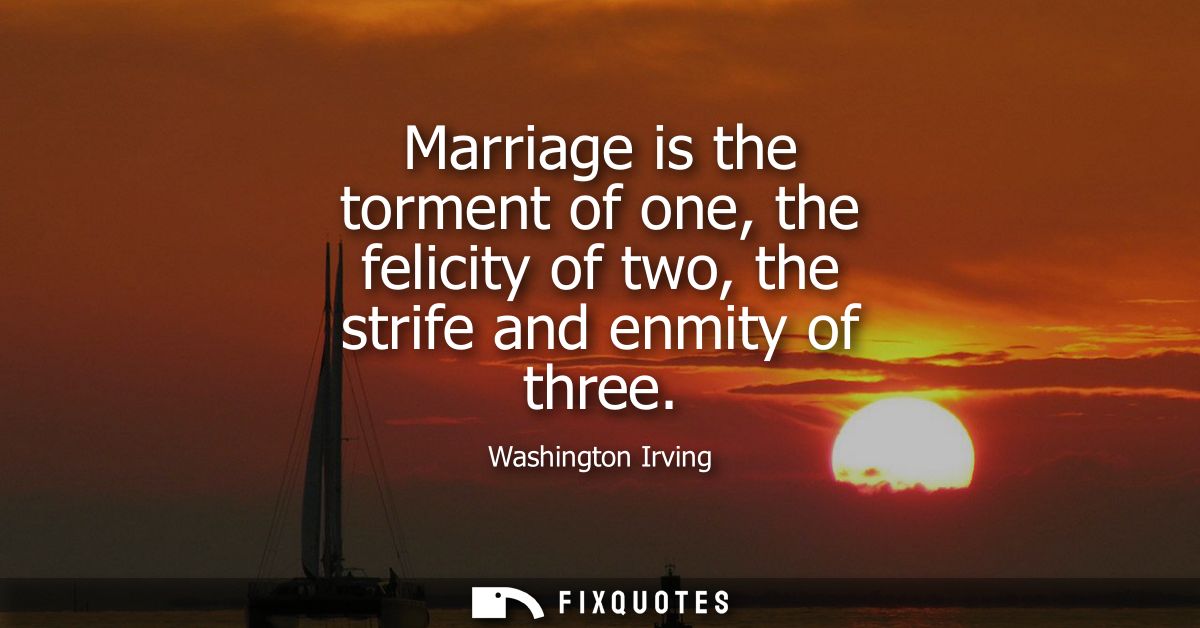
"Marriage is the torment of one, the felicity of two, the strife and enmity of three"
About this Quote
Then Irving drops the real blade: “three.” The third presence could be a child, an in-law, a lover, a friend, or even the public itself. Any additional witness punctures the couple’s bubble and forces the marriage to become politics: alliances, divided loyalties, resource allocation, reputation management. “Strife and enmity” aren’t just jealousy; they’re the inevitable friction of turning a private pact into a small society.
Context matters: Irving writes from an early-19th-century Anglo-American world where marriage was economic infrastructure as much as affection, and domestic life was newly marketed as a moral ideal. His wit isn’t anti-love so much as anti-myth. He’s warning that the institution sells harmony while quietly generating its own antagonists the moment it stops being a duet.
Quote Details
| Topic | Marriage |
|---|---|
| Source | Help us find the source |
| Cite |
Citation Formats
APA Style (7th ed.)
Irving, Washington. (2026, January 15). Marriage is the torment of one, the felicity of two, the strife and enmity of three. FixQuotes. https://fixquotes.com/quotes/marriage-is-the-torment-of-one-the-felicity-of-2295/
Chicago Style
Irving, Washington. "Marriage is the torment of one, the felicity of two, the strife and enmity of three." FixQuotes. January 15, 2026. https://fixquotes.com/quotes/marriage-is-the-torment-of-one-the-felicity-of-2295/.
MLA Style (9th ed.)
"Marriage is the torment of one, the felicity of two, the strife and enmity of three." FixQuotes, 15 Jan. 2026, https://fixquotes.com/quotes/marriage-is-the-torment-of-one-the-felicity-of-2295/. Accessed 28 Mar. 2026.