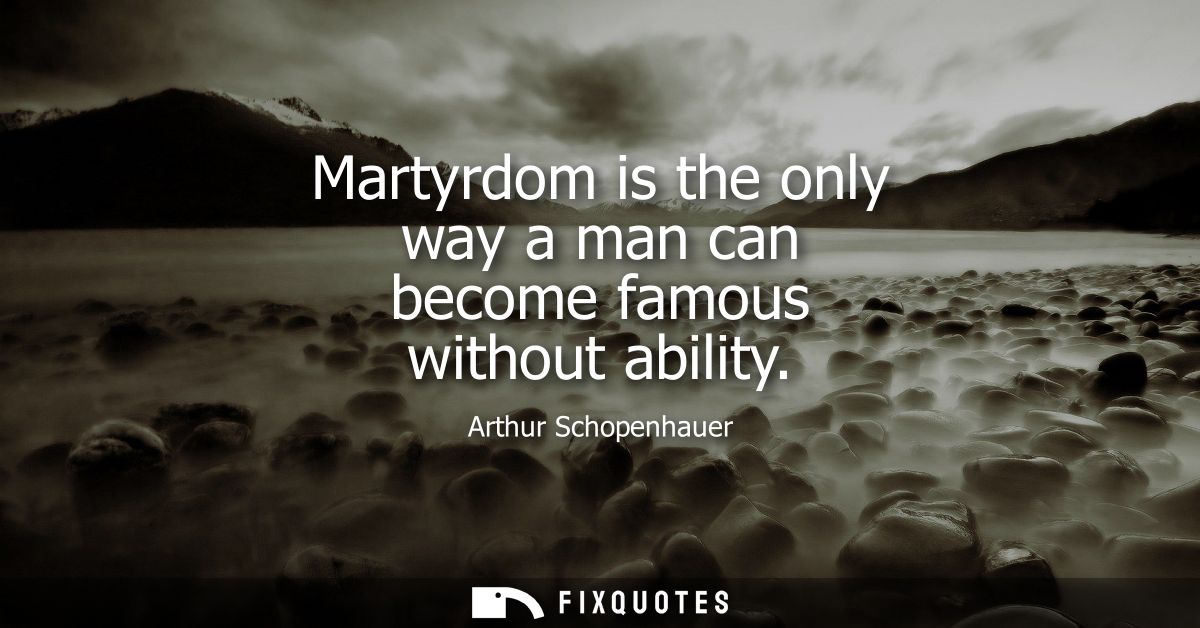
"Martyrdom is the only way a man can become famous without ability"
About this Quote
The subtext is a bleak theory of how societies distribute attention. Schopenhauer is saying public recognition often has less to do with merit than with narrative. Martyrdom supplies a ready-made plot with a villain, a victim, and a moral lesson. It’s fame that arrives prepackaged with meaning, requiring no proof of competence. That’s why it’s “the only way”: most routes to lasting notoriety demand output; martyrdom demands an ending.
Context matters. Schopenhauer lived amid Europe’s post-revolutionary churn and a growing romantic cult of the suffering genius and the political victim. He also nursed his own resentment toward academic institutions and fashionable philosophers who, in his view, won prestige through cliques and theatrics rather than truth. So the barb is double-edged: it targets the public’s appetite for sanctifying suffering and it targets opportunists who sense that being persecuted can be a shortcut to authority. The line’s cruelty is the point: it refuses to let tragedy automatically certify greatness.
Quote Details
| Topic | Wisdom |
|---|---|
| Source | Help us find the source |
| Cite |
Citation Formats
APA Style (7th ed.)
Schopenhauer, Arthur. (2026, January 17). Martyrdom is the only way a man can become famous without ability. FixQuotes. https://fixquotes.com/quotes/martyrdom-is-the-only-way-a-man-can-become-famous-28451/
Chicago Style
Schopenhauer, Arthur. "Martyrdom is the only way a man can become famous without ability." FixQuotes. January 17, 2026. https://fixquotes.com/quotes/martyrdom-is-the-only-way-a-man-can-become-famous-28451/.
MLA Style (9th ed.)
"Martyrdom is the only way a man can become famous without ability." FixQuotes, 17 Jan. 2026, https://fixquotes.com/quotes/martyrdom-is-the-only-way-a-man-can-become-famous-28451/. Accessed 30 Mar. 2026.